What Is Augmentation in BESS?
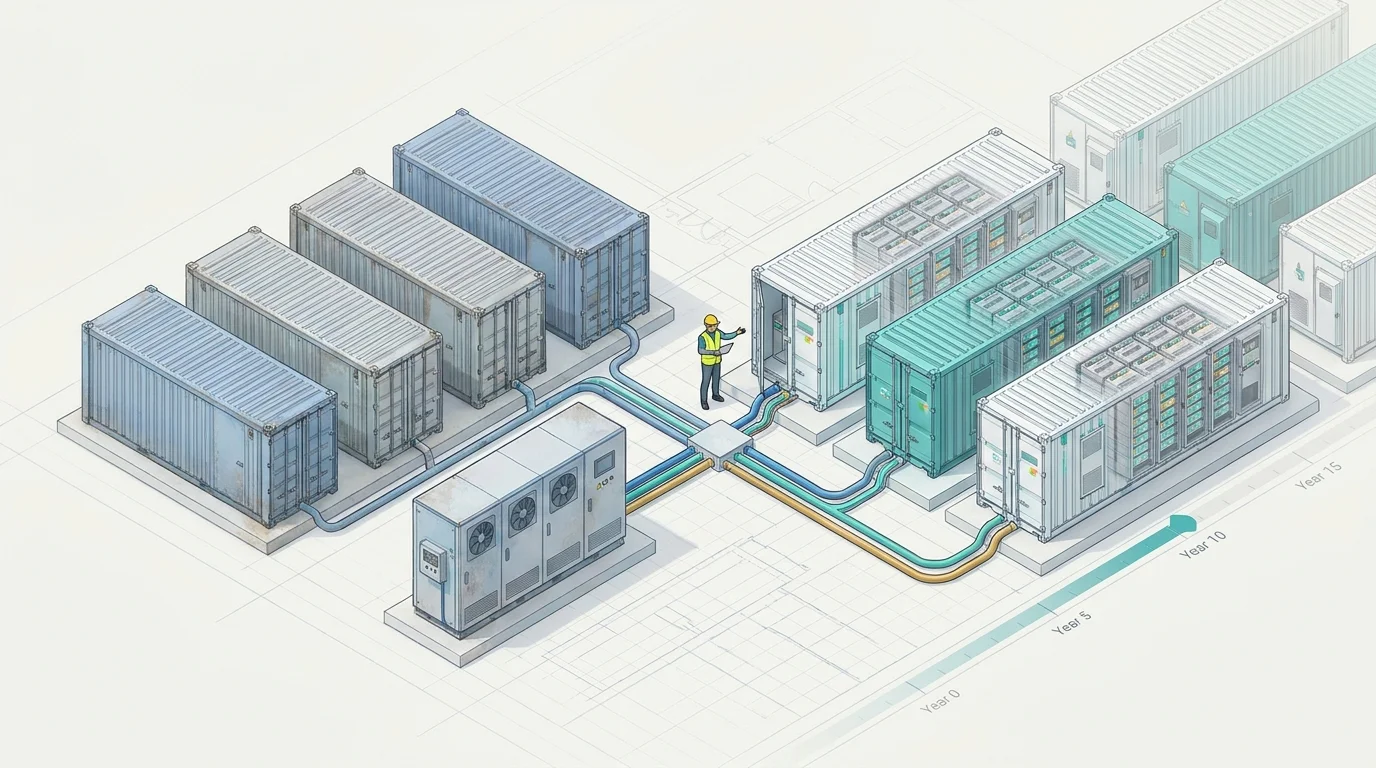
Augmentation is the process of restoring energy capacity at a BESS plant after the original batteries have degraded. Every lithium-ion battery loses usable capacity over time through calendar degradation and cyclic degradation. The rate depends on the chemistry, the operating temperature, the depth of discharge, and the load profile the plant runs. Augmentation is the planned response: at defined points in the project’s life, energy capacity is added or replaced so the plant can continue to meet its contracted obligations.
The word is used constantly in financial models and investor presentations. It is less commonly explained in terms of what it physically requires — which equipment is touched, what engineering constraints apply, and which options are realistic depending on the plant’s design topology.
Why Augmentation Is a Financing Decision
Augmentation is typically considered during the financing stage. Investors, off-takers, and lenders need confidence that the plant will deliver its contracted energy capacity not just at commercial operation date, but for the full term of the revenue contract. Financial models account for this by scheduling augmentation events at defined intervals — commonly at year 5, 10, or 15 — and assigning a cost to each event that feeds into the project’s levelized cost and return calculations.
What the model does not always capture is the physical feasibility of the augmentation it assumes. A model can schedule a module replacement at year 10, but whether that specific module will still be in production a decade from now is a separate question. The gap between what a model assumes and what a plant can actually deliver is where augmentation risk sits — and it is the reason the augmentation strategy needs to be defined during the design phase, not deferred to operations.
Augmentation Is About Energy Capacity
Augmentation is about energy capacity — restoring the MWh that degradation has eroded, not adding power capacity (MW). The PCS does not degrade the way battery cells do, and the grid connection agreement is sized for a fixed power rating. What diminishes over time is the stored energy the plant can deliver per cycle, and that is what augmentation restores.
This distinction shapes which equipment is considered. Replacing battery modules or DC blocks does not necessarily require changes to the PCS, the MV infrastructure, or the grid connection. Adding new AC capacity alongside new battery capacity is a fundamentally different scope — one that reopens grid code compliance, harmonic studies, and electrical infrastructure ratings.
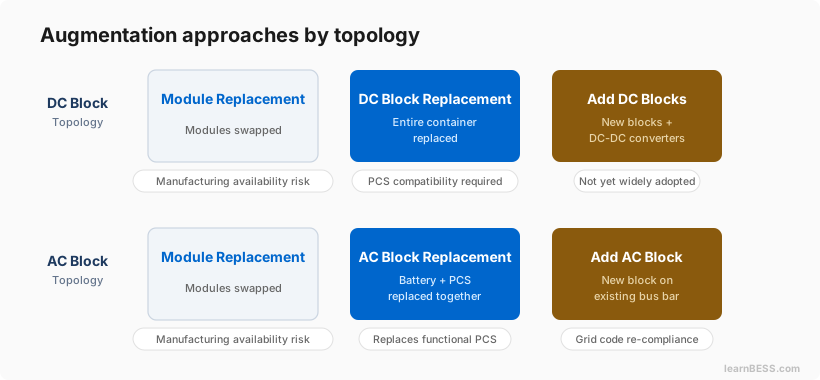
Augmentation approaches across DC block and AC block topologies. Complexity increases left to right — from swapping modules within an existing container to adding new blocks alongside the original equipment.
Augmentation in a DC Block Topology
In a DC block topology — where standalone battery containers are connected to a separate power conversion system (PCS) — there are three approaches to augmentation.
Module Replacement
Individual battery modules inside the container are replaced as they degrade past the performance threshold. The container structure, the DC bus bar, the BMS, and the thermal management system all remain in place.
This is the least disruptive approach on paper. In practice, it depends on a critical assumption: that the exact module — with compatible dimensions, voltage characteristics, and communication protocols — is still available for procurement many years later. Module designs change. Manufacturers discontinue products. A module replacement scheduled for year 10 or 15 is a bet on product continuity that the market has not yet proven it can reliably deliver.
Full DC Block Replacement
The entire DC block is removed and replaced. This eliminates the dependency on a specific module remaining in production, but introduces a different set of constraints.
If the same DC block model is still available, the replacement is relatively straightforward — the existing BoP connections, civil works, and control interfaces are designed for that equipment. But the likelihood of the same containerized product being in production 10 or 15 years later is low. Manufacturers iterate on their designs, cell formats change, and production lines move on.
A DC block from a different product generation — or a different manufacturer — must be engineered to be compatible with the existing PCS. The DC bus bar voltage range, the short circuit current contribution, and the communication interface must all match what the PCS expects. The balance of plant is also affected: cable sizing, civil works, fire separation distances, and foundation loads may all change with a new container design.
Full DC block replacement is practical, but it is not a drop-in swap. It requires site-specific engineering.
Adding DC Blocks with DC-DC Converters
A third option is to design the site from the beginning with space for additional DC blocks, and to use DC-DC converters to manage the interface between new and old containers sharing the same DC bus.
New and old DC blocks operate at different states of health — different voltage profiles, different charge and discharge characteristics, different degradation rates. Balancing state of charge across containers with mismatched state of health is an active control problem. The DC-DC converter must continuously manage the power flow between containers that are aging at different rates, and any failure in that balancing compromises both the new and old capacity.
The approach is technically possible and is discussed in manufacturer roadmaps and conference presentations. For operational projects making augmentation decisions today, it has not yet seen wide adoption.
Augmentation in an AC Block Topology
In an AC block topology — where the battery and the PCS are integrated into the same containerized solution — the same three approaches apply, but the bundled conversion equipment changes the trade-offs.
Module replacement carries the same manufacturing availability risk as in a DC block — the same dependency on a specific module still being in production.
Full AC block replacement means procuring a complete integrated solution — battery and PCS together — even though only the battery capacity has degraded. The PCS, which may still have years of useful life, is replaced along with it. If the same product is still in production, the replacement is straightforward. If it is not, the same manufacturing availability challenge applies.
Adding an AC block means adding PCS capacity, which triggers grid code re-compliance, harmonic studies, and only works if the original electrical infrastructure was sized to handle the additional current and fault contribution. This is not augmentation in the sense of restoring what was there — it is a plant expansion, with the engineering, permitting, and compliance scope that implies.
Augmentation Approaches Compared
DC block topology:
| Approach | What changes | Key risk | Feasibility |
|---|---|---|---|
| Module replacement | Modules swapped | Manufacturing availability | Long-term uncertain |
| Full DC block replacement | Entire container replaced | PCS compatibility | Practical with engineering |
| Adding blocks (DC-DC converters) | New blocks alongside existing | SOC/SOH balancing | Not yet widely adopted |
AC block topology:
| Approach | What changes | Key risk | Feasibility |
|---|---|---|---|
| Module replacement | Modules swapped | Manufacturing availability | Long-term uncertain |
| Full AC block replacement | Battery + PCS replaced together | Replaces functional PCS | Practical if same product available |
| Adding AC blocks | New block on existing bus bar | Grid code re-compliance | Effectively a plant expansion |
The Design-Phase Decision
Augmentation is not a problem to solve later. The strategy that will be available in year 10 is largely determined by the decisions made in year zero.
A site designed with tight spacing between DC blocks and no reserved footprint cannot accommodate additional containers later without civil rework. A plant connected under a grid code compliance study sized exactly to its installed capacity cannot add conversion equipment without reopening that study. An equipment procurement contract that does not address long-term module or container availability leaves the augmentation assumption in the financial model without a supply chain behind it.
The augmentation strategy chosen — or assumed — can influence the choice of equipment manufacturer, the plant design topology, the site layout, and the terms of the supply agreement. For developers, investors, EPCs, asset owners, off-takers, and lenders, understanding what augmentation physically requires is what separates a financial model that reflects reality from one that assumes a future the plant cannot deliver.