What Is EPC in BESS?

EPC stands for Engineering, Procurement, and Construction — a delivery model in which a single contractor takes full responsibility for a complete energy storage plant.
The EPC contractor engineers the plant, procures the equipment, constructs the site, ensures grid connection compliance, and hands over a tested, operational plant to the buyer. One contract, one counterparty, one point of accountability.
What the EPC Contractor Delivers
On a BESS project, the EPC contractor’s scope covers:
- Plant design and engineering
- Equipment selection and procurement
- Civil works
- Electrical installation
- Equipment installation
- Grid connection infrastructure
- Commissioning and site acceptance testing
What sits between these functions is where the EPC contract earns its value: making sure all the equipment works together. A BESS plant uses DC blocks, PCS units, transformers, switchgear, protection systems, and control software from different manufacturers. If a communication protocol mismatch prevents the PCS from responding to the plant controller, or a protection relay configuration conflicts with the grid code, the EPC contractor owns the problem. The buyer does not need to determine which supplier is at fault.
Different types of companies deliver BESS projects under EPC contracts — dedicated engineering and construction firms, or equipment manufacturers that offer full project delivery alongside their own products. In both cases, the contractor does not necessarily perform every task in-house. Civil works are commonly subcontracted to a local firm, electrical installation to a specialist contractor. What defines an EPC contract is not who physically performs the work, but who carries the contractual responsibility for the complete delivery.
EPC Is Not Balance of Plant
EPC is a contract form. Balance of Plant is a scope of work. Confusing the two is one of the most common mistakes in BESS project delivery.
BoP describes the categories of site work that every BESS project requires — civil works, electrical installation, equipment installation, auxiliary power, grid connection infrastructure, commissioning activities, and site acceptance testing. Every project has BoP scope regardless of how it is contracted.
Under an EPC contract, BoP is part of what the EPC contractor delivers. The contractor may subcontract the execution — a civil firm for groundworks, an electrical firm for cabling — but the EPC contractor owns the scope and the coordination. BoP sits inside the EPC contract, not alongside it.
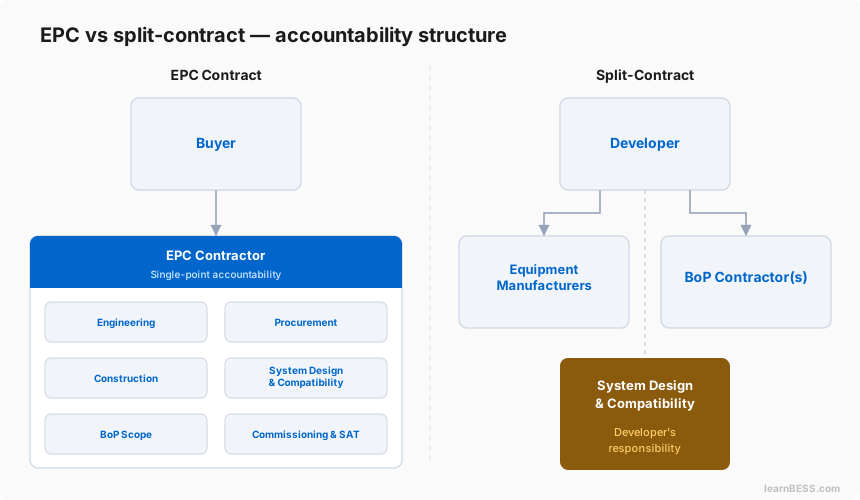 EPC contract vs split-contract — where accountability sits.
Where the Confusion Appears
Under a split-contract approach, the developer procures the main equipment directly from manufacturers and appoints BoP contractors separately for the site work. This is not EPC, and the distinction matters when it comes to accountability.
It is common for a developer to procure DC blocks, PCS units, and MV equipment directly, then look for a BoP contractor to handle the rest of the site delivery — and then try to contract that BoP contractor under terms that resemble an EPC. But a BoP contractor executing civil and electrical works is not taking on EPC-level responsibility. BoP contractors are contracted for defined categories of site work — not for engineering equipment interfaces between products from different manufacturers, managing protection coordination across the full plant, or taking single-point accountability for system-level commissioning.
Under a split-contract model, the functions that an EPC contractor would own — plant-level engineering, equipment compatibility, ensuring all systems perform together — need to sit somewhere. That is usually the developer’s own engineering team or a specialist contractor appointed for the purpose. Developers with strong in-house engineering and project management capability handle this routinely. Developers who are primarily commercial organizations need to bring in those capabilities through external support.
After Handover
After handover, the EPC contractor remains accountable during the Defects Liability Period. A defect claim goes to the EPC contractor regardless of root cause — workmanship, design, or equipment. Under a split-contract approach, warranty and defect claims sit across separate contracts with individual manufacturers and BoP contractors. The developer has to determine root cause before knowing which supplier to claim against. When a defect sits at the interface between two pieces of equipment from different suppliers, that determination is not straightforward.
The choice between EPC and split-contract depends on the developer’s engineering capability, team structure, and commercial strategy. The distinction that matters is understanding what each model requires — and recognizing that appointing a BoP contractor is not the same as contracting an EPC.