What Is FEOC in Battery Energy Storage?
Foreign Entity of Concern (FEOC) is a US federal classification applied to entities tied to China, Russia, Iran, or North Korea. For battery energy storage, the classification carries a direct financial consequence: a project that sources too large a share of its equipment from FEOC-classified entities loses eligibility for the Investment Tax Credit (ITC). Under the rules enacted in 2025, the credit can also be clawed back — in full — up to ten years after the plant is commissioned.
FEOC is a familiar term in the electric vehicle market, where restrictions on battery sourcing have been in place since 2024. The rules that apply to stationary energy storage arrived through separate legislation enacted in July 2025 and are structured differently. They operate under a broader framework called “Prohibited Foreign Entity” (PFE), with escalating compliance thresholds and a recapture provision that extends the compliance obligation to ten years after commissioning.
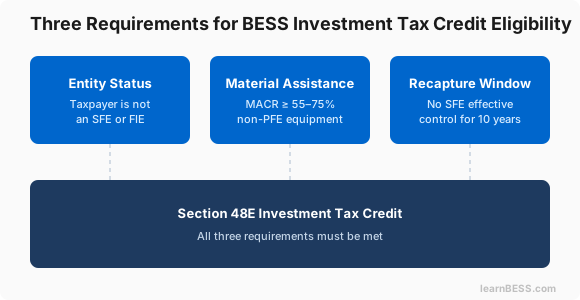
Three layers of FEOC compliance determine whether a BESS project qualifies for the Investment Tax Credit.
Where FEOC Comes From
FEOC originated outside the energy storage industry, arriving through three pieces of federal legislation.
The Bipartisan Infrastructure Law (2021) created the original FEOC definition (codified at 42 U.S.C. §18741). The scope was narrow: it directed the Department of Energy to screen battery manufacturing grant applicants for ties to four “covered nations” — China, Russia, Iran, and North Korea.
The Inflation Reduction Act (2022) applied the FEOC definition to the Section 30D clean vehicle tax credit, restricting EV battery sourcing from FEOCs starting in 2024. Stationary storage was not covered.
The One Big Beautiful Bill Act (enacted July 4, 2025) brought FEOC-type restrictions to battery energy storage (full text). It introduced a broader framework called “Prohibited Foreign Entity” (PFE) that applies to the major clean energy tax credits, including the ITC. Any BESS project beginning construction in 2026 or later must meet these requirements to claim the credit.
How an Entity Is Classified as a Foreign Entity of Concern
An entity qualifies as a FEOC if it meets any one of five criteria.
Designated list. The entity appears on a US federal security or sanctions list.
Subject to jurisdiction. The entity is incorporated in, headquartered in, or performs relevant battery or critical mineral activities in a covered nation. This is the broadest trigger — any company manufacturing battery cells in China is a FEOC under this test, regardless of its ownership structure.
Government ownership or control. A covered nation’s government owns 25% or more of the entity — whether directly or through intermediaries. This covers companies based outside covered nations that are still government-controlled.
Contract or license control. The entity is under effective control through licensing agreements or contracts with another FEOC — for example, through intellectual property or technology licensing arrangements.
Secretary designation. The Secretary of Energy determines that the entity is engaged in conduct detrimental to US national security or foreign policy.
The definition of “government” is interpreted broadly. Under the DOE’s final interpretive guidance (May 2024), it includes state-owned enterprises, senior government and party officials, and their family members.
In practice: Any entity with meaningful ties to the Chinese state — including through individual shareholders or board members with party positions — can trigger FEOC classification.
Prohibited Foreign Entity: The Three Categories
The five criteria above define what a FEOC is. The One Big Beautiful Bill Act then built a more detailed framework — called “Prohibited Foreign Entity” (PFE) — for how these restrictions apply to clean energy tax credits. It defines three categories:
- Specified Foreign Entity (SFE)
- Foreign-Influenced Entity (FIE)
- Material Assistance
Specified Foreign Entity (SFE)
An SFE is an entity directly controlled by or substantially linked to a covered nation — most commonly through more than 50% ownership, or by appearing on the Pentagon’s Section 1260H Chinese Military Companies list. The battery manufacturers currently on the 1260H list are:
- CATL (added January 2025)
- BYD (added June 2026)
- EVE Energy (added June 2026)
- CALB (added June 2026)
Any taxpayer that is itself an SFE cannot claim the credit.
Foreign-Influenced Entity (FIE)
An entity does not need to be an SFE to lose the credit. If a Specified Foreign Entity exercises enough influence over it, the entity becomes a Foreign-Influenced Entity. The main triggers:
- 25% ownership by a single SFE, or 40% across multiple SFEs
- 15% of total debt held by SFE lenders
- The ability to appoint board members or senior executives
- Payments that give an SFE effective control over the facility or its technology
FIE status disqualifies the entity from claiming the ITC, PTC, and advanced manufacturing credits.
Material Assistance and the MACR
Even if a developer is not itself an SFE or FIE, the project can still lose the credit if too large a share of its equipment costs comes from prohibited foreign entities. This is measured through the Material Assistance Cost Ratio (MACR) — the percentage of a project’s total direct manufacturing costs that are not attributable to prohibited foreign entities. The formula:
Where T is the total cost of all manufactured products and components, and P is the cost of products sourced from PFEs. A higher MACR means less PFE content — and the project must meet or exceed the threshold for its construction year.
For energy storage technology, the thresholds escalate annually:
| Construction begins | Minimum MACR (energy storage) |
|---|---|
| 2026 | 55% |
| 2027 | 60% |
| 2028 | 65% |
| 2029 | 70% |
| 2030 and later | 75% |
Under the IRS safe harbor cost tables, battery cells represent approximately 52% of total BESS equipment cost. This makes cell sourcing the decisive factor: if cells come from a PFE, the remaining non-PFE costs amount to roughly 48% — already below the 55% threshold for 2026. A project using PFE-sourced cells cannot meet the MACR regardless of where it sources every other component.
The 10-Year Recapture Rule
FEOC compliance is not a one-time procurement check. If a project claims the ITC and later makes a payment that gives a Specified Foreign Entity effective control over the facility, the entire credit must be repaid to the US Treasury. The recapture window runs for 10 years after the plant is placed in service.
Any new licensing arrangement with an SFE signed on or after July 4, 2025 is automatically treated as giving the counterparty effective control — regardless of the specific contract terms. This means warranty contracts, O&M agreements, replacement parts, and software licensing can all trigger recapture. Compliance is tested annually for the full 10-year window.
The Supply Chain Reality
These restrictions land on a supply chain that is overwhelmingly concentrated in China. The top ten stationary storage cell suppliers globally are all headquartered in China, accounting for roughly 90% of all BESS cells shipped in 2025.
The primary source of FEOC-compliant cell production today is South Korean manufacturers building LFP cell plants in the United States. Several facilities are operating or under construction, with more converting from EV to grid storage production. Compliant domestic capacity is growing but remains limited relative to demand.
Even a US-based factory does not guarantee compliance. Whether its cells qualify depends on the ownership structure and the degree of control a covered-nation entity exercises — a question that applies to any manufacturer with Chinese parent companies operating US plants.
How Developers Demonstrate Compliance
Final regulations have not been published yet. In the interim, Treasury and the IRS issued Notice 2026-15 with three safe harbor methods for calculating the MACR:
- Identification Safe Harbor. Developers use standardized tables to identify which components count toward the MACR calculation, rather than reconstructing the full supply chain.
- Cost Percentage Safe Harbor. Standardized cost percentages replace actual supplier-level cost data — the tables assign a fixed percentage to each component category (cells, BMS, racking, PCS).
- Supplier Certification Safe Harbor. Manufacturers provide signed certifications attesting that their products were not produced by PFEs. Certifications must be retained for six years, and false certifications carry IRS penalties.
Treasury is expected to issue proposed regulations by end of 2026. Until then, these safe harbors are the primary compliance pathway.