BESS Value Chain — Who Does What in Energy Storage Projects
~50 min learning time
What you'll learn
- Who the key stakeholders are in a utility-scale BESS project
- What each stakeholder does and how they earn money
- How EPC contractors, developers, and manufacturers divide responsibility
- How Route-to-Market providers turn a BESS plant into a revenue-generating asset
- How money flows through a BESS project from financing to operations
A utility-scale BESS project is not built or operated by a single company. From the moment a site is identified through to the day the plant dispatches power into the grid, multiple stakeholders are involved — each with a distinct role, a distinct skill set, and a distinct way of earning money.
This module maps out the key stakeholders in the BESS value chain: who they are, what they do, and what their incentive is.
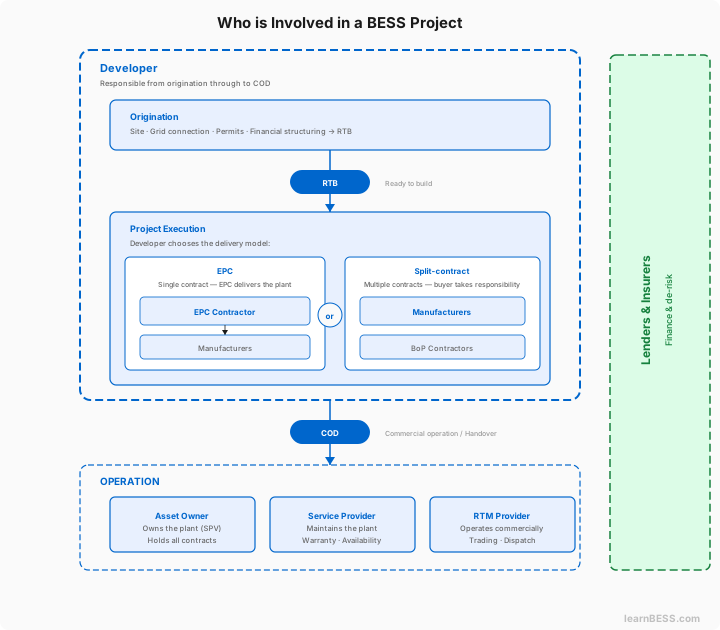
The main stakeholders in a utility-scale BESS project:
| Stakeholder | Role |
|---|---|
| Developers | Originate and advance projects from greenfield to commercial operation |
| EPC contractors | Deliver the plant under a single contract |
| Manufacturers | Supply the equipment — DC blocks, PCS, transformers, Power Plant Controls and SCADA |
| Asset owners & investors | Own the plant and hold the long-term equity position |
| Service providers | Maintain the plant and uphold warranty obligations and performance guarantees |
| RTM providers | Operate the plant commercially — trading, dispatch, revenue optimisation |
| Lenders & insurers | Finance and de-risk the project |
Developers
A developer is the company that takes a BESS project from an empty site to a completed, operating plant. They are responsible for the entire journey — from origination through to handover at commercial operation date (COD). The developer selects and manages the parties involved in delivering the project — EPC contractors, manufacturers, specialist contractors, consultants — even though the contracts themselves generally sit with the project company (introduced in the Asset owners and investors section below).
Origination: from site to ready-to-build
Development starts with origination — the process of turning a greenfield opportunity into a financeable, constructible project. This involves:
- Site identification — finding land with proximity to a viable grid connection point, acceptable planning constraints, and favourable economics
- Land rights — negotiating a lease or purchase agreement with the landowner
- Grid connection — applying for and securing a grid connection agreement with the TSO or DSO, which defines the terms under which the plant can connect and export power
- Permitting and environmental review — obtaining the planning consents and environmental clearances required by the jurisdiction
- Preliminary sizing — determining the plant’s power (MW) and energy (MWh) capacity based on grid connection terms, available land, and target revenue model
- Constraint analysis — evaluating cost, planning, environmental, and technical constraints that could affect viability
The output of origination is a project at ready-to-build (RTB) status — everything is in place for financing and construction to proceed.
Key concept: Ready-to-build means the project has secured land rights, grid connection, planning consent, and a viable commercial structure. RTB is a significant milestone — the project is now financeable and constructible, and execution can begin.
Project execution: from RTB to COD
Once a project reaches RTB, the developer remains in charge. The developer decides how the plant is delivered. There are three common approaches:
- EPC — the developer contracts an EPC contractor to deliver the plant under a single contract. The EPC contractor takes responsibility for engineering, procurement, and construction. The EPC contractor can be a traditional engineering and construction firm or an equipment manufacturer with delivery capability.
- Split-contract — the developer procures equipment directly from manufacturers and coordinates equipment interfaces in-house or through specialist contractors. No single EPC contract — the developer manages multiple suppliers.
In all three cases, the developer is the through-line from origination to COD. The EPC contractor and manufacturers are contracted parties within the developer’s execution strategy. Delivery models are covered in detail in Module 5.
How developers earn money
Developers create value by identifying opportunities early and investing development capital — time, expertise, and money — before the project generates any revenue. There are two primary business models:
-
Develop to sell — the developer takes the project through to COD, then sells the completed plant or the project company (SPV) to an asset owner or investor. The developer earns a premium on the value they created across the full development and delivery cycle.
-
Develop to operate — the developer retains ownership and operates the plant as a long-term revenue-generating asset. Larger developers and utilities often follow this model, sometimes selling a minority stake to an investor to recycle capital while maintaining operational control.
Some developers specialise only in origination — they identify sites, secure grid connections and permits, and sell the RTB-stage project to another developer or investor who handles execution. These origination-focused developers earn a development premium without taking on the cost and risk of construction.
In practice: Many developers use a hybrid approach — selling majority stakes to institutional investors while retaining a minority position and operational control. This allows them to recycle development capital into new projects while earning ongoing management fees and a share of project revenues.