What Is a Route to Market (RTM) Provider in BESS?
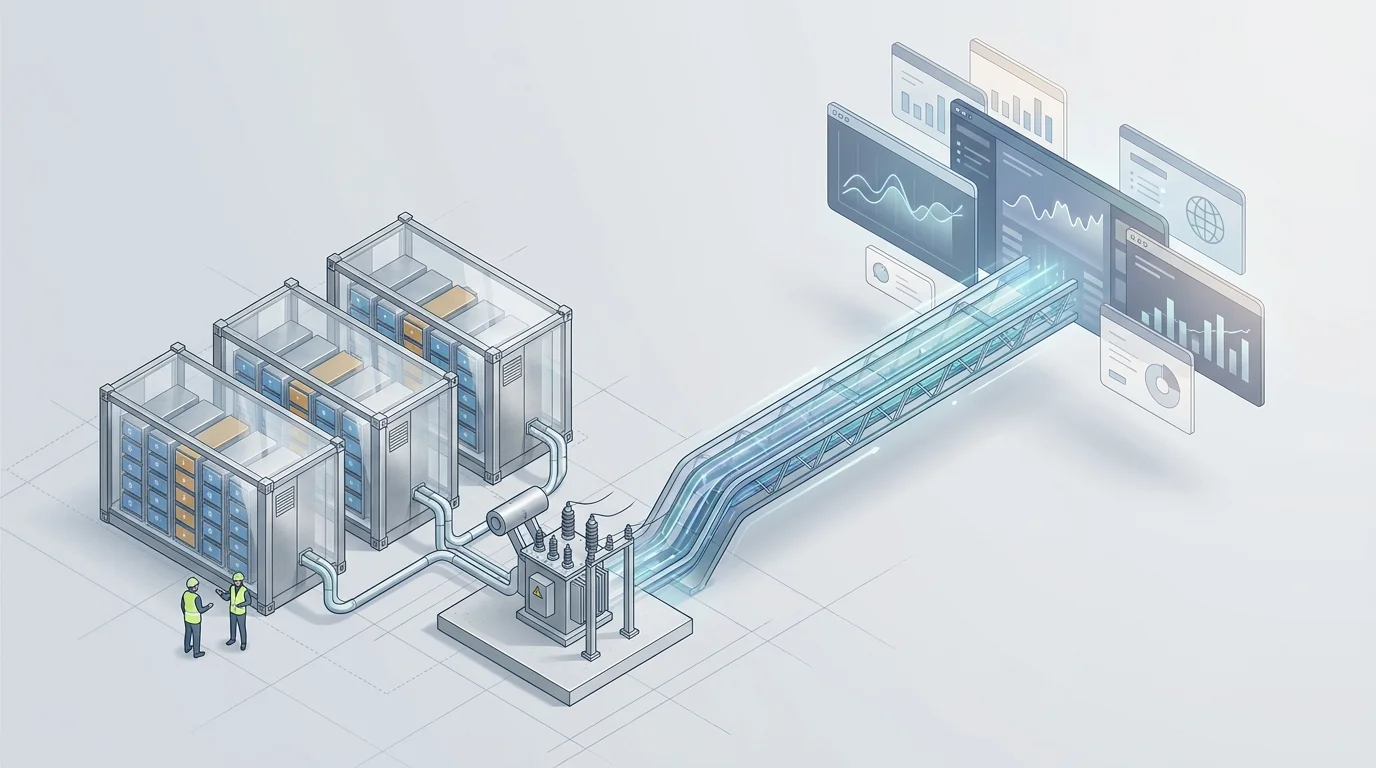
A Route to Market (RTM) provider is the company — or the function within a company — that operates a BESS plant commercially in electricity markets. It handles market registration, trading, and dispatch scheduling — and in some markets, the balancing responsibility that comes with wholesale and balancing services participation.
The term belongs to the commercial side of the BESS value chain — relevant to asset owners and lenders from the financing stage, but rarely encountered by BESS equipment manufacturers and engineers working on the hardware.
Why the Terminology Is Confusing
The BESS industry uses several terms for what is, in many cases, the same role: RTM provider, optimizer, aggregator, offtaker, trading partner. Hundreds of companies offer some form of this service — and the labels they use are rarely consistent.
The same company often performs multiple functions under different labels. One provider may market itself as an RTM provider while primarily offering optimization and trading. Another offers optimization agreements alongside tolling contracts. A third calls itself an optimizer but provides the full market access service.
But the terms are not perfectly interchangeable. Optimizer describes a function — the algorithms and trading decisions that maximize revenue across day-ahead, intraday, and real-time markets. RTM provider describes the broader commercial role. What exactly falls under that role beyond optimization — market registration, balancing responsibility, creditworthiness, contractual structure — varies by provider and by market.
Every RTM provider includes an optimization function. Not every optimizer is a full RTM provider.
The term aggregator comes from demand-side response and distributed energy and is less common in utility-scale BESS, where individual plants participate in markets directly.
Common Responsibilities of an RTM Provider
Market registration and access
Before a BESS plant can earn revenue, it must be registered with the relevant market operators — the power exchange for wholesale trading, the transmission system operator (TSO) for balancing services, and the capacity market administrator where applicable. The RTM provider either holds these registrations directly or ensures the asset is registered under its market participant codes.
Trading and dispatch
The RTM provider’s algorithms determine when the battery charges, when it discharges, at what price, and in which market — spanning day-ahead and intraday wholesale and balancing services. This is what the industry commonly refers to as “optimization.”
Balancing responsibility
Every unit of electricity traded must be accounted for by a balancing responsible party. This party settles any difference between the energy a plant was scheduled to deliver and what it actually delivered. BESS owners commonly delegate this responsibility to their RTM provider, who carries the imbalance position and manages its cost. The exact mechanism varies by market — Balance Responsible Party (BRP) in Europe, Qualified Scheduling Entity (QSE) in ERCOT — but the function is the same.
Revenue reporting and settlement
The RTM provider reports what the asset earned, across which markets, and settles the revenue with the asset owner according to the terms of their agreement.
Dispatch control
Some RTM providers supply their own dispatch controller — often called an Energy Management System (EMS), RTM controller, or dispatch controller — which sits on site and executes the trading decisions in real time. Others send dispatch signals to the plant’s existing EMS or Power Plant Controller (PPC). Whether the RTM provider owns the dispatch layer or interfaces with the owner’s controller varies by contract and by provider.
The Commercial Structures
RTM is not a single service model. It is a spectrum of commercial arrangements, each allocating dispatch control and revenue risk differently between the asset owner and the provider.
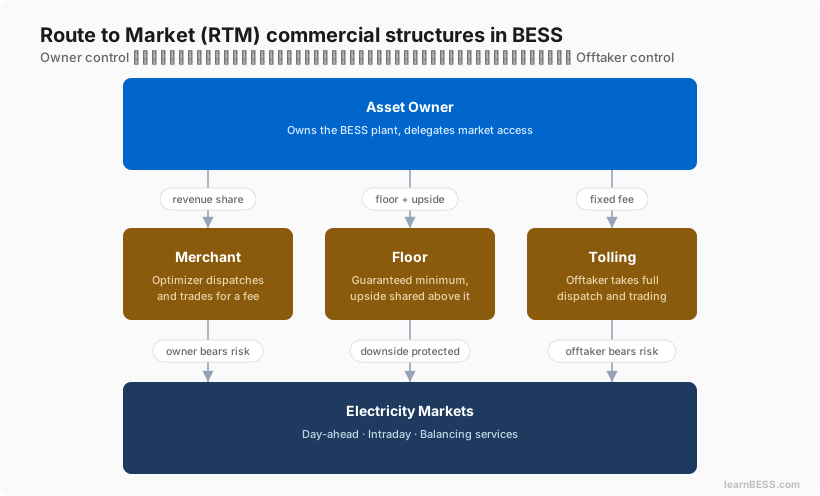
The spectrum of RTM commercial structures — from full owner exposure to full offtaker control.
| Structure | Dispatch control | Revenue risk | How the owner earns |
|---|---|---|---|
| Merchant (with optimizer) | Optimizer | Owner | Market revenue minus optimizer’s fee (often a revenue share) |
| Floor | Owner or optimizer | Shared | Guaranteed minimum payment; upside shared above the floor |
| Tolling | Offtaker | Offtaker | Fixed payment per MW of capacity, regardless of market outcome |
Merchant with optimizer. The asset owner contracts an optimizer to trade the battery’s output and pays a percentage of revenues as a fee. The owner retains full exposure to market prices — both upside and downside.
Floor. The RTM provider guarantees a minimum payment per MW. If revenues fall below the floor, the provider covers the difference. If they exceed it, the upside is shared — reducing the owner’s downside risk while preserving some upside.
Tolling. The offtaker pays a fixed fee for the right to operate the battery, takes full dispatch control, and keeps whatever the market pays. From the asset owner’s perspective, the battery becomes a contracted capacity asset with predictable cash flow.
Between these three sit hybrid arrangements — partial tolls covering one cycle per day, revenue swaps on specific market segments, or structures that combine a floor on one revenue stream with merchant exposure on another. The contract landscape is evolving, and standardization is limited.
What Drives the Choice
The choice of commercial structure depends on the asset owner’s risk appetite, their lender’s requirements, and the maturity of the local market. Lenders providing project finance often require some form of contracted revenue — a floor or a toll — to underwrite the debt. Merchant-only projects are harder to finance but retain full upside. Revenue certainty and upside exposure pull in opposite directions — the commercial structure determines where the balance falls.
Where RTM Sits in the Value Chain
The RTM strategy is established during development and financing — lenders and investors build the business case around it. The RTM provider itself is activated at commercial operation, when the plant starts generating revenue. It sits alongside the Operations and Maintenance (O&M) provider, though the two roles are distinct: O&M maintains the physical plant; the RTM provider operates it commercially.
In Front of the Meter (FTM) and Behind the Meter (BTM) storage, the RTM function looks different. In FTM, the RTM provider is trading in wholesale and balancing services. In BTM, the same function exists but the “revenue” is cost savings — reduced demand charges, optimized self-consumption, and avoided grid fees.
A Dynamic Landscape
The terminology around route to market is not settled. The same function carries different labels depending on the market and the provider — optimizer, RTM provider, offtaker, trading partner. Companies that started as pure optimizers now offer tolling. Trading houses that started as offtakers now build optimization platforms.
What matters is the function: connecting a BESS plant to markets, making trading and dispatch decisions, managing the commercial risk, and delivering revenue to the asset owner. How the industry labels that function will continue to shift. What the function does will not.