Behind the Meter vs Front of the Meter in BESS — What They Actually Mean
Behind the Meter (BTM) and Front of the Meter (FTM) are two of the most commonly used terms in the BESS industry — and two of the least clearly defined. They appear in meetings, datasheets, marketing material, and industry presentations, almost always without a clear explanation of what they actually refer to. When the terms are poorly understood, it is difficult to have a clear conversation about how a BESS plant creates value.
The terms do not describe different types of battery systems. They describe different use cases — specifically, where the value from the BESS is created. A Behind the Meter application creates value inside the facility. A Front of the Meter application creates value out on the grid. The same BESS plant can do both.
This distinction matters because it determines how a project generates returns: whether through reducing costs or generating direct income. A clear understanding of the distinction is essential for aligning developers, asset owners and investors, EPCs, and Route to Market (RTM) providers around the same commercial objectives.
The Meter
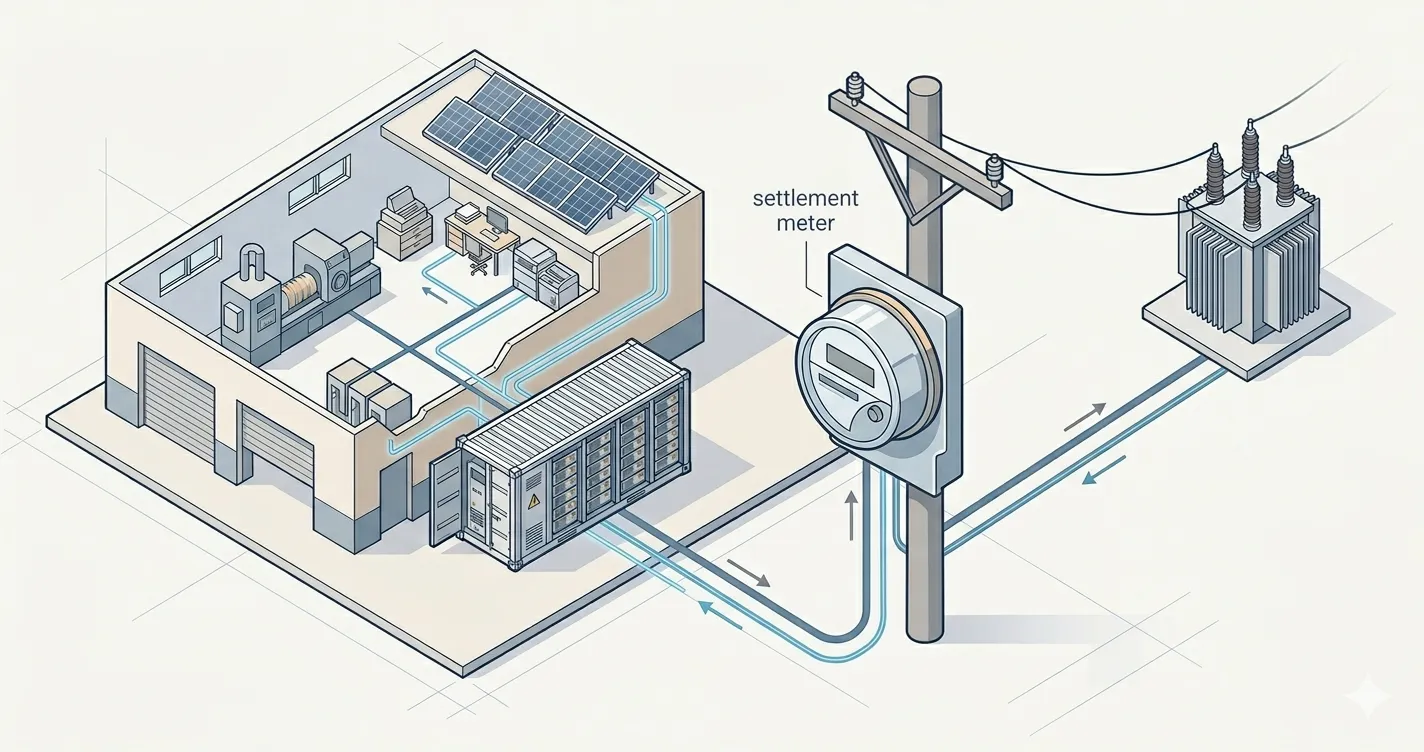
Every BESS plant is physically located behind an energy meter — commonly referred to as the settlement meter. The settlement meter sits at the Point of Interconnection (POI) with the grid, where the facility connects to the distribution or transmission network. Its readings are the basis for financial settlements between the asset owner and the grid operator, measuring power and energy flowing in and out of the facility.
This is important because it means Behind the Meter and Front of the Meter do not describe where the battery is physically located. Every battery is behind the meter. The terms describe the use case — whether the BESS plant optimizes energy management inside the facility, or whether it provides value by charging and discharging through the meter towards the grid.
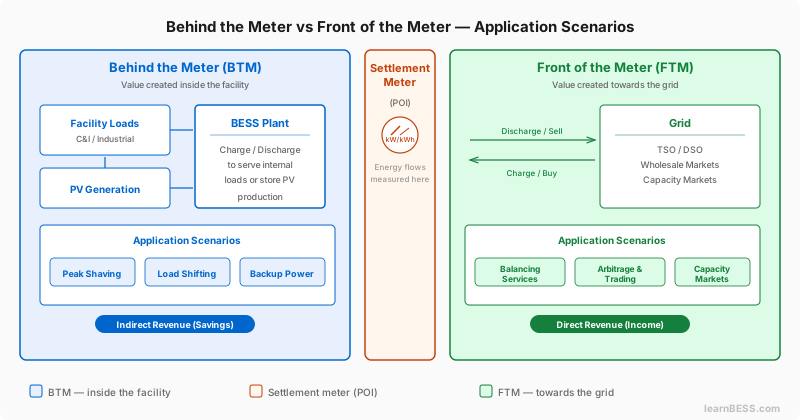 Behind the Meter vs Front of the Meter — the settlement meter defines where value is created.
Behind the Meter (BTM) — Indirect Revenue
Behind the Meter use cases create value inside the facility without passing through the settlement meter. The BESS plant is used to manage internal energy consumption and production — optimizing what the facility draws from the grid or how it uses locally generated energy. This value does not appear as direct income. It appears as savings — through reduced electricity bills, lower peak tariff charges, and fewer grid imports. For Commercial and Industrial (C&I) facilities with high energy costs, this indirect revenue can deliver significant reductions.
The most common BTM use cases include peak shaving, load shifting, and backup power.
Peak Shaving
Electricity tariffs often include demand charges based on the highest power peak recorded during a billing period. A BESS plant can discharge during peak demand periods to keep the facility’s consumption below a contractual or tariff threshold. The facility avoids higher demand charges without reducing its actual energy usage. The battery absorbs the peak instead of the grid.
Load Shifting
A BESS plant can charge when electricity prices are low — often overnight or during periods of low demand — and discharge to provide power to the facility’s loads during hours of higher electricity prices. This reduces the electricity cost for the asset owner. The facility consumes the same amount of energy, but pays less overall by shifting when that energy is drawn from the grid. The same principle applies when the facility has co-located generation such as PV — excess production is stored and used later instead of exported or curtailed.
Backup Power
A BESS plant can provide emergency power to critical loads during grid outages. In facilities where uninterrupted operation is essential — data centers, hospitals, logistics centers, industrial processes — the BESS bridges the gap until the grid is restored or a backup generator takes over. Some configurations also support black start capability, allowing the facility to restart independently from the grid.
Front of the Meter (FTM) — Direct Revenue
Front of the Meter use cases create value by charging and discharging through the settlement meter towards the grid. The BESS plant is not serving internal loads. It is directly participating in energy markets and providing grid services to generate direct revenue for the asset owner.
The most common FTM use cases include balancing services, arbitrage and energy trading, and capacity markets.
Balancing Services
Grid frequency must remain stable — 50 Hz in Europe, 60 Hz in North America. When supply and demand are imbalanced, frequency deviates. A BESS plant can respond within hundreds of milliseconds, injecting or absorbing power to help stabilize the grid. These services are procured by the Transmission System Operator (TSO) through standardized balancing products such as FFR, FCR, aFRR, and mFRR.
Arbitrage and Energy Trading
A BESS plant can charge from the grid when electricity prices are low and discharge to sell energy back when prices are high. The revenue comes from the spread between the overall cost of charging and the sale price.
Capacity Markets
Grid operators and regulators procure capacity to ensure sufficient generation and storage is available to meet future demand. A BESS plant can participate by committing to be available during periods of system stress in exchange for regular capacity payments. Unlike balancing services and arbitrage, capacity market revenue is generally contracted years in advance, providing a stable income stream alongside more volatile trading revenue.
One BESS Plant: BTM, FTM, or Both
A single BESS plant can operate in BTM, FTM, or both. A utility-scale BESS plant usually operates exclusively in FTM — providing balancing services and trading energy on the grid. A C&I facility with on-site storage may focus on BTM use cases such as peak shaving and load shifting, while also participating in FTM services during periods when the facility’s internal demand is low.
Which use cases a BESS plant operates in depends on the available services and trading methodology from the Route to Market (RTM) provider, taking into account the overall commercial strategy, grid connection agreement, and local consumption and production patterns. Asset owners and RTM providers commonly use revenue stacking — combining multiple use cases to take advantage of market conditions and maximize the overall value the BESS plant delivers.