PPC vs EMS in BESS — What Is the Difference?
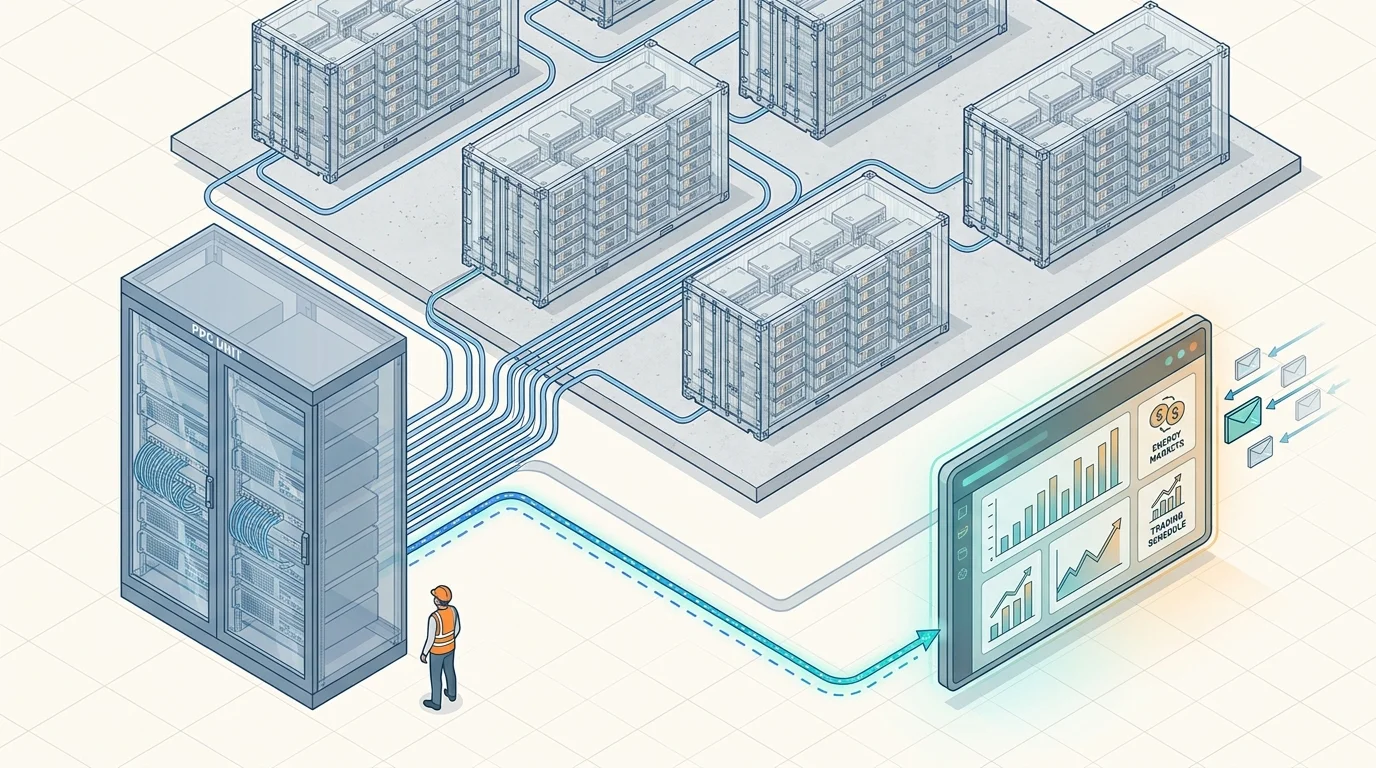
The Power Plant Controller (PPC) and the Energy Management System (EMS) are two terms used across the BESS industry to describe plant-level control — but they refer to different functions. They are routinely conflated or used interchangeably, and the same word can mean different things depending on who is using it.
This post separates them by function: what each one is responsible for, where each one sits in the control hierarchy, and how they relate to each other in practice.
Power Plant Controller (PPC)
The PPC is the plant-level controller. It is responsible for coordinating the operation of all equipment on site and ensuring the plant operates as a single, grid-compliant power plant.
Its core responsibilities:
- Dispatching power setpoints to each BESS section, PCS unit, BMS, or section controller across the site — translating a plant-level command into per-equipment instructions.
- Active power control — ramp rate limiting, power curtailment, and frequency response in accordance with the applicable grid code.
- Reactive power and voltage control — maintaining reactive power output and voltage at the point of interconnection within the envelope defined by the grid connection agreement.
- Fault ride-through — coordinating the plant’s response during grid voltage or frequency disturbances so the plant remains connected and supports the grid as required.
- Grid operator commands — receiving and executing remote dispatch instructions from the TSO or DSO.
The PPC must be tested and certified for grid code compliance before the plant is granted permission to be energized and operate. It is the plant’s operational authority — the controller that the grid operator sees and interacts with.
Energy Management System (EMS)
The EMS is a dispatch and optimization layer. It is responsible for determining when the plant charges, discharges, and at what power level — based on market signals, contracted obligations, and revenue optimization.
Its core responsibilities:
- Dispatch scheduling — generating charge and discharge schedules based on market prices, contracted services, and optimization algorithms.
- Revenue optimization — selecting which markets or services to operate in, adjusting dispatch in response to price signals, and maximizing the commercial return from the plant’s available capacity.
- Market interface — communicating with trading platforms, market operators, or aggregation services to place bids, receive dispatch instructions, and report delivered volumes.
The EMS is often provided by the same company responsible for the plant’s route to market — the RTM provider, optimizer, or energy trader. The commercial logic (when to trade, at what price, in which market) and the dispatch logic (send this schedule to the plant) are closely connected, and the EMS is where they come together.
How PPC and EMS Relate
The PPC and EMS occupy different positions in the control hierarchy. The EMS decides what the plant should do commercially — which market to serve, when to charge and discharge, at what rate. The PPC decides how the plant executes it — distributing commands across equipment, enforcing grid code limits, and ensuring the plant responds correctly to grid conditions.
In practice, the relationship between the two often takes one of two forms:
The RTM provider has their own dispatch controller. The RTM provider or optimizer installs a separate controller on site — their EMS — which issues dispatch commands to the PPC. The PPC receives these commands and executes them, subject to grid code constraints and equipment limits. The EMS tells the PPC what to deliver; the PPC ensures the plant delivers it safely and compliantly.
The RTM provider relies on the PPC’s dispatch functionality. In this configuration, the RTM provider sends dispatch schedules to the PPC, but does not install a separate controller. The PPC itself contains the dispatch scheduling and market-interface functions — the EMS functionality is integrated into the PPC rather than sitting alongside it as a separate system.
Both configurations exist across the industry. The choice depends on the RTM provider’s product, the PPC supplier’s capabilities, and the project’s requirements.
| PPC | EMS | |
|---|---|---|
| Primary function | Plant operation and grid compliance | Revenue optimization and dispatch scheduling |
| Controls | All equipment on site | Charge/discharge strategy and market participation |
| Grid code compliance | Yes — certified and tested | No — operates within the PPC’s constraints |
| Typical provider | PPC & SCADA supplier | RTM provider, optimizer, or energy trader |
| Always present | Yes — every grid-connected plant needs one | Not always as a separate system |
Why the Terminology Is Confusing
Part of the confusion comes from regional conventions. In European markets, “PPC” is mostly the established term for the plant-level controller, and the dispatch or trading layer is generally referenced separately — as the RTM controller, optimizer controller, or EMS. In North American markets, “EMS” is often used as an umbrella term for the entire plant control system, covering both the plant operation and the dispatch optimization functions.
But the functional distinction exists regardless of what it is called. A BESS plant needs a controller that manages grid compliance and equipment dispatch. It also needs a layer — whether separate or integrated — that handles commercial optimization and market-driven scheduling. Whether a project calls the first one a PPC and the second one an EMS, or calls the whole thing an EMS, the two functions are still there.
The confusion becomes practical when multiple suppliers are involved. If the PPC supplier and the RTM provider both describe their system as “the EMS,” the interfaces, responsibilities, and handoff points between them need to be defined explicitly — not assumed from a shared label.