BESS Technology Stack — DC Blocks, PCS, Transformers & Power Plant Controllers
~50 min learning time
What you'll learn
- How a utility-scale BESS plant is structured and what equipment is on site
- What a DC block contains and how the battery system is organised
- What the Power Conversion System does and how string and central PCS topologies differ
- What an AC block is and how it differs from a DC block topology
- How the medium voltage infrastructure and high voltage substation connect the plant to the grid
- How the Power Plant Controller, SCADA, and route-to-market controller coordinate plant operation
A utility-scale BESS plant is a power plant built from a standard set of equipment: cells, converters, transformers, and controls. The arrangement varies by manufacturer, topology, and scale, but every plant solves the same problem — turning stored electrochemical energy into dispatchable grid power. This module walks through the stack layer by layer, from the cell inside the DC block to the Power Plant Controller that coordinates the whole site.
Utility-scale BESS plant
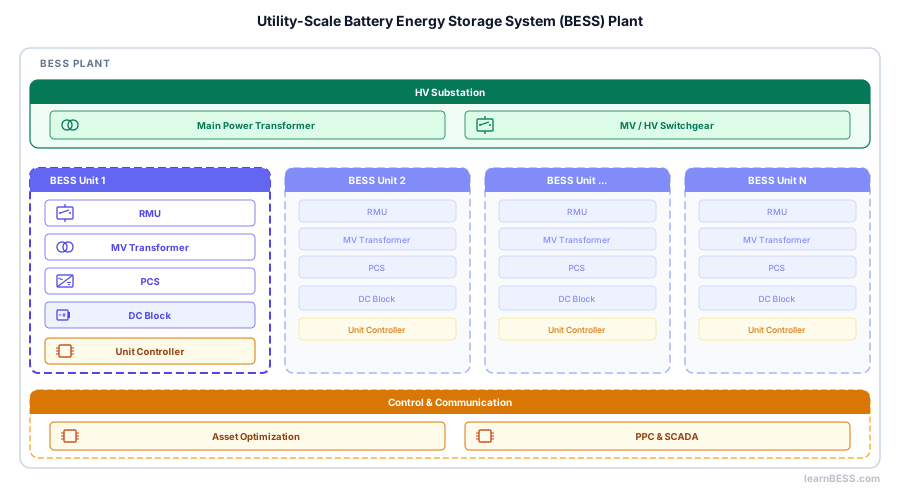
A utility-scale BESS plant brings multiple pieces of equipment together as an integrated system. The core equipment consists of:
- DC blocks (or AC blocks)
- Power Conversion Systems (PCS)
- Medium voltage (MV) transformers and switchgear
- High voltage (HV) substation
- Power Plant Controller (PPC) and SCADA
- Balance of Plant (BoP)
Each of these is covered in its own section. First, how they are organised into a complete plant.
BESS sections and plant structure
A BESS section (often referred to as a BESS block or BESS unit) is a repeating subsystem that forms the building block of the plant. A BESS section generally consists of:
- A number of DC blocks (or AC blocks)
- A number of PCS units
- MV infrastructure — the step-up transformer and RMU
- A section controller
Each BESS section is a self-contained subsystem from the battery cells through to the MV output. The complete BESS plant is formed by connecting multiple BESS sections to a common connection point, which feeds into the point of interconnection (POI) with the grid. Depending on the grid connection voltage, the plant may include an HV substation with a main power transformer, or connect directly at medium voltage. The plant is managed and monitored by the Power Plant Controller and SCADA.
The number of BESS sections determines the plant’s total energy capacity (MWh) and, together with the PCS rating, its power capacity (MW).
Good to know: BESS sections can be connected to the common medium voltage connection point in different ways — either through individual MV feeders or in a daisy-chain configuration, where each RMU’s ring-out feeds the next section’s ring-in. The choice depends on plant size, redundancy requirements, and site design.
Communication and compatibility
All of this equipment must be compatible with each other and communicate reliably. The Power Plant Controller is the plant-level authority — it dispatches commands and settings to each of the BESS sections. The section controller receives commands from the PPC and communicates directly with the DC block’s BMS and PCS units.
The SCADA system monitors all operating conditions and alarms across the entire plant — from individual cell temperatures in a DC block through to the status of HV circuit breakers at the substation. It also acts as the data logger, recording the operational data required for warranty compliance, uptime tracking, performance guarantees, and any data that the TSO or DSO requires — such as transient fault recorder data.
Key concept: Every piece of equipment on a BESS plant must be compatible and communicate reliably. From the DC block’s BMS through to the HV switchgear, the plant only works as an integrated system.