What Is a Power Conversion System (PCS) in BESS?
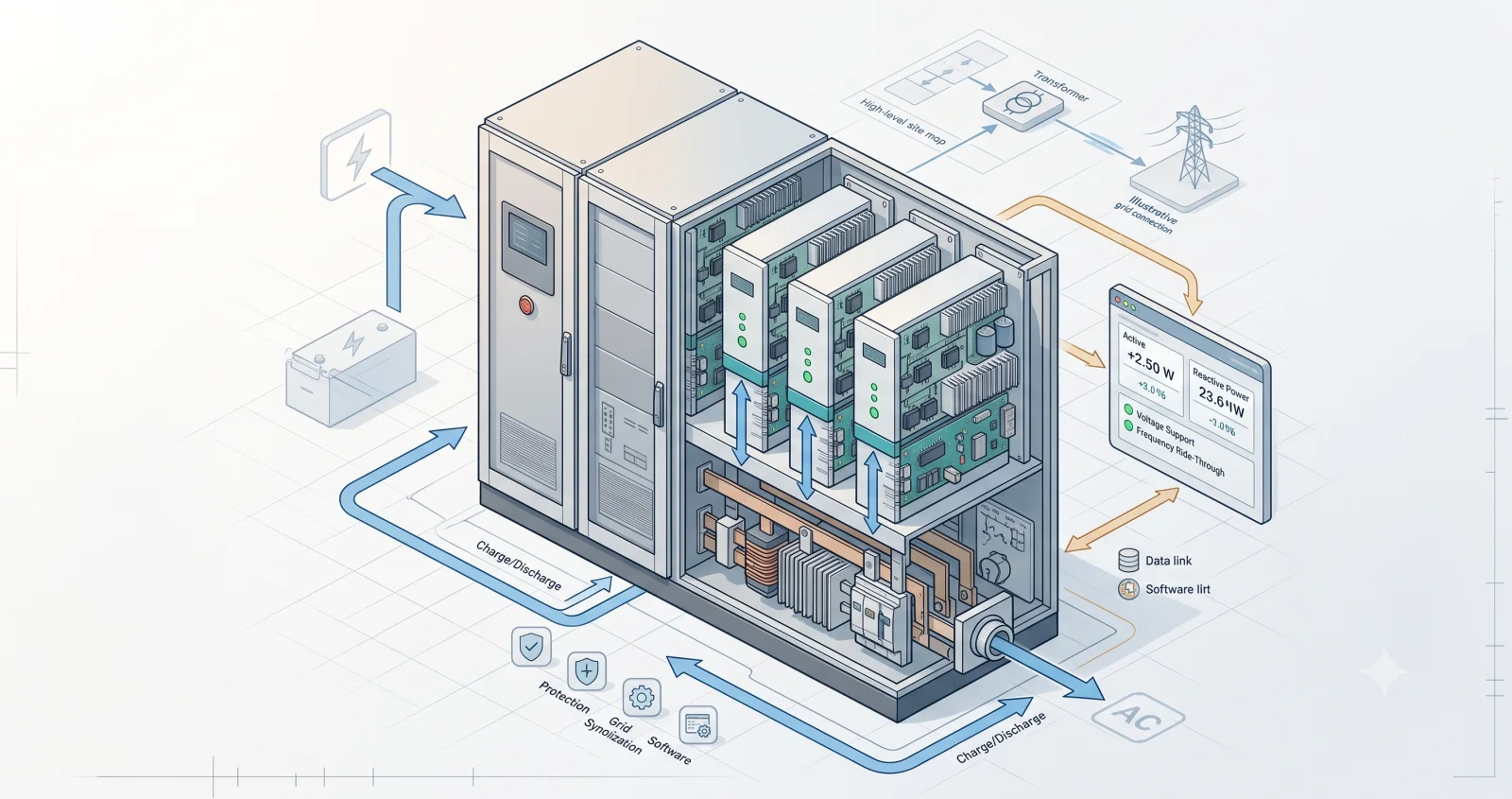
A Power Conversion System (PCS) is the equipment that converts power between the battery’s DC and the grid’s AC, in both directions. It is a system built from power-electronic building blocks, and it is the interface between the battery and the grid.
Almost everyone in the industry calls it the inverter. That is not wrong — an inverter sits at the core of every PCS. But the word comes from solar, where power flows one way and the job is inversion, and it does not tell the full story. A battery charges and discharges, so a PCS converts in both directions, and conversion is only part of what it does.
The manufacturers name it inconsistently as well. The same equipment is referred to as a power conversion system, a power converter, or an energy storage converter. Converter, inverter, and PCS describe three different things at three different levels, and they are routinely used interchangeably. Separating them is the first step to understanding what the equipment is.
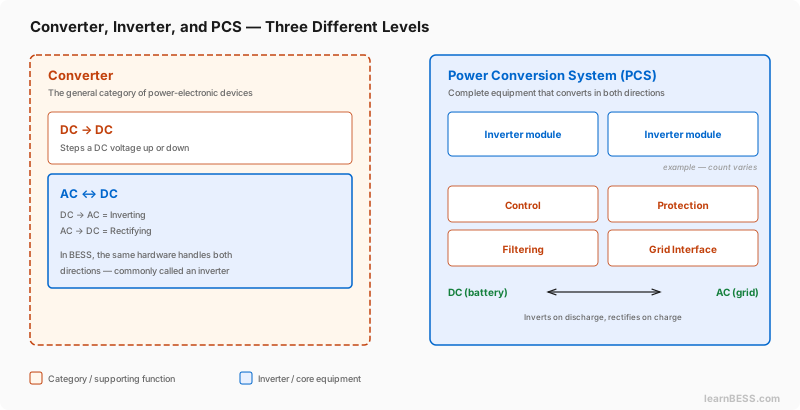 Converter is the general category, inverter is one type of converter, and the PCS is the complete equipment built around one or more bidirectional inverter modules.
Converter, Inverter, PCS — Three Levels
Converter is the category. In power electronics, a converter is any device that changes the form or level of electrical energy: DC to DC, AC to DC, AC to AC, or DC to AC. The word describes a function, and it covers a whole family of devices.
Inverter is one type of converter — the type that converts DC into AC. Every inverter is a converter, but not every converter is an inverter. In solar, the inverter runs in a single direction, which is why the term is commonly assumed to describe a one-way device.
Power Conversion System is the complete equipment built around one or more bidirectional inverter modules, together with the control, protection, filtering, and grid-interface functions needed to move power between the battery and the grid. A single PCS can contain several inverter modules working in parallel. The inverter is a building block within it.
| Term | What it is |
|---|---|
| Converter | The general category — any device that changes the form of electrical energy |
| Inverter | One type of converter that turns DC into AC. In BESS it runs both ways, as a bidirectional inverter |
| PCS | The complete equipment built around bidirectional inverter modules, plus control and protection |
The relationship is one of scope rather than synonyms. An inverter is a type of converter. A PCS is the equipment that puts one or more inverters to work as a bidirectional, controllable, grid-connected system.
What a PCS Does Beyond Conversion
A PCS does more than convert. The functions layered around the conversion are what make it a system, and they are what a project actually depends on.
Four-quadrant power control. A PCS controls active power (MW) and reactive power (MVAr) independently, in either direction. It can inject or absorb reactive power for voltage support even when it is exchanging little or no active power.
Operating modes. A PCS runs in modes that are configured in software. In grid-following (GFL) mode it synchronizes to the grid and delivers commanded amounts of active and reactive power. In grid-forming (GFM) mode it establishes voltage and frequency itself, which is what makes black start and islanded operation possible. Whether a plant behaves as GFL or GFM is determined at the PCS.
Grid-code compliance. Voltage and frequency ride-through, power-quality and harmonic limits, and reactive-power range are all delivered by the PCS. The grid experiences the plant through this equipment, so the PCS is where grid-code compliance is engineered and verified.
Protection and coordination. The PCS monitors DC-side and AC-side conditions, isolates the conversion path, and shuts down safely when limits are exceeded. It also follows setpoints from the power plant controller, which is what allows dozens or hundreds of units across a site to operate as a single plant.
How PCS Equipment Is Classified
Two questions sort out most of the PCS landscape. The first is how the conversion is distributed across the site. The second is how much of the surrounding equipment is integrated into the same package.
Central PCS vs String PCS
Central PCS. Multiple DC strings or blocks are DC-coupled — combined on the DC side — and one large converter, or a small number of them, converts that combined DC at a single point. Fewer, higher-capacity units mean less equipment to install and manage on site.
String PCS. Smaller, modular converters are distributed across the site, typically one for each DC string. Each string is converted on its own and the units are paralleled on the AC side, which makes the strings AC-coupled. Because each converter handles only a small part of the plant, the batteries can be controlled at a finer level, at the cost of more units to install and maintain.
The choice between the two shapes plant layout, cabling, control granularity, capex, and maintenance. It is a design decision in its own right, driven by the site, the battery configuration, and how the plant is operated.
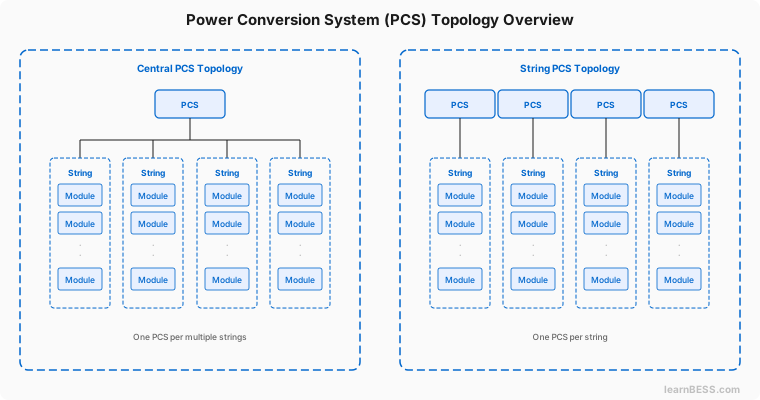 A central PCS converts the DC from several strings at one point; a string PCS places one converter on each string.
Standalone Unit vs Integrated PCS & MV Skid
Standalone unit. The converter is supplied on its own. The medium-voltage transformer and the ring main unit (RMU) are separate scopes, engineered and installed around it.
Integrated PCS & MV skid. The PCS is packaged together with the MV transformer and RMU as a single factory-assembled and tested unit, shipped as a skid or a container. This delivers the conversion, the step-up, and the MV switching as one package, reducing on-site labor and installation time.
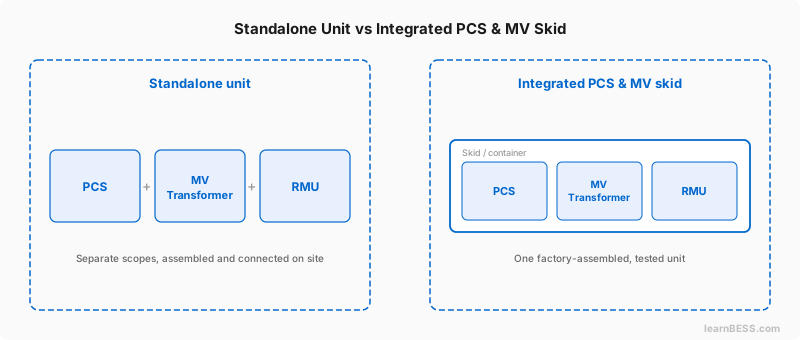 Standalone, the PCS, MV transformer, and RMU are separate scopes; an integrated PCS & MV skid delivers all three as one factory-assembled unit.
Why the PCS Decides What the Plant Can Do
The PCS is the boundary between the plant’s DC domain and its AC domain. The plant’s electrical behavior toward the grid is shaped by the PCS. This is what makes it the plant’s interface — and why its capabilities, rather than the battery’s, set the terms of what the plant can offer the grid.
The parameters that determine whether a plant can meet its grid-connection obligations sit in the PCS specification: the reactive-power range, the ride-through envelope, the harmonic performance, and whether the equipment can operate grid-forming. These are the capabilities a BESS plant is contracted to deliver, and they are all set at the PCS level.
A PCS that can technically perform a function is not the same as a plant that has demonstrated it. Grid-forming capability on a datasheet is not grid-forming behavior verified at commissioning. The plant-level result depends on how the equipment is configured, tuned, and integrated with the rest of the system.
Sizing follows the same logic. The PCS is rated in power (MW), and the battery is rated in energy (MWh). The ratio between them sets the plant’s duration and how quickly it can charge or discharge. It is the PCS rating, not the battery, that caps that rate.
An inverter converts power. A PCS is the equipment a BESS plant is built and contracted around.