What Is the Capacity Market in BESS?
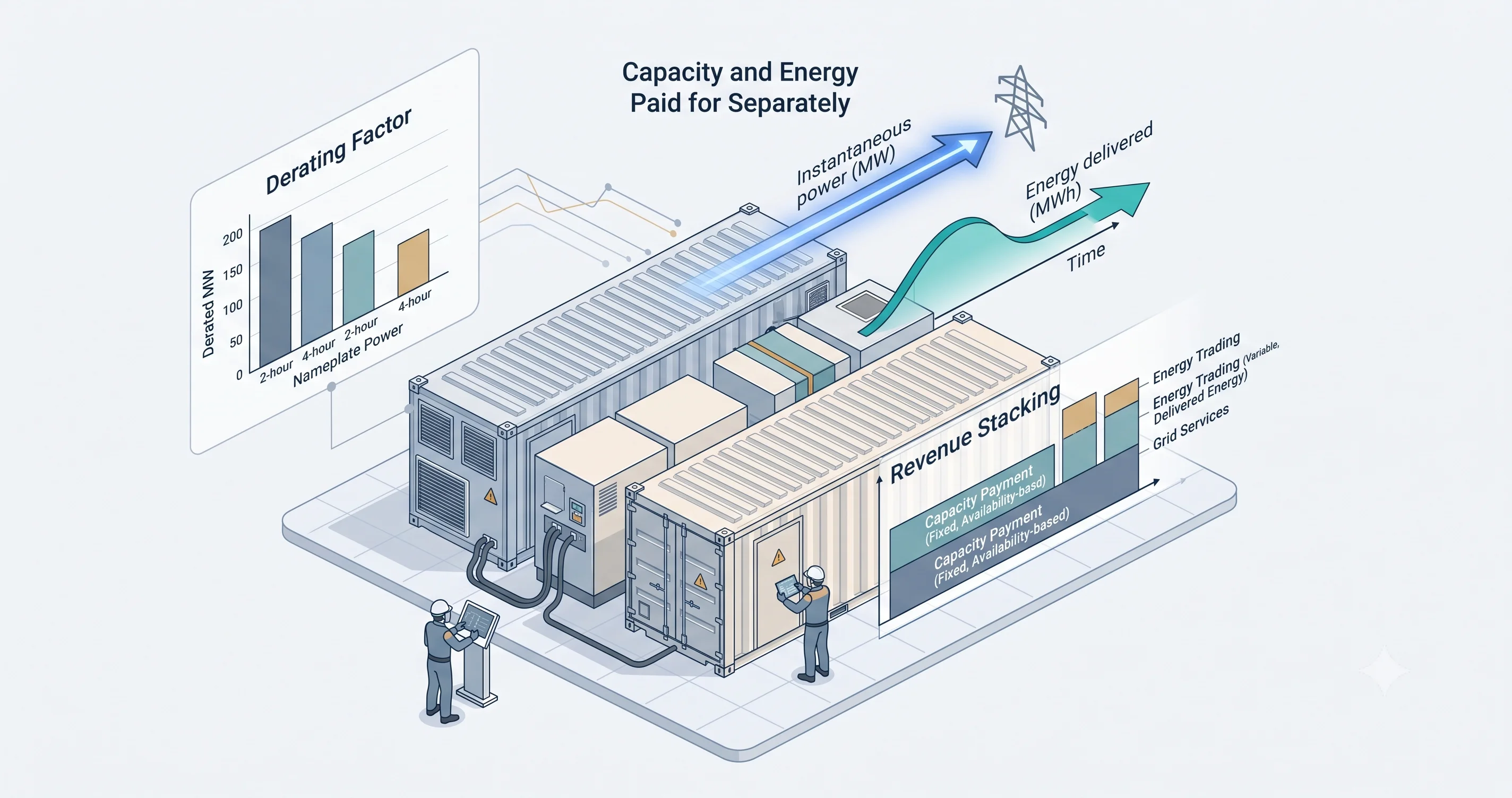
The capacity market pays a battery for being available, not for the energy it delivers. It is a payment for standing ready to supply power when the grid needs it, agreed years in advance, whether or not that power is ever called on.
Its purpose is resource adequacy. An electricity system has to guarantee enough supply to meet demand at the worst moment of the year, not the average one. To make sure that firm supply exists, grid operators procure capacity ahead of time and pay for it. The capacity market is the mechanism that pays for readiness — the ability to deliver power during a period of scarcity — separately from the energy that is actually produced.
That separation exists because energy-market revenue alone may not justify keeping capacity available for rare peaks. A resource that runs only during a handful of stress events a year cannot cover its costs on delivered energy alone. The capacity payment fills that gap and signals where new capacity is needed.
Capacity and Energy Are Paid for Separately
A battery earns from two different things at once, and they are easy to confuse. The energy market pays for electricity actually delivered — energy that flows, measured at the settlement meter. The capacity market pays for a commitment: the promise to be able to deliver a defined amount of power during a defined period, whether or not the call ever comes.
Capacity is measured in power (MW). Energy is measured in energy delivered (MWh). A capacity payment is a fixed amount per unit of capacity per year, set in advance. An energy payment depends on how much the plant runs and at what price. The capacity market is closer to a retainer than a sale.
How Capacity Is Procured and Paid
Grid operators procure capacity through auctions held ahead of the delivery period — often several years ahead, sometimes with a top-up auction closer to delivery. Providers bid the price at which they will commit their capacity, the auction clears at a single price, and every accepted provider is paid that clearing price per unit of capacity for the delivery period.
In return, the provider takes on an availability obligation. When the grid operator declares a system stress event — the moments of genuine scarcity the market exists to cover — the provider must deliver its contracted capacity. Failure to deliver is penalized, and serious or repeated non-delivery can claw back payments. The payment is for readiness; the penalty is what makes the readiness real.
The Derating Factor
For a battery, the capacity it can sell is not the same as its nameplate power. Every technology is derated to reflect how reliably it can deliver during a sustained stress event — a thermal plant is discounted for the chance it is on forced outage. What is specific to storage is what drives the discount: energy duration. This is where most of the confusion sits.
A conventional thermal plant can, in principle, run for as long as it has fuel. A battery cannot — it is duration-limited. A 100 MW battery with two hours of energy can hold 100 MW for two hours, and then it is empty. A system stress event can last longer than that. So the market does not credit a battery with its full nameplate power. It applies a derating factor: a discount that reflects how much firm capacity the battery can genuinely guarantee across a sustained event.
The shorter the duration, the heavier the derating, and the smaller the capacity the battery can sell. The longer the duration, the closer the derated capacity moves toward the nameplate power. This is why duration is a commercial decision as much as a technical one — extending a battery’s duration raises the capacity it can offer into the market, and the derating factor is what translates one into the other. The exact factors are set by each market and revised over time.
Where Capacity Revenue Sits in the Stack
Capacity revenue rarely stands on its own. A battery commonly also earns from wholesale energy trading and from grid services, and the capacity payment is one layer among several. Its share of total revenue varies with market conditions — larger when energy-market margins are thin, smaller when trading is lucrative.
What sets capacity revenue apart is its predictability. It is contracted years ahead and paid at a fixed rate for being available, which makes it the most certain line in an otherwise volatile revenue stack. That certainty is why it matters to project financing out of proportion to its size: a contracted, availability-based payment is the kind of cash flow lenders can underwrite, and it strengthens the bankability of a project that would otherwise rely entirely on merchant income.
Not Every Market Has One
Whether capacity revenue exists at all depends on where the plant connects. Some systems run a central capacity market: capacity is auctioned ahead of delivery and paid a cleared price. Others are energy-only markets that deliberately have no capacity payment, relying instead on high scarcity prices during shortages and on procured grid services to signal investment. A third approach places a resource-adequacy obligation on suppliers, requiring them to contract enough capacity to cover their own load without a central auction.
The structure, the auction timing, the derating methodology, and even whether the market exists at all are jurisdiction-specific. A battery’s capacity revenue in one market says little about what the same battery would earn in another.
For anyone reading a battery’s revenue case, the capacity market reframes three things. Nameplate power is not what the plant sells — the derated capacity is. The payment is for availability, and it stays revenue only as long as the plant delivers when it is called. And it exists only in markets designed with one, which makes it a question to settle early: not how much capacity revenue a project will earn, but whether the market it connects to pays for capacity at all.