AC Block vs DC Block in BESS: What's the Difference?
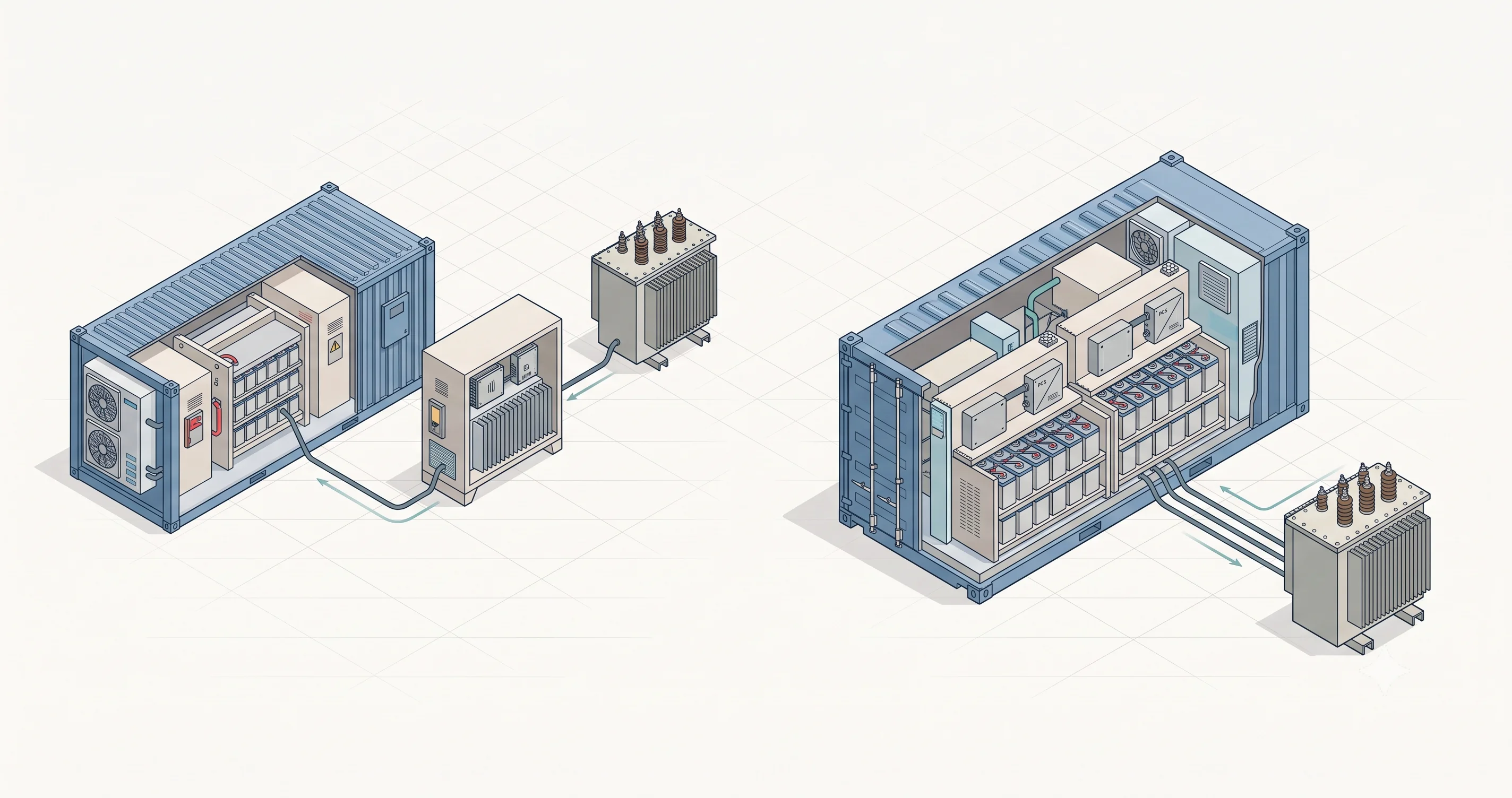
A DC block and an AC block define the two main design topologies for a utility-scale BESS plant. A DC block is the battery system delivered as a standalone unit, with the power conversion system (PCS) as separate equipment. An AC block integrates more than the battery system, combining it with the PCS into a single factory-built unit.
Choosing between them is a design topology decision. What separates the two is where the boundary between the battery system and the PCS is drawn, and whether it is set on site or inside a factory. That is what shapes how the plant is procured, installed, and upgraded.
What a DC Block Is
A DC block is the energy storage unit of a BESS plant — the battery system packaged as a standalone enclosure. It is a containerized or cabinet-based unit that houses the cells and everything needed to manage, protect, and maintain them:
- The cells — assembled into modules, and modules into racks, following a consistent hierarchy
- The battery management system (BMS) — the full multi-level controller hierarchy that monitors and balances the cells
- Thermal management — air or liquid cooling that keeps the cells within their operating window
- Fire detection and suppression — gas and smoke detection with the associated suppression equipment
- DC protection — the switching and protection that safely isolates the battery on the DC side
Everything in that list sits on the DC side of the plant. A DC block stores energy; it does not convert it. Turning the battery’s DC into AC is the job of separate equipment, the Power Conversion System (PCS). In a DC block topology, that PCS is procured and installed as its own equipment.
What an AC Block Is
An AC block is a factory-integrated unit that combines the battery system, the PCS, and the AC block controller (also called a BESS controller, section controller, or unit controller) into a single containerized or cabinet-based assembly. Where a DC block topology keeps the battery system and the PCS as separate equipment, the AC block pre-assembles them into one product, tested as a whole before it reaches site.
Inside the unit, the PCS is commonly mounted above or below the battery racks, or alongside them, within the same enclosure footprint.
An AC block outputs low-voltage AC, generally in the 400–690 V range. Stepping that up to medium voltage is the job of a separate transformer, which sits outside the AC block.
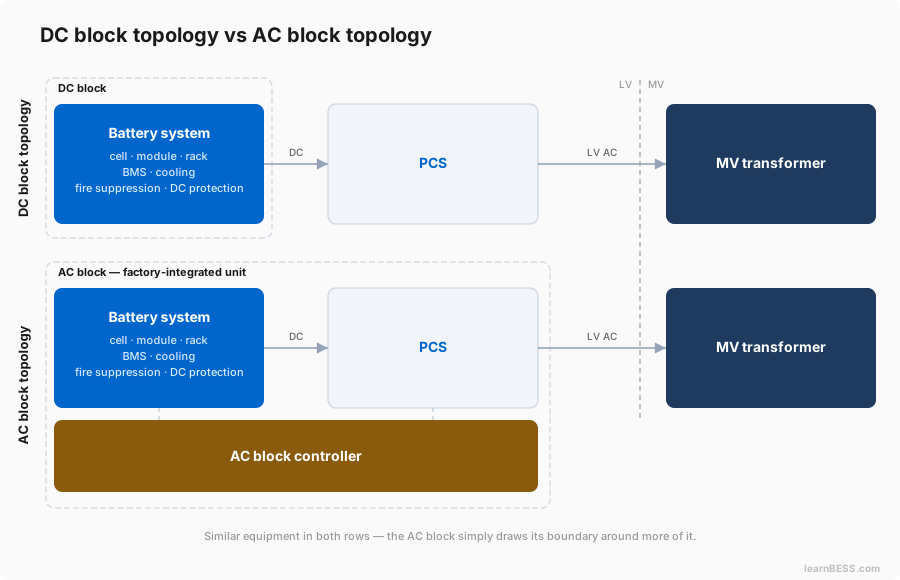 Both topologies use the same equipment. The AC block simply integrates more of it into one factory-built unit.
Topology, Not Product Quality
The choice between an AC block and a DC block is a choice of topology, not a judgment of which product is better. Some manufacturers focus on DC blocks, others on AC blocks, and some supply both. None of these approaches is inherently better than the others — they are two ways of organizing a plant, and the right one depends on the project.
What the topology does decide is which pieces of equipment must work together — and that is where the practical trade-offs begin.
What Each Topology Trades Off
In a DC block topology, the battery system and the PCS are independent equipment, and that independence is where the flexibility comes from. Procurement can source the DC block and the PCS separately, engineering can choose which PCS to pair with which DC block for the best technical fit, and either side can be replaced or upgraded on its own without touching the other. The trade-off is that these separate pieces have to be matched, integrated, and coordinated. More of that work happens on site, and the responsibility for making the parts work together sits with the buyer or designer rather than a single supplier.
In an AC block topology, the battery system, the PCS, and the AC block controller arrive as one factory-tested unit. The advantage is a smaller on-site installation scope and fewer separate interfaces to coordinate. The trade-off is that everything is integrated: a change to any part affects the whole unit as it was shipped, and the buyer is tied to a single supplier for that integrated product.
Neither of these is a weakness on its own. A DC block topology leads with procurement and engineering flexibility; an AC block topology leads with simpler, single-source delivery. Which one a project needs is what settles the choice.
One thing the topology does not decide is how the units are physically arranged on site — how DC blocks sit next to each other, or AC blocks next to each other. That varies from one manufacturer to another, so it is worth checking product by product rather than assuming it follows from the topology.
What Shapes the Choice
Neither topology is a default. Which one fits a given project depends on a few factors weighed together:
- Procurement strategy — the freedom to combine equipment from different manufacturers, or the simplicity of buying from a single supplier
- Cost — how each packaging approach affects equipment, installation, and integration costs for the specific project
- Construction timeline — how much integration work should happen on site versus in the factory
- Upgrade and augmentation plans — whether parts of the system may need to be replaced or expanded independently over the plant’s life
These factors carry different weight from one project to the next, which is why both topologies remain in wide use. Of them, the longest-lived is the last: the topology fixes how freely the battery system and the PCS can be replaced, upgraded, or augmented once the plant is built — a consequence felt long after the procurement decision is made.