BESS Project Insurance — From Financial Close to COD
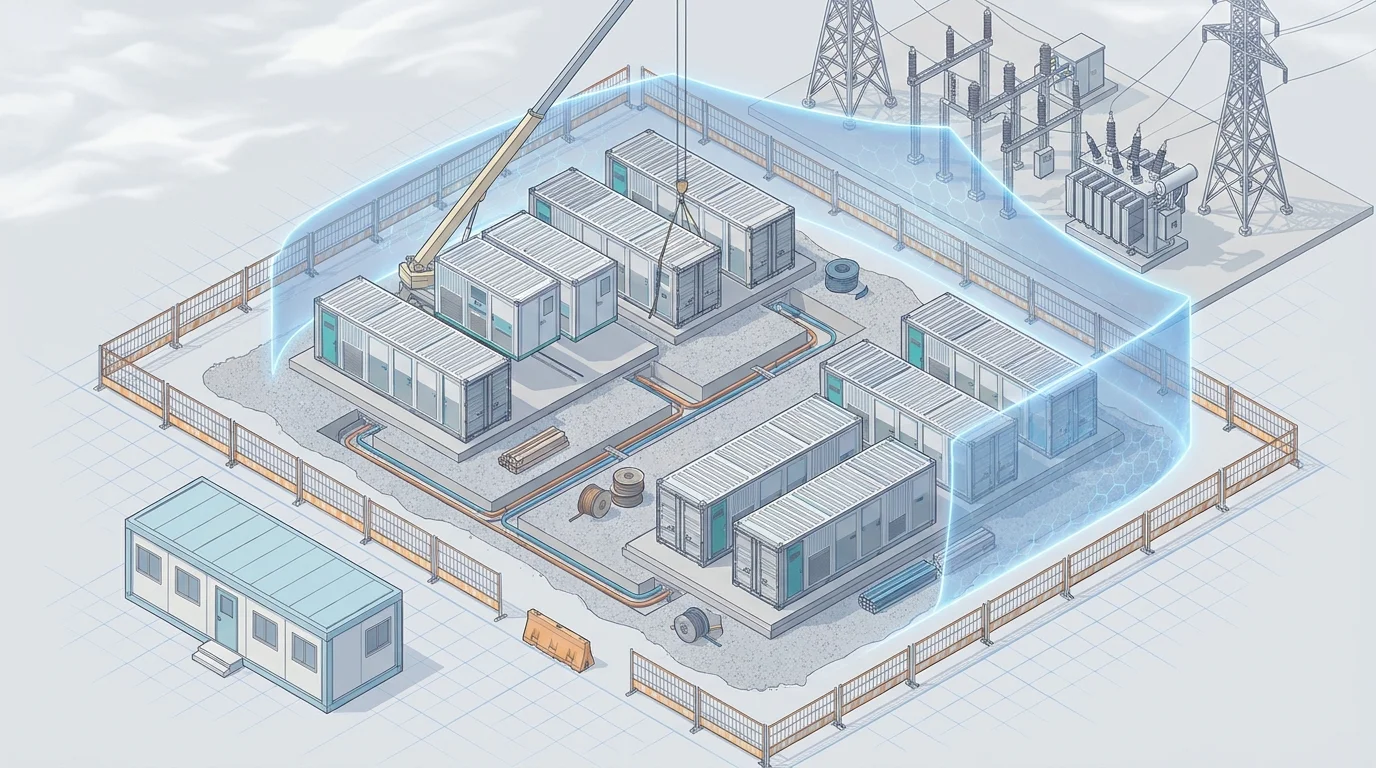
Before lenders release project financing for a utility-scale BESS project, they require a set of insurance products to be in place. These products cover the delivery phase — from financial close through to COD — and each one addresses a different risk: physical damage to the works, financial loss from delay, liability to third parties, environmental contamination, and professional negligence.
Most developers first encounter these requirements through their lender’s term sheet. The policies, minimum coverage limits, and insurer ratings are specified in the loan documentation. Getting them wrong — or leaving gaps between them — can delay financial close or leave the project exposed during the highest-risk phases of delivery.
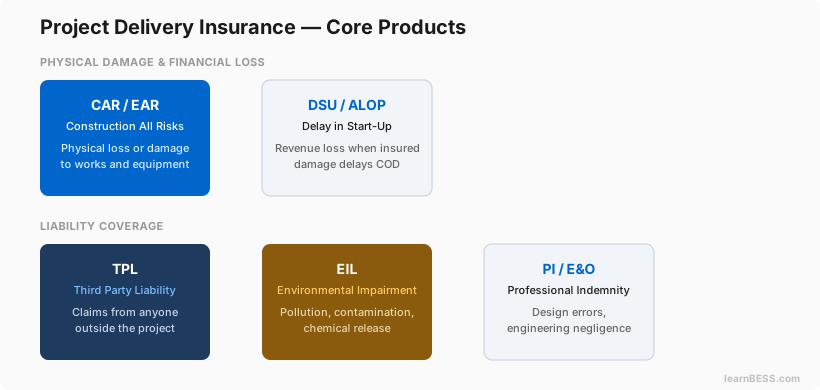 The five core insurance products required during the delivery phase of a utility-scale BESS project.
Construction All Risks (CAR)
Construction All Risks (CAR) insurance — also referred to as Contractor’s All Risks or Builder’s Risk depending on the market — protects against physical loss or damage to the works, materials, and equipment on site. Coverage includes accidental damage, fire, weather events, theft, vandalism, and construction-related incidents.
The policy is arranged by the project owner and covers all parties involved in delivery — the developer, the EPC contractor or individual contractors under a split-contract model, and subcontractors. The policy follows the project, not any single contractor. If a contractor leaves, they have not taken the insurance with them.
In some markets, the term Erection All Risks (EAR) is used instead of or alongside CAR. EAR is designed specifically for the installation and erection of plant and machinery. For a BESS project — predominantly equipment installation — EAR may be more technically appropriate, but in practice the two terms are often used interchangeably.
CAR does not cover defective design or workmanship in the defective item itself, wear and tear, or mechanical breakdown. It does not cover the financial consequences of delay — that is a separate product.
Delay in Start-Up (DSU)
Delay in Start-Up insurance — also called Advance Loss of Profits (ALOP) — covers the financial losses that result when an insured physical damage event delays the commercial operation date (COD).
If a covered event under the CAR policy damages equipment and pushes the project timeline back by three months, DSU compensates for the revenue that the plant would have earned during those months, along with ongoing fixed costs such as debt service and land lease payments that continue regardless of whether the plant is operating.
The critical distinction is that DSU only triggers when the delay is caused by a physical damage event that is itself covered under the CAR policy. A delay caused by permitting issues, supply chain disruption, or contractor underperformance — with no physical damage — is not a DSU claim. DSU is not a general project delay product. It extends the physical damage coverage into lost revenue.
For lenders, DSU is essential. Without it, the developer absorbs the full financial impact of a delay — lost revenue plus ongoing debt service — which is often the difference between a delay being manageable and a delay triggering a default.
Third Party Liability (TPL)
Third Party Liability (TPL) insurance — also called Public Liability — covers claims from anyone outside the project who is affected by activities on site. If construction work damages a neighboring property, or if someone who is not part of the project is injured near the site, TPL is the policy that responds. This is standard on any construction project, not unique to BESS, but it is a lender requirement.
Under an EPC contract, the EPC contractor carries their own TPL and is required to meet minimum limits specified in the construction contract. Under a split-contract model, each contractor carries their own TPL and the developer ensures that coverage limits are consistent across all contracts.
Environmental Impairment Liability (EIL)
Environmental Impairment Liability (EIL) insurance covers pollution and contamination events. Standard liability policies often exclude pollution-related claims, which is why EIL exists as a separate product.
For BESS projects, the relevant risks include PFAS release from battery cell electrolyte during a thermal event, refrigerant leaks from container cooling systems, and oil leakage from transformers. PFAS (“forever chemicals”) are present in lithium-ion cell electrolyte and are under increasing regulatory scrutiny. Actual contamination incidents on BESS sites are rare, but where environmental requirements are strict and containment was not addressed during civil design, remediation costs can be substantial. These contamination risks fall outside the scope of both CAR and TPL.
Professional Indemnity (PI)
Professional Indemnity (PI) insurance — also called Errors & Omissions (E&O) — covers claims arising from design errors, engineering mistakes, or professional negligence in the services provided to the project.
If a design error in the earthing system leads to equipment damage during commissioning, or if an engineering consultant’s specification for foundation loading proves inadequate, PI is the policy that responds. It protects the party that provided the professional service against claims from the project owner or other affected parties.
Under an EPC contract, the EPC contractor carries PI coverage as part of their contractual obligations, covering the design and engineering work they perform or subcontract. Under a split-contract model, the developer may engage independent engineering consultants for design work, and each consultant carries their own PI. The developer’s role is to ensure that PI limits are adequate relative to the potential consequences of a design failure.
What Makes BESS Different for Insurers
BESS construction insurance is structurally similar to insurance for any power generation project. The products are the same. But the underwriting considerations are different, and this is where BESS projects face higher costs and more restrictive terms.
BESS sites have high value density — a large amount of equipment cost concentrated in a compact footprint, with a fire risk profile unique to electrochemical storage. Thermal runaway and propagation between containers is the scenario insurers focus on. As more plants are deployed and operational data accumulates — with relatively few major incidents — premiums have been coming down and insurer appetite has improved.
Serial defect exclusions are particularly relevant. A BESS plant may contain hundreds of identical battery modules from the same manufacturer. If a defect is identified in one unit, the exclusion can remove coverage across every unit of the same type on site. Standard CAR sublimits for fire may also be inadequate given the total values at risk — a thermal event that propagates across multiple DC blocks can exceed what a conventional power project policy was designed to cover.
The underwriting market for BESS is still concentrated among a relatively small number of specialist insurers, which limits competition and can extend placement timelines. Lenders are aware of this and may build additional time into the financing schedule.