BESS Project Bankability — Lenders, Tier Lists, Guarantees & Insurance
~60 min learning time
What you'll learn
- Understand what "bankable" means across lenders, equity, insurers, manufacturers, and EPCs
- See how debt is sized on BESS project finance and what often kills a deal
- Recognise the signals used to assess manufacturer and EPC bankability
- Read BNEF Tier lists, ISO certifications, and credit reports with appropriate scepticism
- Connect performance guarantees, revenue structures, and insurance to overall project bankability
What “bankable” actually means
Bankable means someone is willing to put money at risk against it. That’s the whole word. What makes it tricky in BESS is that “it” changes depending on who’s talking.
A lender calls a project bankable when the contracted revenue, the counterparty structure, and the overall risk profile support writing a loan at an acceptable interest rate. An equity investor calls a project bankable when the expected return justifies the development and construction risk they are being asked to carry. A developer calls an equipment manufacturer bankable when lenders, insurers, and offtakers accept that supplier without pushing the project’s cost of capital up. An insurer calls a plant bankable (they would usually say “insurable,” but the logic is the same) when the site, chemistry, spacing, and certifications pass underwriting. An EPC contractor is called bankable when they have the delivery track record, balance sheet, and bonding capacity to back the contractual guarantees they are signing up to.
The word gets used at every layer of a project because every layer involves someone writing a cheque.
Key concept: Bankability is a judgment, not a score. It is the view a party takes on whether the risk they are being asked to absorb is acceptable at the price they are being paid for it. That view depends on who is asking, what they are being asked to cover, and what else is in their portfolio.
This is why bankability is not binary. A project that will not close with one lender can close with another on different terms. A manufacturer that is not bankable for a 10-year German tolling structure may be bankable for a merchant deployment in ERCOT. A site that would not have been insurable five years ago becomes insurable after a fire-test campaign, a chemistry change, and better spacing.
The shortcut used across the industry is “Tier 1,” most formally applied to equipment manufacturers. It is market shorthand for “this supplier passes most bankability tests, most of the time, for most structures.” Useful as a filter. Misleading in specific cases. The BNEF Tier lists section below covers the list and where the shorthand breaks down.
The lenders’ and investors’ lens
Every definition of bankability ultimately comes back to two groups: lenders and equity investors. They are the people putting money at risk, and they answer two different questions.
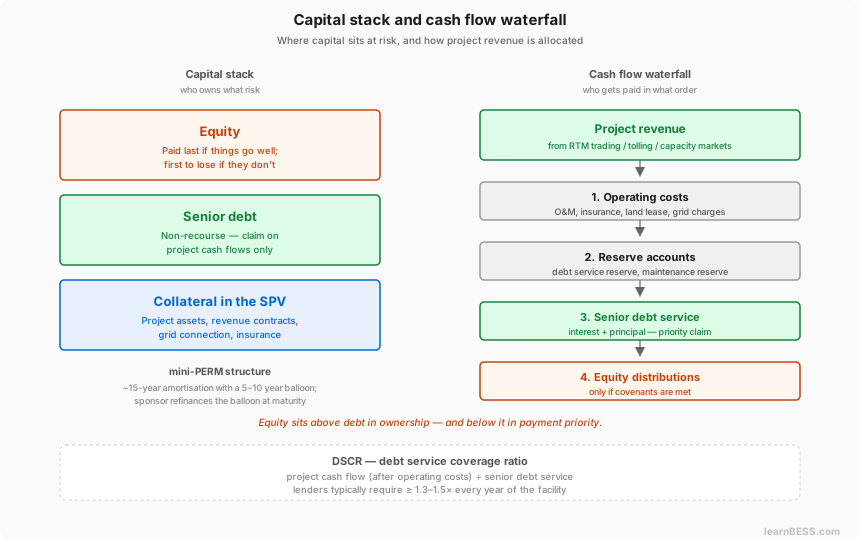
The lender asks: will I get my money back. Debt in BESS projects is generally non-recourse — the lender has no claim on the sponsor’s wider balance sheet (the sponsor being the developer or asset owner standing behind the project), only on the project’s cash flows and assets. That forces a specific way of thinking. The loan is sized not against the hardware, but against the revenues the project is expected to earn over the financing period. The core test is whether those revenues, after operating cost, degradation, augmentation capex, and a margin, cover debt service with enough cushion to survive a bad year.
The equity investor asks: will my return justify the risk. Equity sits below debt in the capital stack — paid last if things go well, wiped out first if they do not. Equity accepts that asymmetry in exchange for the upside: merchant revenue above a contracted floor, capacity market awards, residual value after the debt is repaid. Different equity pools have different patience profiles. A pension fund wants low-teens returns on a fully de-risked, operational, contracted asset. A development-stage or strategic investor will take pre-FID development risk for materially higher upside.
The spread between these two appetites sets the project’s capital structure: how much debt versus equity, at what cost, and on what contractual backbone.
Project finance, not asset finance
BESS debt is project finance. The lender is not lending against the value of the batteries; they are lending against the contracted and modelled cash flows the project will produce. If the plant earns revenue under a long-term tolling agreement with a creditworthy offtaker, that contract is the collateral. If the plant runs merchant, the collateral becomes a modelled revenue forecast, stress-tested under downside scenarios. The lender then layers on structural protections — reserved cash accounts and coverage ratios that trap dividends (hold cash inside the project rather than paying it out to equity) when performance slips.
This creates the first filter on bankability: the more contracted the revenue, the more debt a project can carry, and the cheaper that debt will be.
Key concept: Senior debt prices off revenue certainty. Fully contracted projects attract the tightest margins and the widest equity pool. Merchant-heavy projects pay more on every axis — wider debt margins, more equity, tighter structural controls.
Mini-PERM — the BESS-specific structure
Most BESS debt runs on a mini-PERM structure: repayments are calculated on a longer amortisation schedule — usually around 15 years — but the full remaining balance falls due after 5 to 10. The sponsor has to refinance that remaining balance, the balloon, at maturity. The reason is structural. Batteries degrade. They need augmentation capex partway through asset life. Market rules and revenue products evolve. No lender underwrites a twenty-year BESS loan today the way they do for solar or wind.
The refinancing risk at the balloon sits on the sponsor, not the lender. If market conditions or revenue stacks have deteriorated when the balloon falls due, refinancing is harder and more expensive, or the sponsor has to inject more equity to make the numbers work.
Deal killers
Lenders will walk from a deal for a small number of recurring reasons:
- Revenue that is too merchant without adequate hedging, reserves, or structural mitigants
- No sponsor “skin in the game” — equity from bridge loans or flip structures (short-dated equity designed to exit at or around COD) rather than from the party actually developing the project
- Counterparty weakness on the offtake side — non-investment-grade offtakers, short-dated contracts, or performance covenants the project cannot reliably meet
- Technology or supplier risk the lender cannot diligence — unproven chemistry, no reference plants, no warranty backing, or a manufacturer with a weak balance sheet
In practice: Each basis point (bp — one-hundredth of a percent) of cost of capital compounds across the life of the facility. A project financed at a 200 bp margin (2%) over the benchmark rate versus a 400 bp margin (4%) is a materially different business case. This is why sponsors spend so much effort making revenue contracted, counterparties strong, and equipment proven: every piece of that work translates into cheaper debt and better equity returns.
Company-level signals — ISO, D&B, and credit reports
This section is included with All-Access.
Get access