How Does Battery Storage Make Money in EU Electricity Markets?
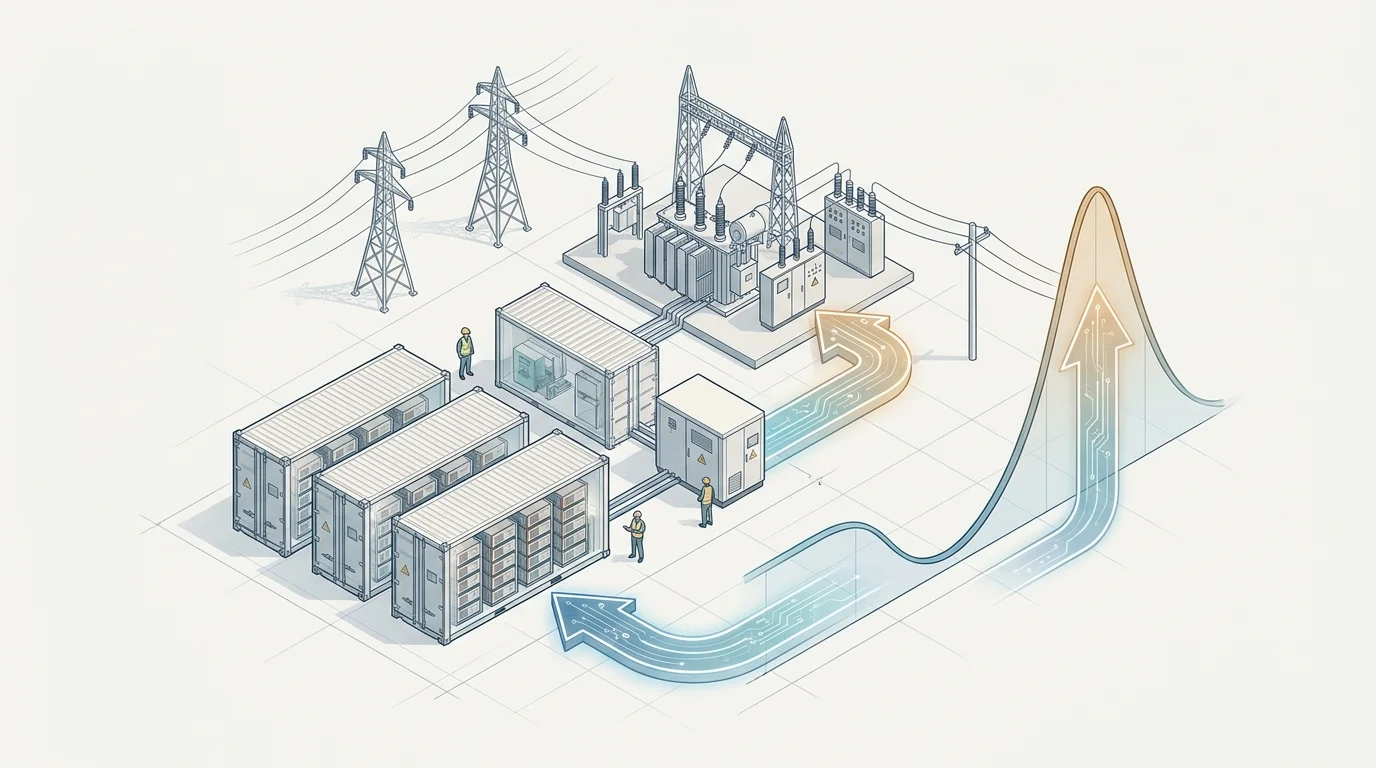
A battery storage plant earns revenue in three ways. It buys electricity when prices are low and sells it when they are high. It sells balancing services to the grid operator. And where a capacity mechanism exists, it is paid to be available during system stress.
Most explanations of storage revenue stop there, and for good reason: those three streams are the answer. But underneath them sit two roles that the industry mentions constantly and almost never defines — the BRP and the BSP — and a stack of legal instruments that decide whether a battery is allowed to earn at all.
The Three Revenue Streams
Energy arbitrage is the most familiar. The battery charges when prices are low and discharges when they are high, capturing the spread. EU market design makes small, fast assets viable here: bid sizes are small, there are no price caps or floors, and intraday trading now runs close to real time — all of which favor an asset that can respond to a late price move in minutes.
Balancing services, often called ancillary services, are where a fast battery is most competitive, because it can inject or absorb power within hundreds of milliseconds. There are four reserve products — FCR, aFRR, mFRR, and RR — and a battery is paid in two ways for them: to hold capacity available, and to deliver energy when activated. The same battery that qualifies for aFRR in one control area does not automatically qualify in the next, because prequalification is run by each national TSO.
Capacity payments are the third stream, and the most stable: a battery is paid years in advance for being available during system stress, whether or not it is ever called. But a capacity mechanism only exists where a member state has a proven resource adequacy concern and chooses to run one. A battery’s capacity revenue therefore depends heavily on which national market it sits in.
The Two Roles Under Every Revenue Stream
Underneath the streams, EU law gives the plant standing as a market participant through two defined roles.
A balance responsible party (BRP) is the market participant accountable for the plant’s position. It submits the schedule for what the plant will do, and it settles the difference between that schedule and what actually happened — the imbalance — every 15 minutes at the imbalance price. That settlement works in both directions: a plant whose position helps the system is paid, and a plant whose position hurts it is charged. Balance responsibility is not optional. Every plant must be covered by a BRP — the asset owner either takes on the role itself, or delegates it by contract.
A balancing service provider (BSP) is the market participant that sells balancing capacity and balancing energy to the transmission system operator. It is the role through which a battery gets dispatched to restore system balance, and it is paid for holding capacity and for the energy it delivers when activated.
BRP and BSP are not the same thing. The BRP is accountable for the plant’s own position and settles the imbalance it creates, in either direction. The BSP is paid to resolve imbalances on the system. They are separate roles, defined in separate articles — and the money flows between them: the BRPs who cause imbalances pay, indirectly, the BSPs who resolve them, with the transmission system operator sitting financially neutral in the middle. They are not two parallel lanes, one cost and one revenue. They are two ends of the same transaction.
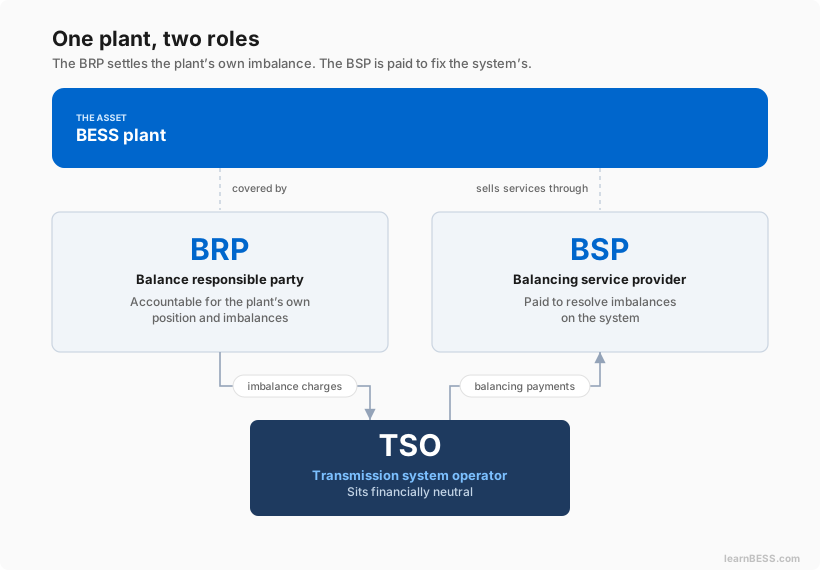
One plant, two roles. The BRP is accountable for the plant’s own position and settles its imbalance with the TSO. The BSP is paid to resolve imbalances on the wider system. The same asset holds both roles at once, and the money flows from the party that causes the imbalance to the party that fixes it.
In practice one company — the Route to Market (RTM) provider — usually fills both roles at once. It trades the asset, submits the schedules, carries the imbalance position, and sells the balancing services, all under a single contract. From the asset owner’s seat the boundary between the two roles goes unnoticed, because a single company holds both. The roles remain distinct all the same: the same plant, in the same hour, has its imbalances settled by the BRP while being dispatched through the BSP to fix someone else’s.
Two further ways a battery earns or avoids cost map onto the same two roles. Imbalance settlement sits on the BRP side: a plant that can hold its schedule precisely — or deliberately take a position that helps the system — is paid the imbalance price rather than charged it. Congestion management sits on the BSP side: a battery sited at a congestion point can be paid to charge or discharge to relieve it through market-based redispatch.
Four Instruments, Four Jobs
The three streams rest on a stack of four EU instruments, each with a different job and a different legal weight.
- Regulation (EU) 2019/943 sets the rules of the market itself — how day-ahead, intraday, balancing, and capacity markets are organized, and the principles every participant competes under.
- Directive (EU) 2019/944 defines the actors and their rights — including the legal definition of energy storage, and the rules on whether network operators may own it.
- Regulation (EU) 2017/2195, the Electricity Balancing Guideline, runs the balancing markets in detail — the European platforms, standard products, and imbalance settlement.
- Regulation (EU) 2024/1747 is the 2024 market design reform. It did not replace the 2019 package — it edited it, adding a flexibility framework, a peak-shaving product, and a clear line on which technologies get price support.
What about FFR? Fast frequency response sits outside this stack. It is not one of the four reserve products these instruments govern, and none of them covers it. It is procured nationally, against each grid operator’s own inertia conditions — which is why no two FFR products agree on their parameters. What FFR is, and how it differs from FCR.
The distinction between a regulation, a directive, and a network guideline is not academic. The market rules in Regulation (EU) 2019/943 are identical in Germany, Spain, and Poland. The storage definition in Directive (EU) 2019/944 is transposed into each member state’s national law, which is where variation enters. And the balancing markets run by the Balancing Guideline are implemented by each TSO through its own terms and conditions. The frame is harmonized; the detail is national.
Where the EU Frame Ends and National Implementation Begins
That gap — between the harmonized frame and the national detail — is where a battery’s actual revenue is decided.
- Balancing market access. The EU requires markets to be open to storage. Each TSO runs its own prequalification and defines its own product parameters. Qualification does not transfer across borders.
- Imbalance pricing. Single versus dual imbalance pricing, and the exact price calculation, are set nationally.
- Network tariffs. The no-discrimination and no-double-charge principles are EU-level. The actual tariff a battery pays is national. A battery both withdraws electricity to charge and injects it to discharge, and whether it is charged once or twice for that round-trip is decided by each national regulator.
- Capacity mechanisms and flexibility schemes. Whether one exists at all, and how storage participates, is a national choice within EU design constraints.
The reason two batteries with identical hardware earn different revenue in different EU countries is almost never the EU framework — it is the national implementation of it. A revenue model built on “EU law allows storage to do X” is only as good as the check that the target member state has actually implemented X in a way a merchant battery can access.
What This Means for a Storage Business Case
Three things follow for a developer, investor, or asset owner.
Because a battery carries full balance responsibility and must prequalify for each balancing product, most owners delegate both the BRP function and the trading to an RTM provider. Selecting that provider — and understanding how it co-optimizes the asset across markets — is where the value is won or lost.
There is no CfD-style revenue floor for storage. The 2024 reform reserved two-way Contracts for Difference for new wind, solar, geothermal, hydro without reservoir, and nuclear. Storage is deliberately excluded. A battery’s revenue is market-based, stacked across arbitrage, balancing, congestion, and — where available — capacity.
And the double-charging question must be confirmed, not assumed. It is an EU principle that storage should not be charged twice for one round-trip of energy. Whether the target member state has removed that double charge for grid-scale merchant storage specifically is a national number, worth verifying before the tariff treatment is taken for granted.