How Are BESS Batteries Recycled?
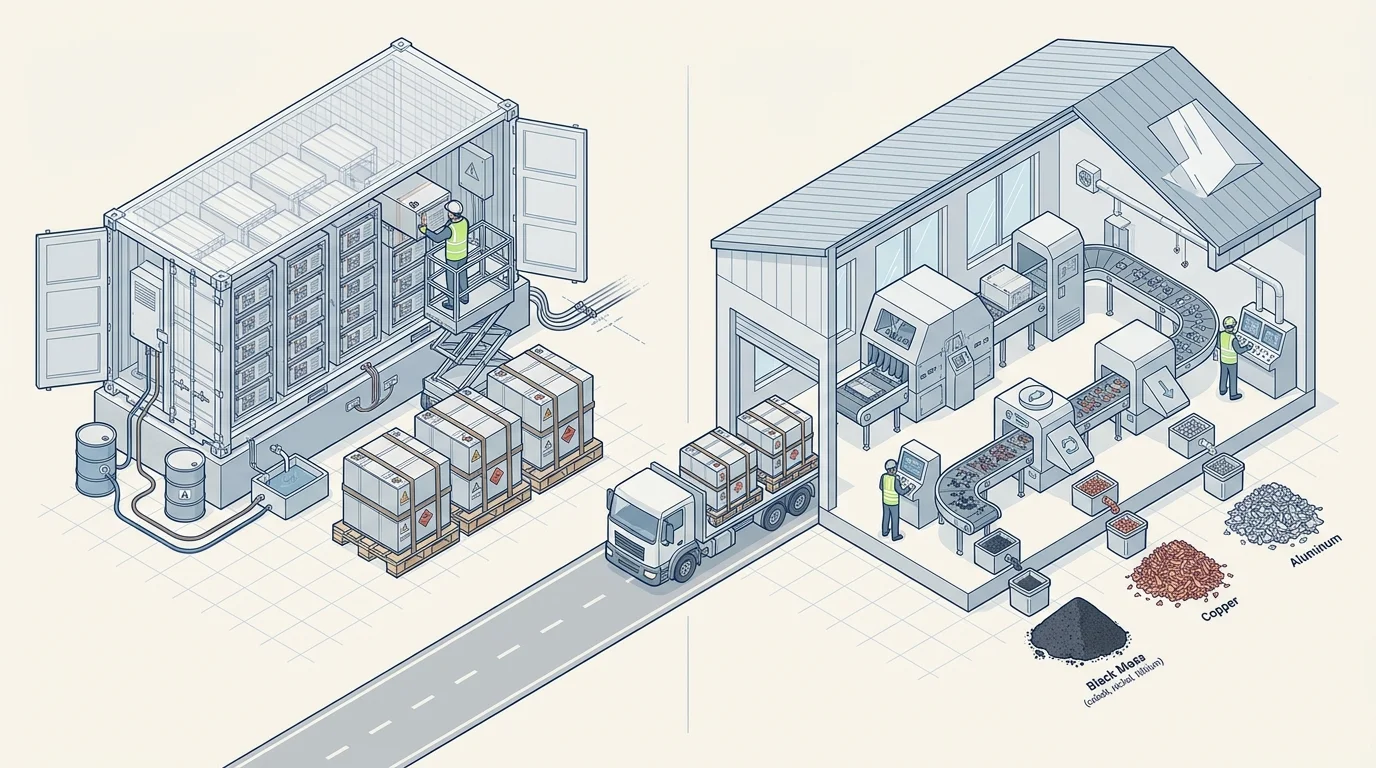
A BESS battery is recycled by having its valuable metals — lithium, cobalt, nickel, copper, manganese, aluminum — chemically separated and returned to the supply chain. The dominant method shreds the cells into a powder called black mass and recovers the metals from there, though other approaches exist.
That is recycling — the material recovery that happens at a specialist facility after the battery has left the plant. It is not the same as decommissioning, the site operation that removes the battery from the plant in the first place. The two are separate subjects, and this post is about the recycling.
When a BESS Battery Reaches End of Life
End of life is measured in state of health (SoH) — the ratio of the battery’s current usable capacity to its original rated capacity. A battery at 80% SoH retains 80% of the capacity it shipped with.
For utility-scale BESS, end of life typically arrives at around 60–70% SoH, depending on the chemistry, application, and contract terms. The battery has not stopped working at that point — it still charges and discharges — but it no longer meets the performance specifications it was contracted to deliver.
A battery reaches end of life one of three ways:
- State of health. The battery degrades to its usable threshold, typically around 60–70%.
- Mechanical or electrochemical failure. A failure — a venting cell, a short circuit, a mechanical defect — takes the battery out of service regardless of its state of health.
- Recall. A recall or failed safety inspection forces the battery out of service.
Manufacturers typically specify that their batteries are not to be used after they have reached end of life. State of health is a technical measure, not a warranty construct — a battery that falls below its usable SoH threshold has reached end of life whether or not a warranty is still in force.
What Actually Gets Recycled Today
A negligible share of what the battery recycling industry processes today comes from utility-scale BESS. Current volumes are dominated by manufacturing scrap — production waste from cell and module lines — followed by warranty replacements pulled during a plant’s operating life, and units removed after transport damage, commissioning faults, or safety events.
Full plant decommissioning barely registers — the utility-scale systems that have been fully decommissioned and recycled so far have been early, small-scale projects.
Second life does not change this picture at utility scale. Grid services require predictable, warranted performance from homogeneous battery systems, and a container of mixed-provenance, mixed-age cells is operationally unacceptable for that. For new utility-scale projects, end of life means recycling.
How Material Recovery Works
Once modules reach a recycler, most facilities run a two-stage approach: mechanical pre-treatment to produce black mass, followed by refining to recover individual metals.
Hydrometallurgical processing is the dominant method. Batteries are dismantled and shredded, and the organic materials — electrolyte, separator, binder — are removed, usually by heat treatment. What remains is a mix of cathode and anode active materials known as black mass. That black mass is dissolved in acid, and the target metals are selectively recovered through chemical separation. Recovery rates for cobalt and nickel exceed 90%. Lithium recovery has historically been lower, around 80%, and is improving.
Pyrometallurgical processing is smelting. Batteries are fed into a furnace at high temperature, and metals with lower melting points — cobalt, nickel, copper — are recovered as an alloy. Lithium and aluminum tend to end up in slag and are harder to recover. The process is energy-intensive and recovers lithium poorly, which is why hydrometallurgy is preferred for lithium-bearing chemistries.
Direct recycling is an emerging approach that recovers cathode material without breaking it down into its constituent elements. The cathode is removed, cleaned, and re-lithiated to restore its original structure, avoiding the energy and chemical cost of full dissolution and re-synthesis. It is being commercialized in China and is particularly relevant for LFP cathodes, where the individual elements have low standalone value but the assembled cathode structure is worth preserving.
What the Battery Is Worth
Whether recycling pays depends on chemistry.
NMC batteries carry the most valuable material mix, driven by their cobalt and nickel content. LFP is the harder case: iron and phosphate have low commodity value, so the economics rest on recoverable lithium and copper, and margins are tighter.
Disposal is rarely the alternative. In the EU, landfilling lithium-ion batteries is prohibited outright. Elsewhere the economics reach the same outcome — even LFP contains recoverable lithium, copper, and aluminum with real market value, and no commercial operator sends material with market value to landfill.
Who Pays for the Recycling
The treatment has to be paid for by someone. Who that is depends on where the plant is.
In the EU, extended producer responsibility assigns the cost of collection, transport, and treatment to the party that first places the battery on the market — frequently the importer, not the cell manufacturer. The United States has no federal equivalent; instead, tax credits under the Inflation Reduction Act make domestic recycling competitive with virgin material, and the economics do the work that regulation does in Europe. In markets with neither mechanism, the treatment cost is simply a commercial item to be allocated in the supply contract.
In most major markets, recycling capacity already exceeds the volume of batteries currently reaching end of life. The constraint is not technology or capacity — it is supply. Who bears the treatment cost depends on the jurisdiction and the supply contract, not on what the recycling industry is technically capable of doing when the plant retires.