What Is Thermal Runaway in BESS?
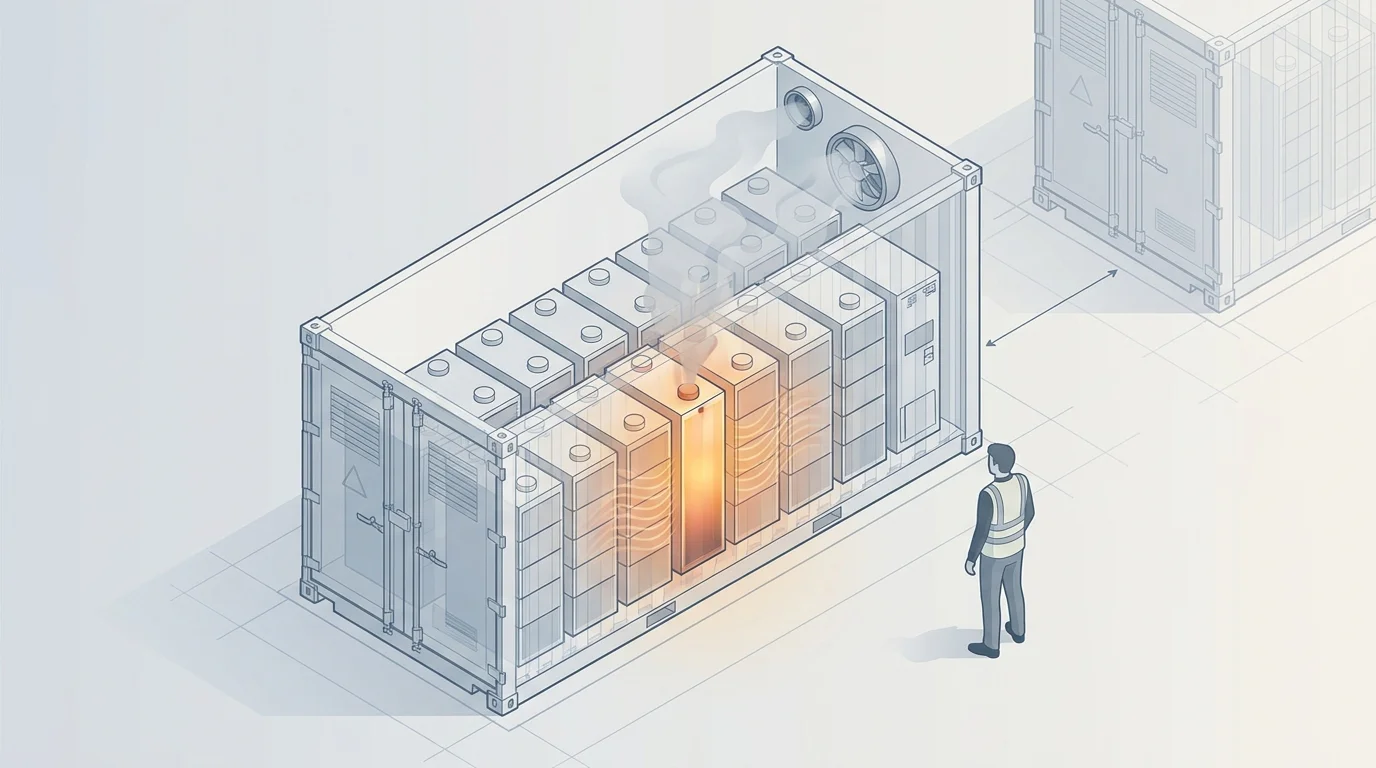
Thermal runaway is the self-sustaining exothermic failure of a battery cell. Once the reaction starts, the cell’s internal chemistry releases heat faster than the cell can dissipate it, and the reaction does not need ambient oxygen to continue. It cannot be extinguished by any external system once it is underway.
Fire safety design for BESS assumes that thermal runaway may occur and focuses on containing its consequences — limiting propagation, managing the flammable gases it produces, and protecting adjacent equipment and people.
How It Starts
Thermal runaway is rare but not random. Common initiators include:
- Manufacturing defects. Internal short circuits from contamination or mechanical misalignment, usually appearing within the first few hundred cycles or after thermal stress.
- Mechanical damage. Impact during transport or installation, or seismic events for sites in high-risk zones.
- Electrical abuse. Overcharge, over-discharge, or over-current beyond BMS protection limits. In systems with redundant BMS protection layers, this is rare.
- Water ingress. Leaking coolant from a liquid cooling system, water from a fire suppression discharge, or rainwater entering through improperly sealed service access. Water in the wrong place creates short circuits that can trigger thermal runaway.
The BMS enforces voltage, current, and temperature limits at cell and module level, and opens the rack contactor if any limit is exceeded. It reduces the probability of thermal runaway but cannot eliminate it — a defect-initiated internal short circuit and water ingress both bypass BMS protection.
Why It Cannot Be Extinguished
Once a cell is in thermal runaway, the exothermic decomposition reactions are internal and self-sustaining. They do not require ambient oxygen. Clean agent and aerosol suppression systems are designed to extinguish electrical fires — arcing, cable fires, external combustion — not to stop the reactions inside a cell. A suppression system that discharges correctly has done its job. The thermal runaway continues regardless.
This is why fire safety design for BESS is built around containment. Suppression addresses electrical fires around the equipment. Detection, ventilation, deflagration management, and separation distances address the consequences of thermal runaway itself.
Heat and Gas: Two Different Hazards
Thermal runaway produces two hazards that require different responses.
Heat — the propagation risk. The failing cell transfers heat to its neighbors. If adjacent cells absorb heat faster than they can dissipate it, they enter thermal runaway in turn. Propagation can extend cell to cell, module to module, rack to rack, or DC block to DC block — or it can stop at the first cell. Cell design, module construction, thermal barriers, and the equipment’s UL 9540A test result determine where propagation stops.
Gas — the deflagration risk. A cell in thermal runaway vents flammable gases: hydrogen, carbon monoxide, methane, and electrolyte vapor. These gases do not burn inside the cell. They accumulate inside the enclosure and burn where they find oxygen and an ignition source.
The gas hazard operates on a different timeline. A thermal runaway event can fill an enclosure with flammable gas over minutes or hours. If the event consumes enough oxygen inside the enclosure, the gas cannot ignite. The mixture becomes dangerous when fresh air enters — when a door is opened, a seal fails, or ventilation is restored — and the oxygen level rises back into the range where ignition is possible. The delay between gas release and ignition can be hours.
Propagation is contained by cell and module design, thermal barriers, and rack construction. The gas hazard is managed by off-gas detection, ventilation, and deflagration venting or explosion prevention systems at the enclosure level. NFPA 855 governs both, and the 2026 edition has shifted the requirement toward active gas management as the primary explosion-control strategy.
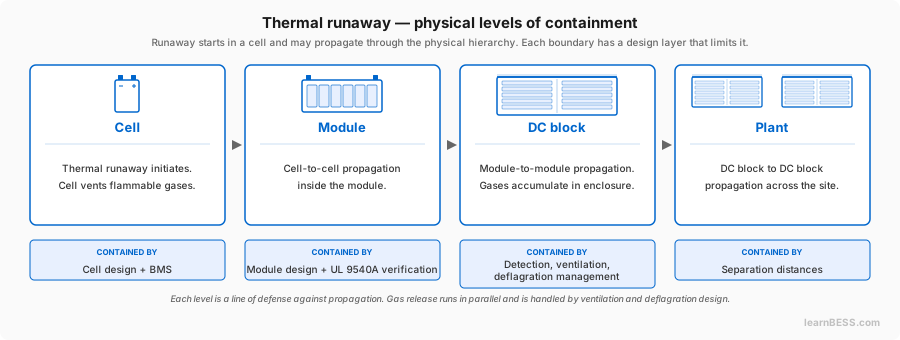 Runaway starts in a cell and may propagate through the physical hierarchy. Each boundary has a design layer that limits it.
Containment at Each Level
Fire safety at the DC block is a cell-level, module-level, and enclosure-level problem. Fire safety at the plant is a site-level problem.
Inside the DC block:
- Off-gas detection — sensors that detect the gases released during cell failure, typically before smoke or heat is present.
- Ventilation — active fans that extract accumulated gas from the enclosure, keeping concentrations below the flammable range.
- Suppression — clean agent or aerosol systems that address electrical fires around the equipment.
- Dry pipe connections — pre-installed pipe connections that allow firefighters to flood the enclosure with water after a thermal runaway event, cooling the cells and limiting further propagation.
- Deflagration management — either relieving the pressure after ignition through deflagration venting, or preventing the gas from ever reaching a flammable concentration through active detection and forced ventilation.
Across the plant:
- Separation distances — between DC blocks, between equipment, and between the plant and its site boundaries.
- Access and egress — roads, turning areas, and staging space for emergency vehicles.
- Water supply — on-site storage or mains connection for firefighter use.
Understanding thermal runaway as a containment problem — heat on one side, gas on the other, with different systems addressing each — is the starting point for evaluating any BESS fire safety design.