EU Electricity Market Participation for BESS — Specialist Training Guide
25 min read
What you'll learn
- Understand the EU legal architecture — regulation, directive, network code, and guideline
- Know how EU law defines energy storage and its "market participant" status
- Understand balance responsibility and the BRP role a BESS plays
- Map where a BESS earns — wholesale, balancing, imbalance settlement, congestion, and capacity
- Understand revenue stacking, the state-of-charge constraint, and the double-charging rule
- Know what the 2024 reform changed for storage and where national implementation takes over
A battery energy storage system earns money in EU electricity markets the same way any other asset does — by being a recognized market participant that can buy, sell, and provide services under a common set of rules. This guide covers how those rules work: where a BESS plant is allowed to compete, how it gets paid, and where the law that sets the frame ends and national implementation takes over. Every rule, threshold, and product named here is anchored to the specific article of the EU instrument that establishes it.
Module 4 of the course, How BESS Makes Money, covers the revenue streams at practitioner level — what arbitrage, balancing services, and capacity payments are and how they fit a business case. This guide is where the regulatory detail lives: the legal machinery underneath those revenue streams, and how a storage asset is treated inside it.
The legal architecture — four instruments, four jobs
EU electricity market design is not one law. It is a stack of instruments adopted mainly under the 2019 “Clean Energy for All Europeans” package and substantially reformed in 2024. Understanding which instrument does which job is the first step, because the type of instrument determines how directly it binds and where national discretion enters.
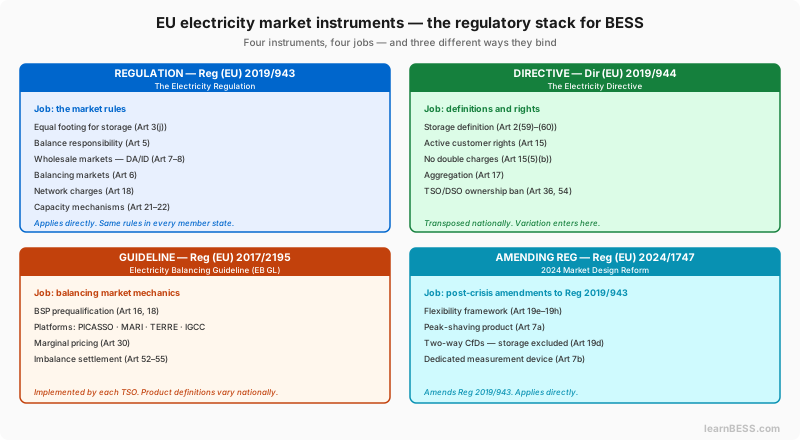
The four instruments that matter for storage
Regulation (EU) 2019/943 — the Electricity Regulation. This sets the rules of the market itself: how day-ahead, intraday, balancing, and capacity markets are organized, the principles all participants compete under, dispatching and redispatching, and network charge principles. A regulation applies directly and uniformly across all member states without national transposition. The article-by-article guide covers every storage-relevant provision.
Directive (EU) 2019/944 — the Electricity Directive. This defines the actors and their rights — including the legal definition of “energy storage,” the rights of active customers and aggregators, and the rules on whether network operators may own storage. A directive sets binding objectives but is written into national law by each member state, which is where variation enters. The article-by-article guide covers the storage-relevant articles.
Regulation (EU) 2017/2195 — the Electricity Balancing Guideline (EB GL). A network guideline that runs the balancing markets in detail: the European platforms, standard balancing products, balancing energy pricing, and imbalance settlement. It sits alongside the System Operation Guideline (Regulation (EU) 2017/1485, “SO GL”), which sets the technical reserve requirements. The article-by-article guide covers BSP prequalification, the European platforms, and imbalance settlement.
Regulation (EU) 2024/1747 — the 2024 market design reform. This amends both 2019/943 and the agency regulation 2019/942. It introduced the flexibility framework, a peak-shaving product, two-way Contracts for Difference, and measures to promote power purchase agreements. It did not replace the 2019 package — it edited it. The article-by-article guide covers the storage-relevant amendments.
Key concept: The distinction between a regulation, a directive, and a network guideline is not academic. The market rules in Regulation (EU) 2019/943 are identical in Germany, Spain, and Poland. But the storage definition and aggregator rules in Directive (EU) 2019/944 are transposed nationally, and the balancing markets run by the EB GL are implemented by each TSO through national terms and conditions. The frame is harmonized; the detail is national. That gap is where most of the practical friction lives.
Where the network code for connection fits
A fifth instrument — the Requirements for Generators network code (Regulation (EU) 2016/631, “RfG”) — governs the technical requirements a plant must meet to connect to the grid at all. Connection is the gate to participation, but it is a large enough topic to have its own guide. This guide assumes the plant is connected and focuses on market participation once it is.
Storage as a market participant — the definitions that unlock everything
This section is included with All-Access.
Get All-AccessBalance responsibility — no free pass for storage
This section is included with All-Access.
Get All-AccessRevenue stacking — and the constraint that bounds it
This section is included with All-Access.
Get All-AccessThe double-charging problem — why tariff treatment is decisive
This section is included with All-Access.
Get All-AccessWho is allowed to own storage — and why it matters to you
This section is included with All-Access.
Get All-AccessWhere EU law stops and national implementation begins
This section is included with All-Access.
Get All-Access