Regulation (EU) 2019/943 — What It Means for BESS
20 min read
What you'll learn
- Understand what the Electricity Regulation is, where it sits in EU electricity market law, and how it binds
- Know how the regulation's definitions and the "equal footing" principle give a BESS standing to compete
- Know how balance responsibility, the balancing and wholesale markets, and dispatch/redispatch apply to a battery
- Know the network-access rules — bidding zones, the 70% cross-zonal rule, network charges, and congestion income
- Understand the resource adequacy framework and how capacity mechanisms admit storage
Regulation (EU) 2019/943 is the instrument that sets the rules of the electricity market — how day-ahead, intraday, balancing, and capacity markets are organized, the principles every participant competes under, how the grid is accessed and congestion managed, and how resource adequacy is secured. This guide covers the articles of the regulation that matter to a battery energy storage system — the storage-relevant provisions, not a walk through the full text — with every rule, threshold, and principle anchored to the article that establishes it.
Module 4 of the course, How BESS Makes Money, covers BESS revenue streams at practitioner level. This guide is the regulatory layer beneath it — the specific text of Regulation (EU) 2019/943 that decides where a storage asset may compete and how it is paid. It is scoped to this regulation; where a rule depends on another EU instrument, that is noted at the point it arises.
The Electricity Regulation
Regulation (EU) 2019/943 of the European Parliament and of the Council of 5 June 2019 on the internal market for electricity is part of the 2019 “Clean Energy for All Europeans” package — the EU’s 2019 reform of the electricity market. It replaced the earlier Regulation (EC) No 714/2009, and it is paired with Directive (EU) 2019/944, which replaced the corresponding directive.
Regulation, not directive
A regulation and a directive bind in different ways. A regulation applies directly and uniformly across all 27 member states without national transposition — the market rules it sets are the same in Germany, Spain, and Poland. A directive, by contrast, sets binding objectives that each member state writes into its own national law, which is where national variation enters.
That said, the regulation delegates a great deal of operational detail to network codes and guidelines (such as the Electricity Balancing Guideline) and to national regulatory authorities and TSOs. The rules are harmonized at the level of principle and market design; the implementation is national.
Structure
The regulation is organized into chapters. The four that matter for a BESS come first:
- Chapter I — Subject matter, scope, and definitions (Articles 1–2)
- Chapter II — General rules for the electricity market (Articles 3–13)
- Chapter III — Network access and congestion management (Articles 14–19)
- Chapter IV — Resource adequacy (Articles 20–27)
The remaining chapters cover transmission and distribution system operation (ENTSO-E, the regional coordination centres, the EU DSO entity) and the regulation’s final provisions — largely the institutional machinery of running the system, and outside a market participant’s direct concern.
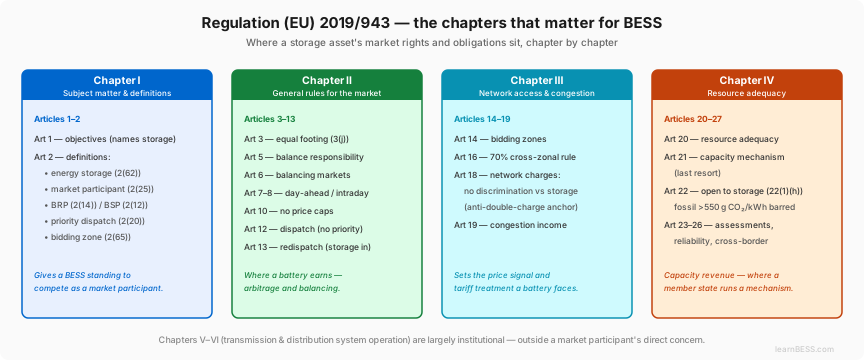 The four chapters that govern a storage asset’s market rights and obligations. Chapters I–IV carry everything a market participant needs; the remaining chapters are institutional.
Amended by the 2024 reform
The 2024 market design reform (Regulation (EU) 2024/1747) amended the regulation substantially — inserting new articles on flexibility, a peak-shaving product, and Contracts for Difference, and changing several existing thresholds. Where a figure in this guide was changed by the reform, that is noted at the point it arises.
Key concept: The 2024 reform amended this regulation rather than replacing it. Any specific threshold — a bid size, a gate-closure time — should be checked against the consolidated, currently-in-force text, because the reform moved several of them.
Chapter I — Subject matter, scope, and definitions
This section is included with All-Access.
Get All-AccessChapter II — Market principles and balance responsibility
This section is included with All-Access.
Get All-AccessChapter III — Network access and congestion management
This section is included with All-Access.
Get All-AccessChapter IV — Resource adequacy and capacity mechanisms
This section is included with All-Access.
Get All-AccessWhat the Electricity Regulation means for a BESS project
This section is included with All-Access.
Get All-Access