String vs Central PCS — Specialist Training Guide
35 min read
What you'll learn
- Know what string, central, and modular central PCS are
- Understand how SoC imbalance limits a central PCS
- Compare cost, availability, maintainability, and impact on controls
- Weigh the pros and cons of each topology to make better design decisions
A utility-scale BESS plant converts power between its battery strings and the grid in one of two ways: one converter per string (string PCS), or one large converter for multiple strings connected in parallel (central PCS). The choice shapes how the plant is controlled, laid out, built, and maintained, and it cannot be changed once the plant is built. This guide compares both topologies and the modular central variant across usable energy, availability, cost, controls, and balance of plant.
What is a Power Conversion System
The Power Conversion System (PCS) is the bidirectional interface between the battery’s DC side and the grid’s AC side. It converts DC to AC when the plant discharges and AC to DC when it charges. It controls the active and reactive power the plant exchanges with the grid.
Good to know: Module 2 — BESS Technology Stack covers PCS fundamentals alongside DC blocks, transformers, and the Power Plant Controller. This guide focuses on how the PCS topology shapes the plant.
Why topology matters
String PCS or central PCS is not a question of which converter to buy. It is a plant design decision. It cascades into electrical design, controls architecture, site layout, construction method, maintenance strategy, and long-term economics. Once the plant is built, the topology is locked in for 15–20 years of operation.
The difference comes down to where the battery strings are coupled:
- Central PCS — the battery strings are coupled on the DC side, on a shared DC bus, and converted together by one PCS.
- String PCS — each battery string is converted by its own PCS, and the strings are coupled on the AC side.
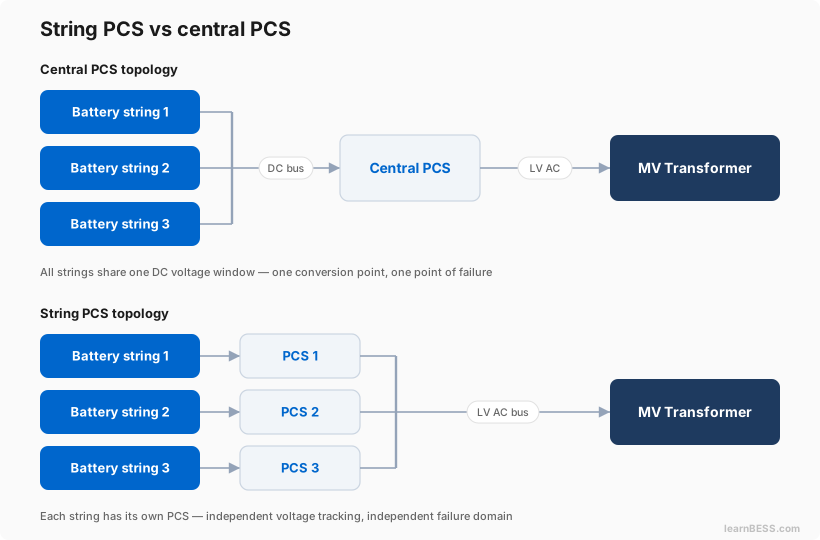
Central PCS: battery strings coupled on the DC side. String PCS: battery strings coupled on the AC side.
Equipment comparison — cost and conversion efficiency
This section is included with All-Access.
Get All-Access