What Is the EU Battery Regulation?
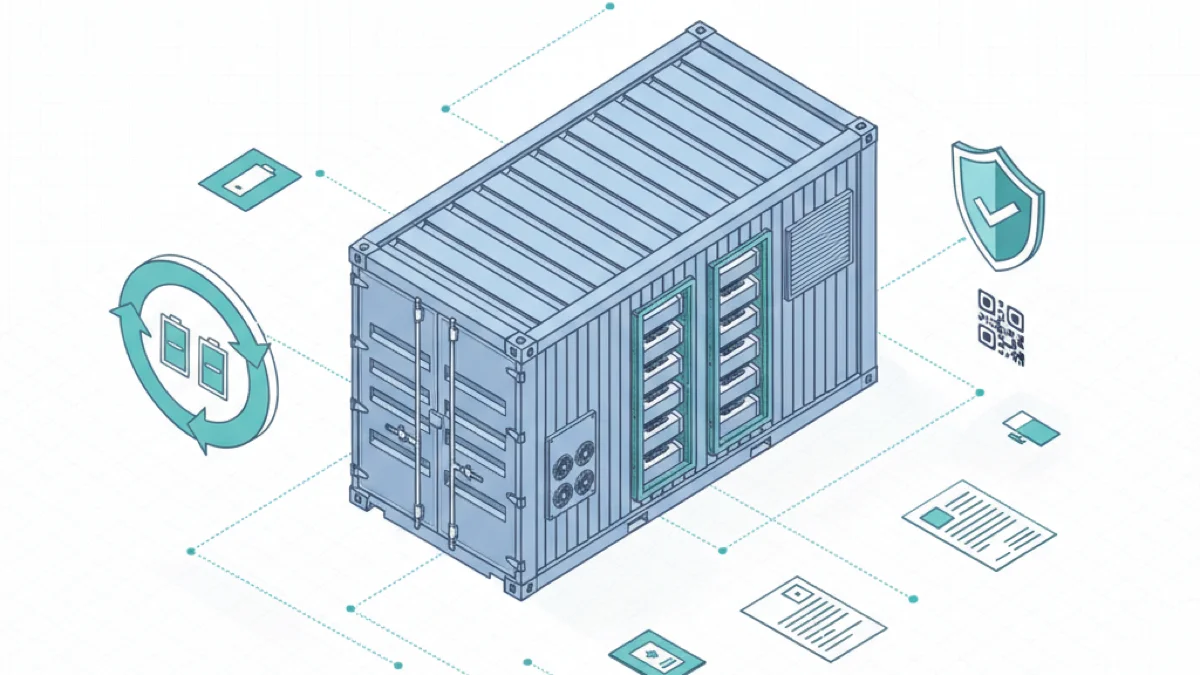
The EU Battery Regulation (Regulation (EU) 2023/1542) is the legal framework governing every battery placed on the European market. It replaced the old Battery Directive (2006/66/EC) in August 2023 and covers the entire lifecycle — from raw material sourcing and carbon footprint at the point of manufacture, through safety, labeling, and digital tracking during use, to collection, recycling, and material recovery at end of life.
Most discussions in the BESS industry treat it as a sustainability regulation. It is not. It is a product regulation — a comprehensive set of requirements that determines whether a battery can legally be sold in the EU. For utility-scale BESS, it already mandates safety testing, BMS data access, and performance reporting. Within the next two years, it will require digital battery passports, carbon footprint declarations, and supply chain due diligence.
Regulation, Not Directive
The old Battery Directive was a directive — each EU member state transposed it into national law, producing inconsistent implementation across the bloc. The EU Battery Regulation is a regulation — it applies directly and uniformly in all 27 member states without national transposition. The rules are the same whether the battery is placed on the market in Germany, Spain, or Poland.
Two exceptions to this uniformity: extended producer responsibility is administered at member-state level, and penalties are defined in national law. But the substantive requirements — what must be done — are harmonized.
What the Regulation Covers
The regulation lays down requirements in six areas:
- Sustainability and safety — substance restrictions, carbon footprint, recycled content, performance and durability, and stationary BESS safety
- Labeling, marking, and information — physical labels, QR codes, BMS data access
- Conformity assessment and CE marking — the procedures for demonstrating compliance before a battery can be sold
- Due diligence — supply chain obligations for cobalt, lithium, nickel, and natural graphite
- Extended producer responsibility — collection, recycling, and material recovery at end of life
- Digital battery passport — a per-unit electronic record for traceability and transparency
This scope is what makes it a product regulation, not an environmental one. It regulates the battery from the materials that go into it, through how it performs and how it is tracked, to how it is taken back and recycled.
Where BESS Fits
The regulation classifies batteries into five categories: portable, SLI (starting, lighting, ignition), LMT (light means of transport), EV, and industrial. Utility-scale BESS falls under the industrial battery category, with a specific subcategory: stationary battery energy storage system — an industrial battery with internal storage specifically designed to store and deliver electric energy to the grid or to end users.
Every utility-scale BESS is above the 2 kWh threshold that triggers the full obligation set: carbon footprint declaration, recycled content reporting, performance and durability requirements, and the digital battery passport. A single DC block typically holds 3 to 8+ MWh. There is no ambiguity about scope.
The regulation does not distinguish between utility-scale and residential battery storage. A 10 kWh home battery and a 400 MWh grid-scale plant face the same requirements. The distinction is commercial, not regulatory.
What Is Already in Force
Several obligations have applied since August 2024:
- Safety testing (Article 12) — every stationary BESS placed on the EU market must have technical documentation demonstrating compliance with Annex V safety parameters, tested using state-of-the-art methodologies.
- BMS data access (Article 14) — the BMS must store state-of-health data and provide read-only access to the asset owner and any third party acting on their behalf.
- Performance and durability reporting (Article 10) — batteries must be accompanied by documentation reporting rated capacity, capacity fade, power fade, internal resistance, round-trip efficiency, expected lifetime, and self-discharge rate.
- Substance restrictions (Article 6) — batteries must not contain restricted substances beyond permitted thresholds.
Since August 2025, all batteries must also bear the separate collection symbol.
What Is Coming
February 2027 — digital battery passport. Every industrial battery above 2 kWh must have a digital battery passport accessible through a QR code on the battery. The passport is a per-unit electronic record containing manufacturer data, chemistry, carbon footprint, and recycled content. Once the battery is in operation, state-of-health data must be updated at least daily. Three access tiers control who sees what: public, authorities, and parties with a legitimate interest.
August 2027 — due diligence. Economic operators above €40 million in annual turnover must implement supply chain due diligence for cobalt, lithium, nickel, and natural graphite. This requires a management system, risk assessments covering environmental and human rights impacts, supply chain traceability, third-party verification, and public reporting every three years.
Carbon footprint declaration — waiting on delegated act. Manufacturers must declare the carbon footprint of each battery model per manufacturing plant, calculated using company-specific data for the battery-specific components (anode, cathode, electrolyte, separator, cell casing) combined with PEF-compliant secondary datasets for the rest of the supply chain. The nominal date was February 2026, but the European Commission has not yet published the calculation methodology. The regulation’s “whichever is the latest” clause pushes the deadline to 18 months after the delegated act enters into force.
Recycled content — waiting on delegated act. Disclosure of recycled cobalt, lithium, and nickel content is scheduled for August 2028. Mandatory minimum shares follow in two waves: by 2031, batteries must contain at least 16% recycled cobalt, 6% lithium, and 6% nickel in active materials. By 2036, the thresholds rise to 26% cobalt, 12% lithium, and 15% nickel.
Performance minimums — waiting on delegated act. Currently, manufacturers must report performance parameters. Once the delegated act is published, minimum values become mandatory — batteries that fall below the floor cannot be sold in the EU.
The Delegated Act Problem
Many of the regulation’s deadlines are nominal. The actual compliance date depends on when the European Commission publishes the delegated act specifying the detailed methodology. For carbon footprint, recycled content, and performance minimums, the delegated acts are still pending as of mid-2026.
The practical effect: manufacturers cannot fully prepare for a requirement whose methodology has not been published. Tracking which delegated acts have been published, which are in draft, and which are missing is itself a core compliance task. The regulation’s “whichever is the latest” mechanism is the single biggest source of uncertainty in compliance planning.
Who Bears the Obligations
The regulation distinguishes between economic operators and producers — and the distinction matters for BESS supply chains.
Economic operators (manufacturers, importers, distributors) bear the CE marking, conformity assessment, and documentation obligations. The manufacturer carries the primary burden. The importer must verify that the manufacturer has done its part. Both must retain technical documentation for 10 years.
The producer is a separate concept: whoever first makes the battery available on the market in a given EU member state. The producer bears extended producer responsibility — registration, funding waste collection and recycling, and reporting to competent authorities. For utility-scale BESS, identifying the producer is one of the most contested contractual questions. If the DC block manufacturer has no registered entity in the member state, the entity that imports the systems and first makes them available — often the EPC contractor or the developer’s procurement arm — becomes the producer.
This determination affects the EPC price, the contract structure, and the project’s end-of-life cost model. It must be defined in the supply contract, not left to assumption. The regulation also intersects with NIS2 cybersecurity obligations — another compliance layer for BESS plants operating as essential energy infrastructure in the EU.