What Is Deflagration in BESS?
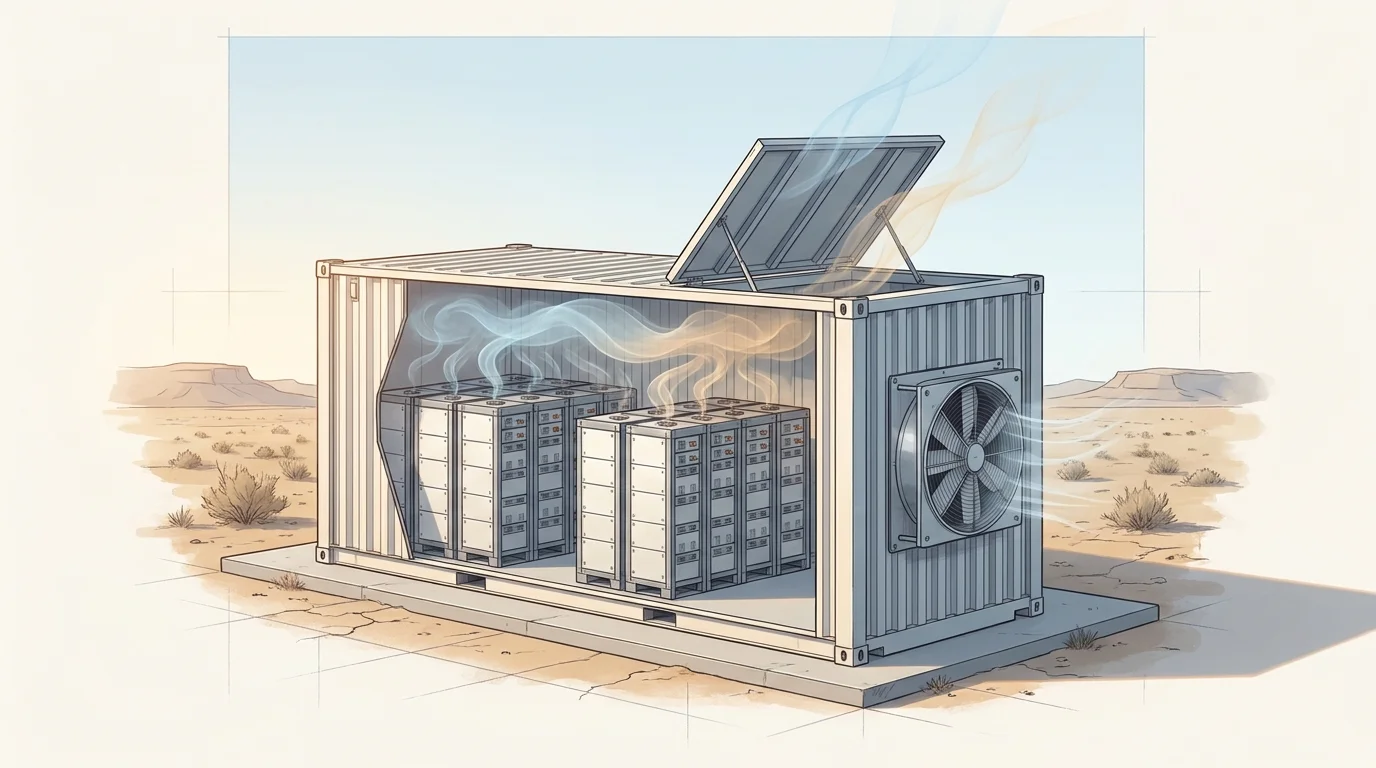
A deflagration is a flame front moving through a flammable gas mixture at subsonic speed, driven by heat transfer from the burning gas to the unburned gas ahead of it. It is the event that BESS explosion protection is designed around.
Developers, fire safety professionals, and permitting authorities often treat “deflagration” and “explosion” as interchangeable. They are not. The distinction determines which protection strategies work and which do not.
Deflagration vs Detonation
The reason deflagration venting works is that a deflagration is slow enough for a mechanical panel to respond. A detonation is not. It is a supersonic shock wave — kilometers per second — that compresses and ignites the gas mixture ahead of it simultaneously. No mechanical panel can open fast enough to relieve it.
| Deflagration | Detonation | |
|---|---|---|
| Speed | Subsonic (m/s to tens of m/s) | Supersonic (km/s) |
| Mechanism | Heat transfer to unburned gas | Shock wave compresses and ignites |
| Pressure rise | Gradual — vent panel can respond | Instantaneous — shock arrives first |
In a DC block enclosure, the flammable gases released during thermal runaway produce a deflagration, not a detonation. This is the physical basis for deflagration venting as a protection strategy.
How Deflagration Happens in a DC Block
A DC block does not explode because the cells detonate. It explodes because flammable gas accumulates inside the enclosure, finds oxygen and an ignition source, and deflagrates.
A lithium-ion cell in thermal runaway vents a mixture of hydrogen, carbon monoxide, methane, and electrolyte vapor. These gases do not burn inside the cell. They accumulate inside the DC block enclosure and become dangerous when three conditions hold at once: the gas concentration is between the Lower Flammable Limit (LFL) and the Upper Flammable Limit, enough oxygen is present, and an ignition source provides the energy to start the reaction.
The gas is the hazard. Everything in BESS explosion protection — passive and active — is designed to manage that gas.
Passive Explosion Protection — Deflagration Venting
A deflagration vent is a deliberately weak panel or bursting disc installed in the wall or roof of the enclosure. It opens at a low burst pressure. No power, no control logic, no moving parts.
The sequence is straightforward: gas accumulates, an ignition source triggers combustion, the flame front propagates, and the burning gas expands, raising the pressure inside the enclosure. When the pressure exceeds the panel’s burst threshold, the panel opens and gives the pressure a controlled exit path — out through the panel instead of through the enclosure walls, door, or cable entries. The deflagration is controlled, not prevented.
The panel responds to the pressure after ignition, not to the gas before it. In standards terms, deflagration venting is governed by NFPA 68.
The advantage is simplicity. The panel works whether the enclosure is energized or not — during commissioning, during a grid outage, with no auxiliary power. The limitation is that it only acts after ignition. It does nothing to prevent the event, and anyone near the panel when it opens is in the blast path. If the event is larger than the vent was sized for, the pressure can still exceed what the panel can relieve.
Active Explosion Protection — Prevention
Active explosion protection prevents ignition entirely. Gas detectors inside the enclosure — calibrated to trigger well below the flammable range — activate forced ventilation fans that exhaust the gas before it reaches a dangerous concentration. In standards terms, this is explosion prevention under NFPA 69.
The limitation is that it depends on auxiliary power. The detectors, the control logic, and the fans all need electricity. If the enclosure loses auxiliary power — because the grid is down, because the auxiliary supply has failed, or because the enclosure is not yet commissioned — the active system does not operate. A thermal runaway event during that window has no gas management.
Why Both Are Layered
In practice, passive and active systems are not alternatives — they are layered.
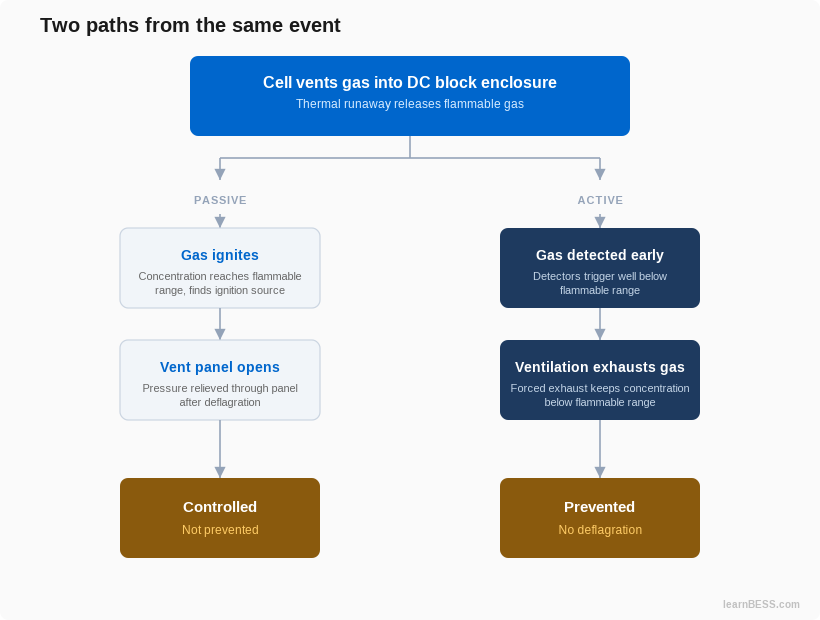
Two paths from the same event. The passive path controls the deflagration after ignition. The active path prevents it entirely — but only while auxiliary power is available.
| Passive | Active | Active + passive | |
|---|---|---|---|
| Prevents deflagration | No — controls it | Yes | Yes |
| Requires auxiliary power | No | Yes | Yes |
| If auxiliary power is lost | Deflagration controlled | No deflagration control | Deflagration controlled |
Active explosion protection is the primary system. Passive deflagration venting is the additional safety layer — it ensures the enclosure still has protection if auxiliary power is lost.
When evaluating explosion protection on a DC block, the question is not whether a deflagration panel is present. It is whether the design prevents the deflagration from happening in the first place — and what protects the enclosure when it cannot.