What Is Black Start in BESS?
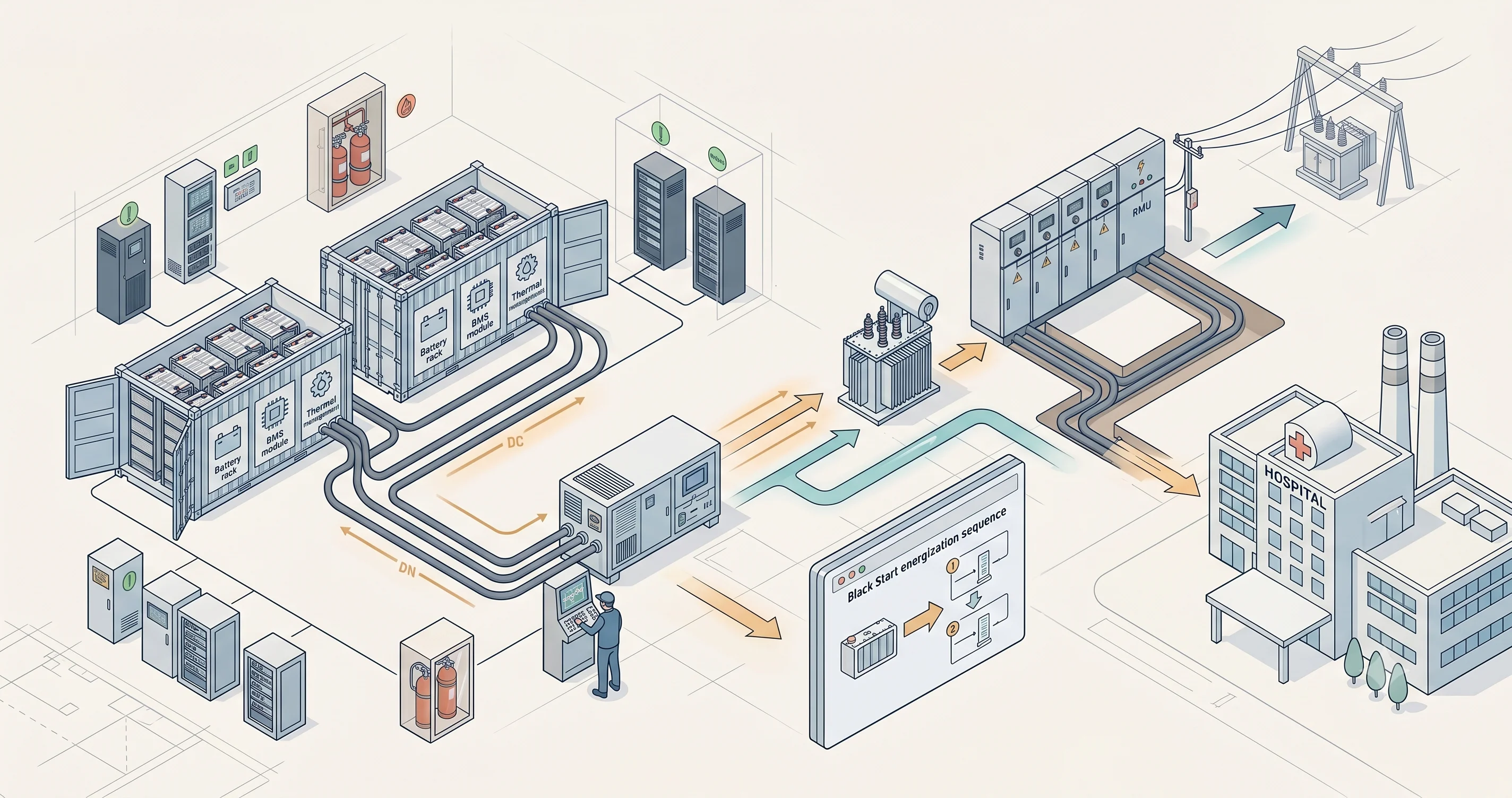
Black start is the ability to bring a BESS plant online from a de-energized state without relying on the external grid. Under normal conditions, a BESS plant energizes from the grid toward the batteries. The grid supplies voltage and frequency, and the plant’s equipment powers up sequentially from the Point of Interconnection (POI) through the medium-voltage network, transformers, and PCS down to the DC blocks. Black start reverses that direction. The plant energizes from the batteries toward the grid.
This reversal is not just a change in sequence. It requires grid-forming control on the PCS, an auxiliary power strategy for the plant’s internal systems, and infrastructure designed to support energization without an external voltage reference. A PCS with black-start capability on its datasheet does not mean the plant can perform a black start.
When Black Start Is Needed
Black start is relevant wherever a BESS plant needs to operate without the external grid. The use cases vary, but they share one requirement: the plant must be able to bring itself online independently.
Backup power for critical loads. A BESS plant co-located with a hospital, a military installation, a logistics center, or an industrial facility may need to supply power during a grid outage. If the grid goes down, the plant needs to energize itself and provide power to those loads without waiting for grid restoration.
Auxiliary power for other generation. In some configurations, a BESS plant provides startup power to thermal generation. Auxiliary power transformers supply the power needed for a gas turbine or combined-cycle plant to begin its own startup sequence. The BESS plant needs to black start itself first before it can support anything else.
Weak grids and remote sites. A plant connected to a weak grid may not be able to energize reliably from the grid side. If the grid voltage is insufficient or unstable at the point of connection, the plant may need to self-energize and then synchronize to the grid once its internal systems are stable.
Grid restoration. A transmission system operator (TSO) may require a BESS plant to self-energize after a widespread outage and help restore parts of the grid on the upstream side of the plant. In this case, the plant is not just powering its own loads. It is forming a section of the grid.
Black Start Requires Grid Forming
A black-start-capable BESS plant must have grid-forming (GFM) control on its PCS. Without an external grid to provide a voltage reference, grid-following control cannot operate. There is no waveform to lock onto, no frequency to track. Grid forming is what allows the PCS to generate its own voltage and frequency from the DC bus and begin the energization sequence.
The reverse is not true. A grid-forming PCS does not necessarily support black start. Grid-forming control is one requirement. Black start also requires auxiliary power infrastructure, startup logic, and a plant designed to energize in the right sequence. Many grid-forming PCS platforms are designed for grid-connected operation and do not include the control modes or hardware interfaces needed for a cold start from zero.
What the Plant Needs
The PCS cannot begin generating AC power until the plant’s internal systems are operational. Before the black-start sequence begins, several systems need to be powered up independently of the grid and independently of the PCS itself.
Battery management system (BMS). The BMS must be active before the DC bus can be energized. It monitors cell voltages, temperatures, and state of charge, and it controls the contactors that connect the battery strings to the DC bus.
Control systems and SCADA. The plant controller, SCADA, and communication systems need to be operational before any switching or energization can begin. Without them, breakers cannot be commanded, equipment status cannot be monitored, and the energization sequence cannot be coordinated.
HVAC and cooling. The PCS and DC blocks generate heat during operation. Cooling systems need to be running before or shortly after energization begins, depending on the plant design and ambient conditions.
Breaker control and auxiliary power. Circuit breakers throughout the plant need auxiliary power to operate. Their control circuits, motor drives, and position indicators require a supply before they can be opened or closed as part of the energization sequence.
How these systems get their initial power is a design decision. UPS systems are commonly installed for different parts of the plant — the DC blocks, the PCS controls, and the power plant controller and SCADA. These provide the initial power needed to bring the plant’s control and monitoring systems online before the black-start sequence begins. Some plants also use a diesel generator on site to supply auxiliary power before the PCS starts. Once the PCS is operational and generating AC power, it can feed the plant’s auxiliary power system directly, replacing the UPS or diesel supply. The auxiliary power strategy needs to be designed into the plant from the start. It is not something that can be added as an afterthought.
The Energization Sequence
Under normal grid-connected operation, a BESS plant energizes from the grid inward. The grid provides voltage at the POI, and the plant’s equipment powers up from the high-voltage side through the medium-voltage network to the DC blocks. The PCS operates in grid-following mode, synchronizing to the grid’s voltage and frequency.
During a black start, the direction reverses. Energization starts from the battery side and moves outward toward the load or the grid.
Once the auxiliary systems are operational and the BMS has confirmed that the battery strings are ready, the DC bus is energized. The PCS then begins generating an AC voltage waveform in grid-forming mode. From there, the energization progresses through the low-voltage AC cabling, the medium-voltage transformer, the medium-voltage ring main unit (RMU), and the medium-voltage cables connecting the rest of the plant.
Each stage of the energization needs to be stabilized before the next begins. Energizing a transformer from the inverter side presents different electrical characteristics than energizing it from the grid side. Inrush currents, voltage transients, and protection settings all need to be accounted for in the plant design.
Once the internal plant network is stable, additional equipment and loads can be energized. If the purpose is backup power, the critical load is connected to the plant’s islanded grid. If the purpose is grid restoration, the plant extends its energized network toward the point of connection with the external grid.
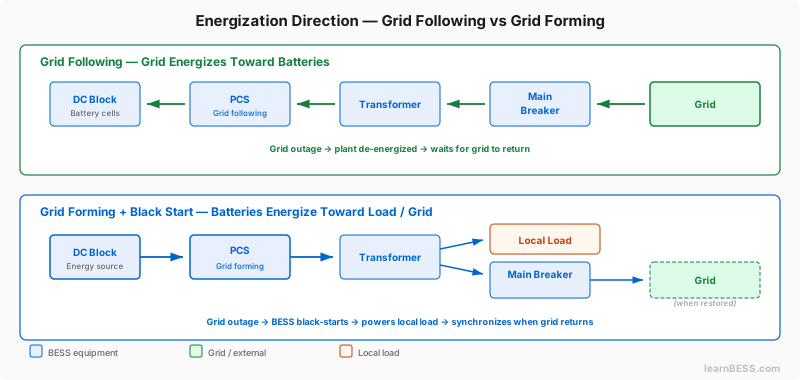 In grid-following mode, the grid energizes the plant toward the batteries. In grid-forming mode with black start, the plant energizes from the batteries toward the grid.
Returning to the Grid
If the external grid is restored while the BESS plant is operating in islanded mode, the plant needs to transition back to grid-connected operation. How this is done depends on the grid operator’s requirements and the plant’s grid connection agreement.
In some cases, the grid operator requires the plant to de-energize completely and then re-energize from the grid side in grid-following mode. In other cases, the plant can synchronize its grid-forming output to the restored grid and transition without a full shutdown. This requires matching voltage, frequency, and phase angle at the point of connection before closing the interconnection breaker.
Where the grid connection agreement specifies grid-following operation, the PCS may need to switch from grid-forming to grid-following mode after synchronization. This transition needs to be seamless. A poorly executed resynchronization procedure can introduce voltage or frequency transients that cause protection relays to trip the plant off the grid.
The requirements for resynchronization vary by grid operator and by market. The plant’s control system, protection settings, and PCS capabilities all need to support whichever method the grid operator specifies.