Grid Forming vs Grid Following — What It Means for BESS
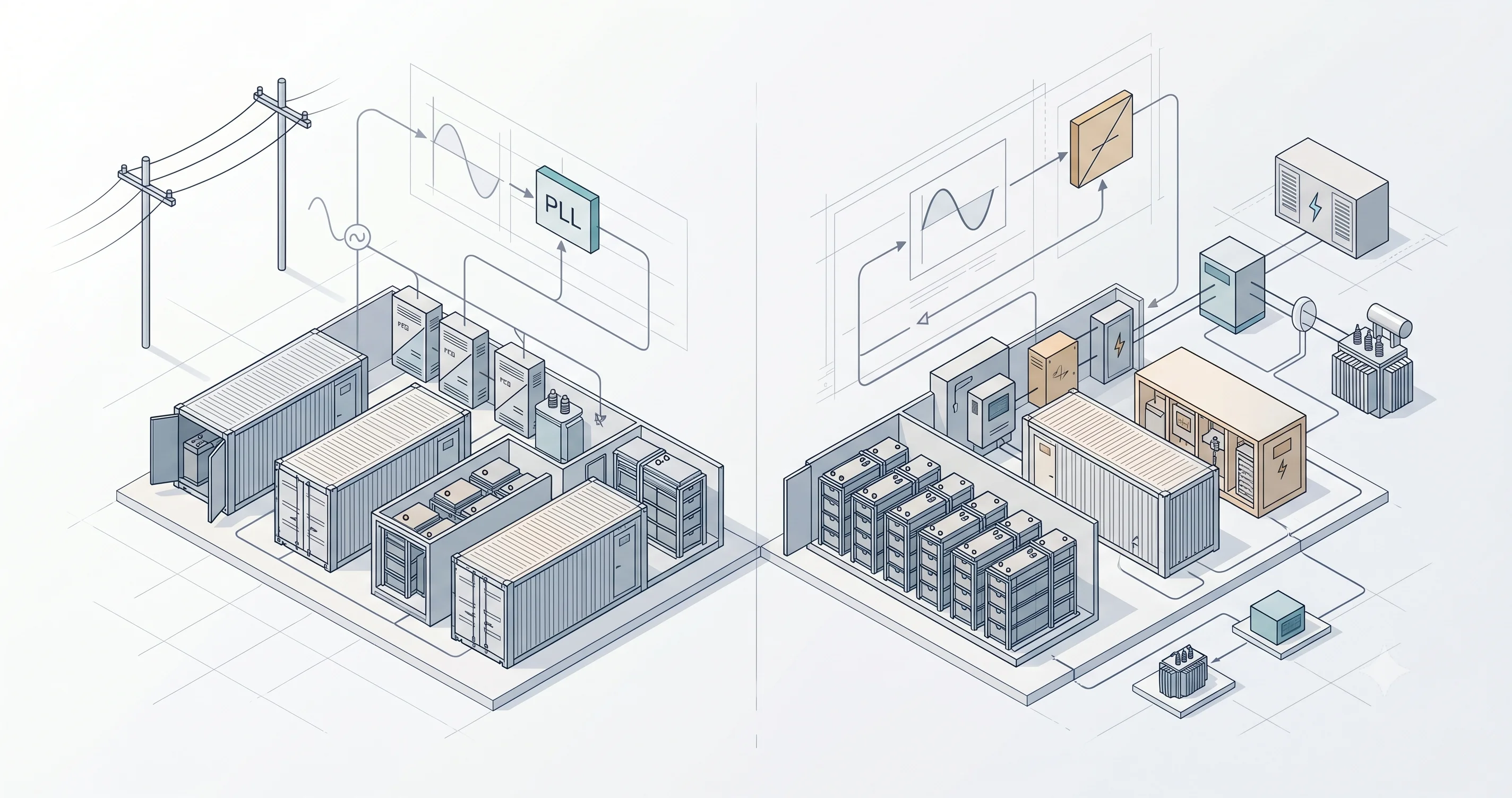
Grid forming and grid following are two control philosophies for inverter-based resources (IBR). In BESS, the distinction applies to the power conversion system (PCS) and determines how the plant interacts with the electrical grid.
The terms appear in nearly every equipment specification and grid code discussion in the industry, and different stakeholders use them in different ways. Developers, investors, and equipment manufacturers often treat grid forming as a PCS feature — a line item on a datasheet. The actual distinction runs deeper. Grid forming and grid following describe different ways the PCS relates to the grid, and the choice between them affects plant design, grid code compliance, and operational behavior well beyond the PCS itself.
Grid-Following Inverter
A grid-following (GFL) inverter operates as a controlled current source. It measures the grid’s voltage waveform using a phase-locked loop (PLL), synchronizes to that waveform, and injects current accordingly. The grid provides the voltage and frequency reference. The inverter follows it.
Grid-following control has been the standard for BESS and other IBR because it works well when the grid has a strong, stable voltage reference. That reference has traditionally come from synchronous generators — large rotating machines in thermal and hydroelectric power plants whose physical mass and electromagnetic properties establish and maintain the grid’s voltage and frequency. As long as enough synchronous generation is online, the reference is reliable and grid-following inverters operate without issue.
The majority of BESS plants operating today use grid-following PCS.
Grid-Forming Inverter
A grid-forming (GFM) inverter operates as a controlled voltage source behind an impedance. Instead of measuring and following an external reference, it generates its own voltage waveform and controls frequency through internal algorithms. It self-synchronizes. No PLL required.
The practical consequence: a grid-forming inverter does not need an existing grid to operate. It can establish voltage and frequency independently, which is what enables operation in islanded conditions and participation in grid restoration after a blackout.
Grid-forming control is not a hardware change. The same PCS platform can typically support both grid-following and grid-forming modes. The difference is configured in software, not built into different hardware. A PCS that ships with grid-forming capability and one that ships without it may use identical power electronic components.
| Property | Grid Following (GFL) | Grid Forming (GFM) |
|---|---|---|
| Electrical behavior | Controlled current source | Controlled voltage source behind impedance |
| Synchronization | PLL tracks external voltage | Self-synchronizing — no PLL dependency |
| Inertial response | Measurement-based — detects deviation, then responds | Inherent — resists frequency change immediately |
| Weak grid operation | Performance degrades as grid weakens | Stable — provides the voltage reference |
| Island operation | Cannot operate without external voltage source | Can form and sustain an island |
| Black start | Not capable | Capable (with additional hardware support) |
The Capabilities Synchronous Machines Leave Behind
Synchronous generators have historically given the grid a set of properties as a byproduct of their physical design — not because they were programmed to, but because spinning mass connected to the grid through an electromagnetic coupling behaves that way. As synchronous generation is retired and replaced by IBR, those properties need to be actively provided through inverter control. Grid-forming control is what provides them.
Voltage source behavior. A grid-forming inverter acts as a voltage anchor. In weak grid conditions — areas with few synchronous machines online, or long radial connections — a grid-following inverter may struggle to find a stable voltage reference. A grid-forming inverter does not have this problem because it establishes its own reference.
Inertial response. When system frequency changes, a grid-forming inverter resists that change immediately. The resistance is embedded in the control structure itself — a physics-based behavior, not a calculated response. This is distinct from balancing services such as fast frequency response (FFR) or frequency containment reserve (FCR), which are measurement-based: the BESS detects a deviation and dispatches power to correct it. Grid-forming inertial response and contracted balancing services are complementary, not interchangeable.
Positive damping. Grid-forming inverters can autonomously damp power oscillations in the system, reducing the risk of instability without requiring external signals or coordination.
Fault current contribution. Grid-forming inverters contribute higher transient fault current than grid-following inverters. This matters because protection systems across the grid were designed around the fault current levels of synchronous machines. As synchronous generation is replaced, declining fault current can cause protection systems to underperform.
Black-start enablement. Because a grid-forming inverter can establish voltage and frequency from zero, it is a prerequisite for black-start capability — the ability to energize a plant and begin restoring power without an external grid supply. A PCS with black-start functionality requires grid-forming control by definition. The reverse is not true: a grid-forming PCS does not necessarily support black start, which requires additional hardware and control capabilities beyond the grid-forming mode itself.
When Grid Forming Is Needed
Some applications require grid-forming control regardless of what any grid code says. An islanded microgrid — a remote mine site, a military installation, a facility designed to operate independently — has no external voltage reference for a grid-following inverter to lock onto. Grid forming is not optional. It is the only mode that works. The same applies to any scenario where the BESS plant must operate independently of the grid, whether that is a facility with islanding capability or a black-start use case where the plant needs to energize from zero.
In these cases, the need for grid forming is driven by the physics of the application, not by a regulatory requirement. The grid operator may or may not require it. The application does.
Beyond specific use cases, the broader trend across transmission system operators (TSOs) and distribution system operators (DSOs) is toward requiring grid-forming capability for new IBR. As synchronous generation is retired and the share of inverter-based resources on the grid increases, the properties that synchronous machines provided — inertia, voltage source behavior, fault current — need to come from somewhere. Several TSOs have already mandated grid-forming capability for new connections, and others are moving in the same direction. The pace varies by market, but the direction is consistent.
The Gap Between Equipment Specification and Plant-Level Operation
Grid-forming capability appears frequently in BESS equipment specifications and purchase agreements. In some cases, the specification reflects a concrete project requirement — a grid code mandate, a black-start contract, or an islanding scenario for a co-located load. In many cases, it is included because the buyer anticipates that grid-forming requirements will apply in the future.
Whether existing grid connections would retroactively be required to support grid-forming operation is an open question. If a plant has been commissioned and the grid connection approved under the prevailing grid code, there is typically no established mechanism for the DSO or TSO to mandate a change in control mode — particularly where that change would require modifications to the plant.
A PCS that supports grid-forming operation does not automatically make the BESS plant grid-forming capable. Grid forming at the plant level requires infrastructure beyond the PCS — an auxiliary power supply capable of energizing plant systems without grid supply, additional metering at the Point of Interconnection (POI) for resynchronization, and communication systems that operate independently of the grid.
Retrofitting plant-level grid-forming functionality after commissioning — adding auxiliary power systems, installing instrumentation, revising the protection and control architecture — is a significant scope of work. It is not a software update.
Where there is no current grid code requirement, no contracted use case, and no DSO or TSO authorization to operate in grid-forming mode, the specified capability remains uncommissioned. The PCS may support it. The plant may not be designed for it. The grid may not allow it.