Ready to Build (RTB) in BESS — What's Actually in Place?
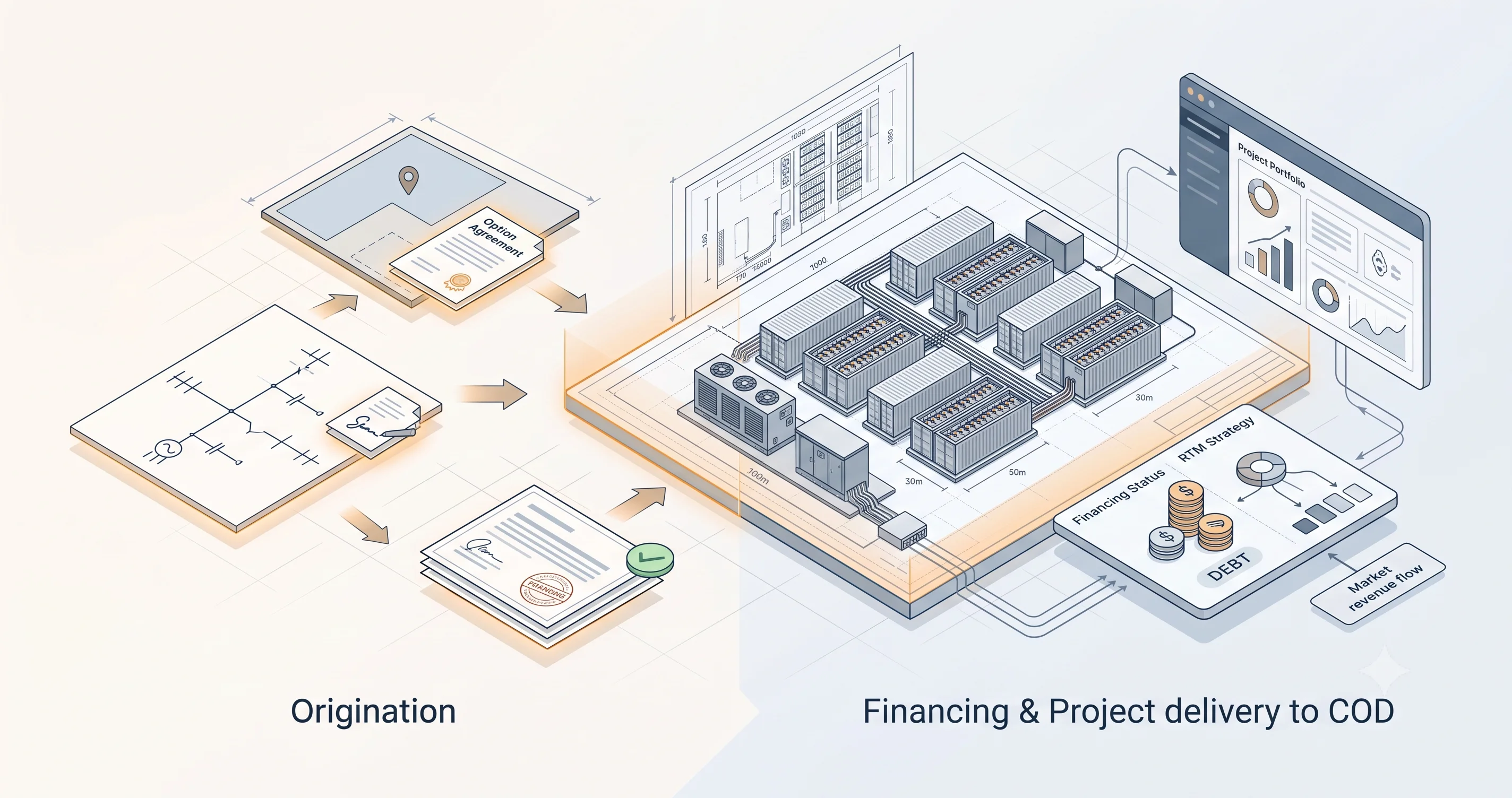
Ready to Build (RTB) is the milestone at which a BESS project has completed origination and is ready to be financed and constructed. It marks the transition from developer risk capital — spent on land, grid connection, permitting, and design — to funded project capital backed by equity and debt.
Until a project reaches RTB, everything the developer has spent is at risk. After it, the project becomes financeable — external capital is willing to take on the delivery risk. But RTB is not a binary gate. What separates a project that moves smoothly to financial close from one that stalls is the quality and completeness of what sits behind the label.
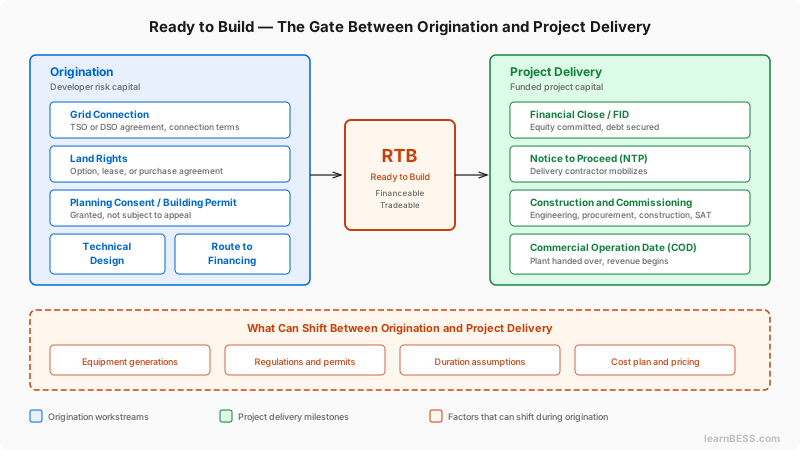 RTB marks the transition from developer risk capital to funded project delivery.
What a Ready to Build Package Consists Of
A project at the Ready to Build stage has completed the core origination workstreams:
- Grid connection — an offer or signed agreement with the TSO or DSO, defining connection voltage, export and import power, and technical compliance requirements.
- Land rights — an option, lease, or purchase agreement securing the site.
- Planning consent or building permit — granted and not subject to outstanding appeal.
- Technical design — a defined site layout, equipment specification, and preliminary cost plan.
- Route to financing — committed or identified equity and debt, an identified revenue structure (toll, floor, or merchant), and a Route-to-Market provider.
These five components are the minimum. What varies — significantly — is how complete each one actually is.
Why RTB Means Different Things
RTB is one of the most loosely used terms in BESS development. Some developers declare RTB with a building permit alone. Others require planning consent, grid connection, land, and a defined commercial structure all firmly in place. There is no industry-standard definition, and no independent body certifies whether a project has reached it.
This creates an information gap. A project described as “RTB” by one developer may be months away from financial close. The same label from another developer may mean every requirement is resolved and the project can proceed immediately.
The gap matters most when projects change hands. RTB-stage projects are regularly acquired by investors or developers who take them through the project delivery phase towards Commercial Operation Date (COD). Due diligence often reveals work that still needs to be done — permits with unsatisfied conditions, fire safety assessments that need updating, grid connection terms not yet finalized, or site layouts that no longer reflect current equipment.
Institutional investors entering the BESS market have encountered this repeatedly. Projects marketed as RTB turned out to have unresolved planning conditions, fire safety issues, or drainage problems. The label was applied, but the substance behind it was incomplete.
Clean RTB vs Loose RTB
The industry often informally distinguishes between clean RTB and loose RTB.
A clean RTB project has no material items left to resolve. Grid connection is signed and securities are paid. Planning consent is granted with all conditions discharged. Land is secured. The technical design reflects current equipment and regulations. The project can move to financial close without surprises.
A loose RTB carries unresolved items that surface during due diligence — planning conditions not yet satisfied, an appeal window still open, grid securities unpaid, no defined revenue structure, or a cost plan that has not been updated. Any of these can delay financial close or reduce the project’s value.
The difference is reflected directly in price and risk. A clean RTB commands a premium. A loose RTB trades at a discount — or fails to trade at all.
Why the Assumptions Change
RTB is a snapshot. It reflects conditions when origination was completed. Between origination and the project delivery phase, the prerequisites can shift dynamically. Origination timelines in BESS routinely run one to four years — long enough for the assumptions behind an RTB to change materially.
BESS equipment generations change. A site layout designed around a specific DC or AC block may no longer reflect the latest equipment available on the market. Newer generations may offer higher energy density or different dimensions. The original layout may undersize the opportunity or may not be compatible with the equipment available at the time of procurement.
Regulations evolve. Building permit requirements, fire safety separation distances, and road clearances change. BESS permitting rules in several markets have moved through multiple regimes in recent years. Permits may need to be revised. Site layouts may need to be reworked.
Duration assumptions shift. Projects originally designed for one-hour duration may now be better suited to two. Two-hour projects may have the potential for four. A change in target duration affects equipment selection, site layout, revenue modeling, and the entire business case.
The cost plan ages. Equipment pricing, construction costs, and interest rates change. The financial model must be re-run against current inputs — and the returns may look different from what was originally projected.
An RTB developed during a two-year period may not have the same prerequisites at the time of finalization due to lengthy grid connection agreement discussions and building permit processes. The milestone does not expire, but the assumptions behind it may have evolved.
When RTB Changes Hands
Some developers specialize in origination — they secure land, grid connection, and planning consent, then sell the RTB-stage project to a buyer who takes it through financing and project delivery. Development spend to reach RTB runs from several hundred thousand to several million euros per project. This is all pre-revenue capital at risk, and only a fraction of projects that enter development reach financial close. Projects drop out because of planning refusals, grid connection delays, unviable economics, or failure to secure financing.
Developers who manage this treat it as a portfolio problem. They run multiple sites in parallel, knowing that most will not reach RTB. The ones that do must be clean enough to attract financing and survive due diligence — because the capital spent on the projects that failed is recovered only through the projects that succeed.
The due diligence process is where RTB quality gets tested. A buyer evaluates each component against their own objectives — strategy, equipment preferences, duration targets, risk appetite. An RTB package that fits one buyer may not fit another. RTB is not a fixed milestone that a project either passes or fails. It is a package that must be evaluated against the objectives of the party taking the project forward, and re-evaluated against current conditions every time it changes hands.