BESS Project Lifecycle — Development, Construction & Commercial Operation
~70 min learning time
What you'll learn
- How a utility-scale BESS project is structured across its phases and what happens in each
- What origination involves and what Ready to Build (RTB) status actually means
- How financial close, Notice to Proceed, and delivery models shape project execution
- What happens during engineering, procurement, manufacturing, construction and installation, commissioning, and site acceptance test
- How commercial operation starts — handover, Defects Liability Period, O&M, and Route-to-Market mobilisation
- How the plant is operated over a 15 to 25 year life — service agreements, augmentation, refinancing
A BESS project is a multi-year delivery programme involving dozens of contracts, hundreds of millions of euros, and a defined sequence of technical and commercial milestones. This module covers each phase of the lifecycle — from the first site assessment to the ongoing operation of a commissioned plant.
The phases of a BESS project
A utility-scale BESS project moves through two stages — development and operations.
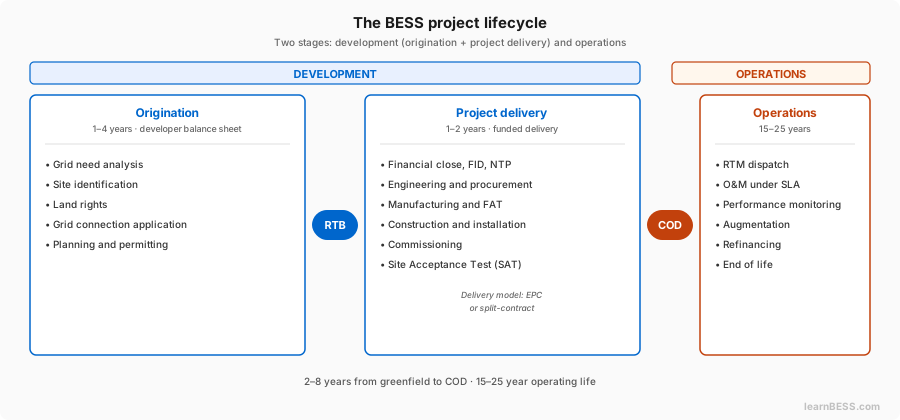
Development covers everything from the first site assessment to Commercial Operation Date (COD). It has two phases:
- Origination — turning a greenfield opportunity into a project that meets Ready to Build (RTB) status. At the developer’s risk, funded from the developer’s own balance sheet.
- Project delivery — financing, procuring, building, commissioning, and accepting the plant. Funded through equity and debt drawn down against the delivery programme, beginning at financial close. The delivery model (EPC or split-contract) determines how this phase is contracted.
Operations is the active management of the plant from COD through to end of life — usually 15 to 25 years.
The named gates
Within these stages, four named milestones mark the project’s progress. Each is a specific contractual and financial event referred to constantly in BESS industry conversation:
- Ready to Build (RTB) — end of origination. The project has land rights, grid connection, planning consent, and a credible route to financing.
- Final Investment Decision (FID) — the asset owner commits capital. Equity and debt are secured; financial close is reached.
- Notice to Proceed (NTP) — the formal instruction issued to the delivery contractor to start work, usually a few weeks after financial close.
- Commercial Operation Date (COD) — the plant is handed over from the delivery team to the operations team and begins commercial dispatch.
These gates structure the entire lifecycle. Knowing where a project sits relative to them is how the industry tracks project maturity for financing, acquisition, and delivery planning.
How phases overlap
Phases overlap. Procurement and construction progress in parallel — equipment manufacturing happens while civil works are underway. Commissioning begins on parts of the plant while other parts are still being installed. The phases are a framework, not a strict timeline.
Typical durations from greenfield to COD range from 2 to 8 years. Origination alone can take 1 to 4 years and varies significantly by jurisdiction. Construction and commissioning together run 12 to 24 months.
Attrition is highest in the early phases. Industry experience across major markets indicates that fewer than one in seven projects that enter development reach financial close, and not all of those complete construction. Projects drop out because of planning refusals, grid connection delays, unviable economics, or failure to secure financing.
Money flows into the project in stages:
- Development capital — funded by the developer from their own balance sheet, at risk until financial close
- Equity contribution — committed at or around financial close, drawn down against the construction programme
- Debt drawdown — released against construction milestones verified by the lender’s independent engineer
- Revenue — starts flowing at COD
Key concept: Each phase is a gate. A project that cannot meet the requirements of the next phase stops progressing. Money, equipment, and stakeholders are only committed once the previous gate has been passed.
Manufacturing and Factory Acceptance Test (FAT)
This section is included with All-Access.
Get All-Access