C&I vs Utility-Scale Battery Storage: Key Differences
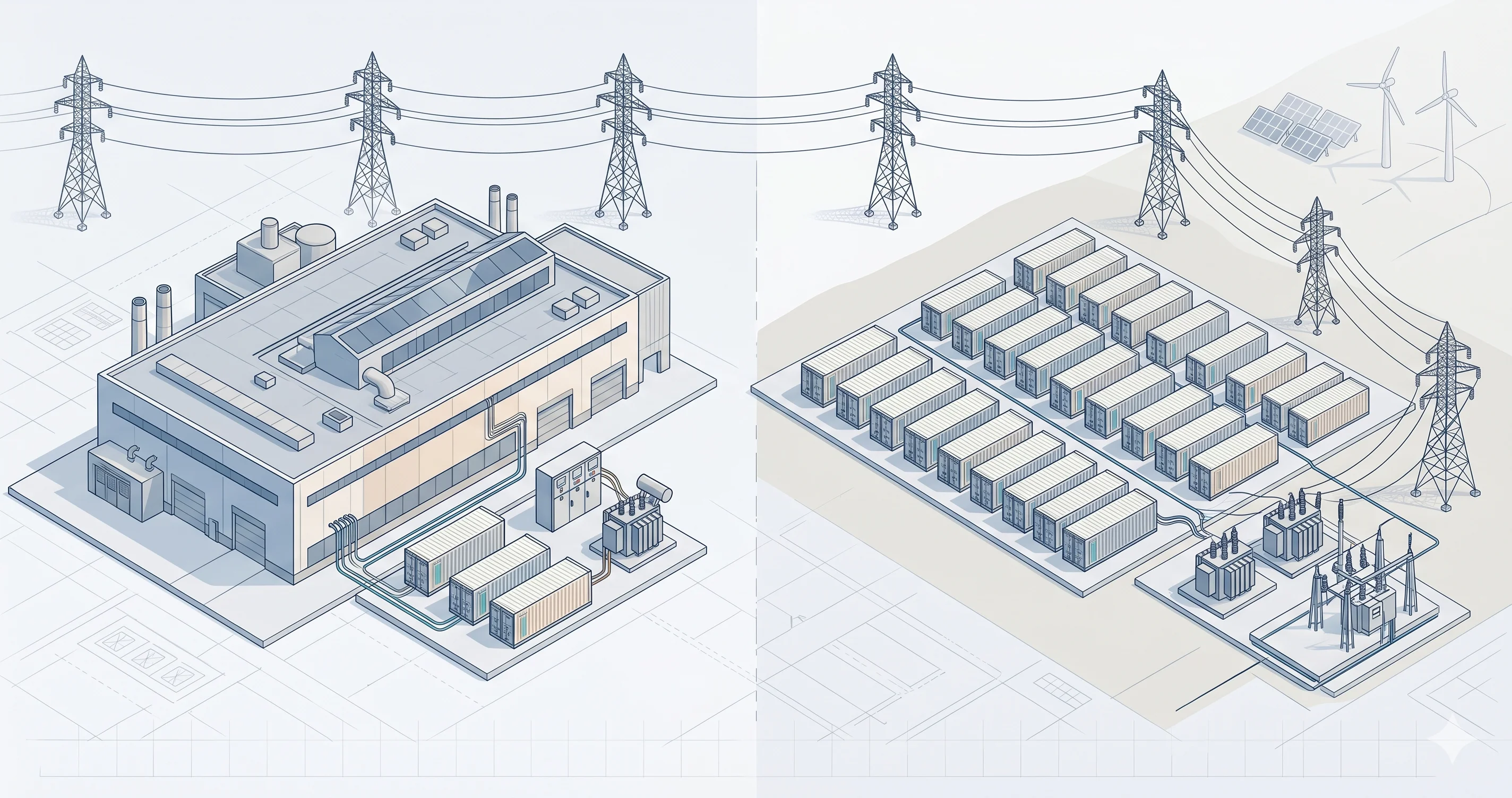
The terms Commercial and Industrial (C&I) and utility-scale battery storage are used constantly in the BESS industry, and routinely conflated by developers, investors, and equipment manufacturers when discussing project requirements. They are often described as a sizing distinction — small projects in cabinets, large projects in containers — and the categorization stops there.
The actual boundary sits elsewhere. It is drawn at the grid connection, specifically by what exists behind it. Once that boundary is clear, the use cases, the equipment overlap, and the question of which manufacturers to work with all fall into place.
Where the Boundary Actually Sits
A C&I battery storage plant is connected at a site that already has a load — a factory, a mine, an office building, a logistics center, a data center. The grid connection was put in place to serve that load, and the BESS plant is added to it. There is consumption behind the meter that the BESS plant can interact with.
A utility-scale battery storage plant is connected at a site that does not have a meaningful load. The grid connection exists for the BESS plant itself, possibly alongside generation such as PV or wind. There is no commercial or industrial load behind the meter.
Size, physical form factor, and project scale do not define the segment. A data center with tens of megawatt-hours of on-site storage is still C&I — there is a load behind the connection. A small dedicated BESS plant on a remote substation is still utility-scale — there is no load behind the connection.
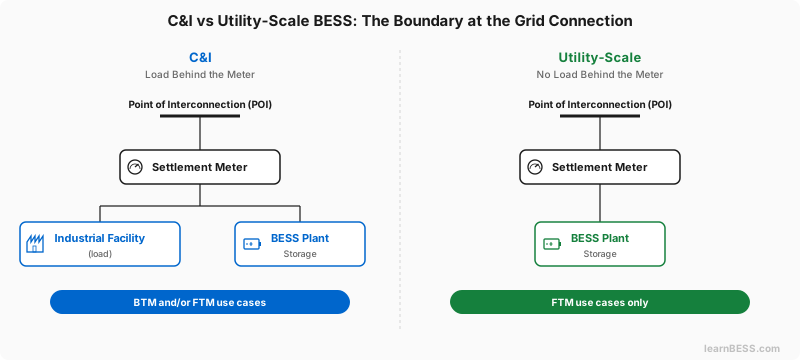 The dividing line between C&I and utility-scale battery storage is not project size, but whether there is an existing load behind the grid connection.
C&I Use Cases
Because there is consumption behind the meter, a C&I plant can operate in Behind the Meter (BTM) scenarios, using stored energy to interact with the facility’s own load. The most common BTM use cases are peak shaving (discharging during demand peaks to avoid demand charges), load shifting (charging when electricity is cheap and discharging when prices or facility load is high), and backup power (supplying critical loads during grid outages).
A C&I plant is not limited to BTM. If the grid connection has spare capacity, the same plant can also operate in Front of the Meter (FTM) scenarios — providing balancing services, participating in arbitrage, or selling capacity. Many C&I projects are built with a stacked strategy that uses both BTM and FTM use cases on the same plant.
Utility-Scale Use Cases
Without a load behind the connection, a utility-scale plant operates exclusively in FTM scenarios. The most common are balancing services (responding within hundreds of milliseconds to grid frequency deviations through standardized products such as FFR, FCR, aFRR, and mFRR), arbitrage and energy trading (charging when prices are low, discharging when prices are high), and capacity markets (committing to availability in exchange for regular capacity payments).
The plant generates direct revenue through the grid. There is no internal load to optimize, no facility tariff to manage, no consumption peak to shave.
The Equipment Is Often the Same
The DC block, the PCS, and the medium-voltage equipment used in a C&I plant and in a utility-scale plant are frequently identical. A container DC block built for a 200 MWh utility-scale site can be deployed at a 50 MWh C&I site. A standardized PCS used in a 100 MW utility-scale plant can be deployed at a large C&I facility with the same power requirement.
This is also why the cabinet-versus-container shortcut is misleading. Cabinets are commonly assumed to mean C&I and containers utility-scale, but the assumption breaks down on any large C&I site. A data center, a steel mill, or an industrial complex with tens of megawatt-hours runs on container-scale equipment. Form factor follows project size, not segment.
Where the Segments Actually Diverge
The meaningful difference between C&I and utility-scale battery storage is not in the equipment itself, but in the equipment manufacturers and partners that operate in each segment. Even where two manufacturers offer technically equivalent products, their commercial strategy, customization flexibility, and engineering support model can be very different. That is what determines whether a project is well-supported or not.
DC Block Manufacturers
Some DC block manufacturers focus exclusively on the utility-scale segment. They build standardized products for hundreds-of-megawatt-hour and gigawatt-hour sites, optimize their manufacturing for high-volume identical orders, and structure their sales and engineering teams around large utility-scale customers. They may decline smaller C&I projects, or accept them only at terms that reflect their core business — limited customization, longer lead times, less flexibility on smaller batches.
Other manufacturers focus on C&I. They expect smaller production batches, build their design and manufacturing process around customization, and structure their organization to support project-specific engineering work. The DC block they ship may be technically similar to the utility-scale alternative, but the company behind it is set up for a different kind of customer.
PCS Manufacturers
A PCS is, in principle, segment-agnostic. The same converter platform can be deployed in either C&I or utility-scale plants, and the application-specific features such as peak shaving, load shifting, and balancing services are configured in software rather than built into different hardware.
The divergence is again commercial. PCS manufacturers position their products differently for each segment, and their engineering organizations tend to specialize. A PCS company focused on utility-scale plants may have limited bandwidth to support the BTM-specific tuning a C&I project requires. A PCS company focused on C&I may not have the references or grid-code experience to be credible on a hundred-megawatt utility-scale plant.
Controls Providers
The largest divergence between segments sits in the controls layer — the BESS plant controller, the power plant controller (PPC), and the Hybrid Power Plant Controller (HPPC) where renewables are co-located.
For utility-scale plants, controls are generally delivered as a turnkey product. The PPC handles standardized FTM scenarios such as grid code compliance, balancing services dispatch, and market participation, and the controls provider can deliver largely off-the-shelf functionality. The HPPC adds complexity for hybrid plants but follows the same standardization logic.
C&I is different. BTM scenarios are project-specific. The peak shaving logic has to reflect the facility’s actual tariff structure and consumption pattern. The backup power configuration has to integrate with the facility’s critical-load topology. The load shifting strategy depends on local generation, on-site equipment, and the operator’s preferences. Each project requires architectural design and customization that does not generalize across customers.
A controls provider can technically address both segments, but in practice they specialize. Companies built around utility-scale and large C&I tend to be turnkey-product organizations. Companies built around smaller C&I tend to be customization-and-service organizations. The two operating models are difficult to combine well inside the same company.
What This Means in Practice
The implication for asset owners, developers, and EPCs is procurement-driven. When evaluating an equipment manufacturer or a controls provider, the spec sheet is not enough. The question that matters is whether the manufacturer’s commercial strategy and engineering support model fit the specific project.
Whether the project is delivered under an EPC contract or a split-contract model, the evaluation of manufacturer fit falls on the party carrying delivery and integration risk. A manufacturer chosen for a strong utility-scale track record may underperform on a C&I project that requires customization and BTM-specific support. A manufacturer with a portfolio of similar projects in the same segment is a more reliable choice than one whose references sit on the other side, regardless of how attractive the commercial proposal looks.
The C&I and utility-scale labels matter because they signal where a manufacturer’s organization, engineering capability, and commercial strategy actually sits. The equipment may overlap. The companies behind it operate in different markets.