BESS 101 — What is a Battery Energy Storage System?
~15 min learning time
What you'll learn
- What BESS is and what a utility-scale plant consists of
- Why Battery Energy Storage Systems are needed
- How BESS plants generate revenue
- Who the key stakeholders are in the BESS value chain
- Where the industry is heading — chemistry, regulation, grid-forming, and supply chain
If you’ve just started a job at a BESS company, or you’re trying to figure out whether to make the move into energy storage, this module is your starting point.
A clear, practical explanation of what Battery Energy Storage Systems are, why they exist, how they make money, and where the industry is heading. No assumed knowledge.
What is BESS?
A Battery Energy Storage System (BESS) is a complete system capable of storing electrical energy in batteries and dispatching it back to the grid on demand. BESS ranges from smaller residential units to utility-scale installations rated at hundreds of megawatt-hours. This course specialises in utility-scale — large BESS plants connected directly to the distribution or transmission grid.
Key concept: The principle is simple: charge when electricity is cheap or abundant, discharge when it is expensive or needed.
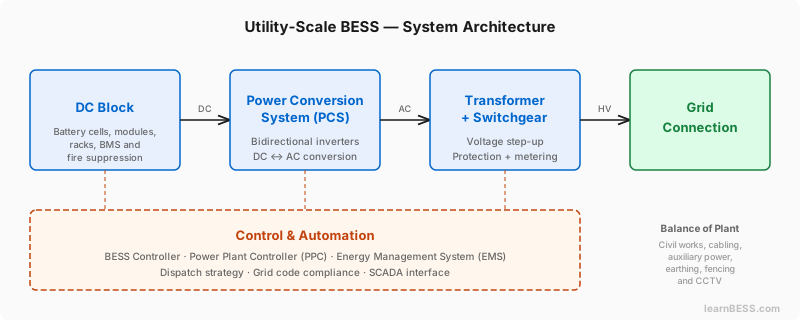
A utility-scale BESS plant generally consists of:
- DC blocks (battery enclosures) — cabinet or containerised units housing battery modules, racks, DC protection equipment, and a Battery Management System (BMS)
- Power Conversion System (PCS) — bidirectional inverters converting between DC and AC
- Transformers and switchgear — step voltage to grid level, provide protection, and enable safe isolation of equipment
- Balance of Plant (BoP) — civil works, auxiliary power, cabling, installation, and site infrastructure
- Control systems — the intelligence layer managing equipment status, grid compliance, and providing operator, service, and revenue optimisation interfaces
That’s a high-level overview of the different equipment and disciplines that come together in a BESS plant. Module 2 breaks down the full technology stack — what each piece of equipment does and how the complete system is integrated.
Good to know: The BESS industry is full of abbreviations and terminology that can vary by market and stakeholder. This course clarifies the key terms and concepts you need to build a solid understanding of the industry.
Why BESS?
The electricity grid must balance generation and demand continuously to maintain system frequency. Historically, the fleet has been dominated by:
- Gas turbines
- Hydropower
- Coal and nuclear power plants
Over the past few decades, wind and solar plants have been increasingly deployed. They generate electricity when the resource is available — not when demand is present. As renewable generation has grown, and is forecast to grow further, balancing supply and demand has become harder. Volatile electricity prices, falling system strength, and more complex frequency management all raise the operating difficulty for grid operators.
Battery Energy Storage Systems are used to smooth the volatility curves and shift production to when it is needed, helping to stabilise grids on both a short-term and long-term basis. BESS plants are also able to provide support in very short timeframes — often hundreds of milliseconds — and have proven to be a reliable source of grid support when it is most needed.
The grid itself also needs to be strengthened and expanded to support the energy transition and further deployment of wind and solar. However, upgrading transmission and distribution infrastructure takes decades of planning and development. BESS can be deployed in a fraction of that time, making it an attractive solution for bridging grid constraints while longer-term infrastructure catches up.
How BESS generates revenue
A BESS plant generates revenue through grid services, arbitrage trading, or a combination of multiple use cases — including hybrid configurations with wind or solar plants to reduce curtailment and maximise renewable output.
- Frequency regulation — responding to grid frequency deviations by injecting or absorbing power. TSOs procure these services through auctions or contracts.
- Energy arbitrage — charging during low-price periods and discharging during high-price periods to profit from electricity price differences.
- Capacity markets — payments for guaranteeing power availability during periods of anticipated scarcity, whether or not the plant actually dispatches.
In practice, operators combine multiple revenue streams from a single asset. This is called revenue stacking.
Key concept: Most BESS plants don’t rely on a single revenue stream — they stack multiple use cases to maximise returns. Module 4 — How BESS Makes Money — breaks down the specific markets, how they are traded, and how operators manage dispatch scheduling.
Who builds and operates BESS
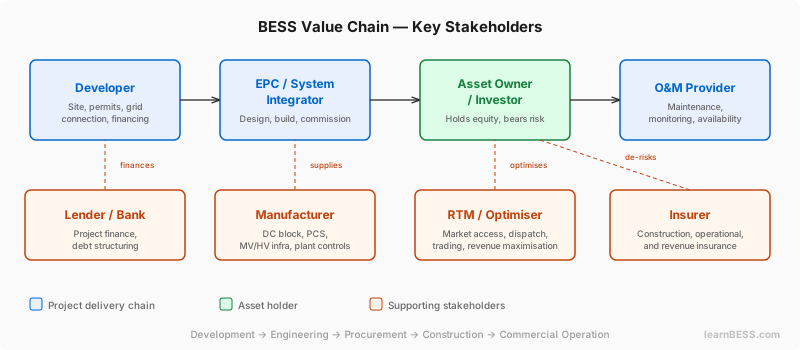
A BESS project involves multiple organisations across its lifecycle:
| Role | What they do |
|---|---|
| Equipment manufacturers | Produce cells, modules, DC blocks, PCS units, transformers, and control systems |
| EPC contractors | Take full responsibility for engineering, procurement, and construction of a BESS plant — coordinating equipment from different suppliers into a working system |
| Developers | Originate projects — securing sites, permits, grid connection agreements, and investment structures |
| Asset owners / Investors | Own the plant and hold the contractual relationships — O&M, warranties, insurance, and route-to-market contracts |
| Service providers | Uphold warranty obligations, perform preventive and predictive maintenance, and manage performance guarantees |
| RTM providers | Operate the plant commercially — energy trading and charge/discharge dispatch planning |
| Lenders & Insurers | Provide financing and de-risk the project |
Good to know: The BESS value chain consists of different stakeholders, each focusing on different aspects of the industry. Module 3 — BESS Value Chain — maps out the full value chain in detail: who is responsible for what, and how the financial structures connect them.
From origination to operating BESS plant
A utility-scale BESS project runs through two stages — development and operations — gated by four named milestones:
- Development — turning a greenfield opportunity into a completed, grid-connected plant. Development has two phases:
- Origination — securing site, grid connection, permits, and commercial structure to reach Ready to Build (RTB)
- Project delivery — financing, engineering, procurement, manufacturing, construction, commissioning, and acceptance to reach Commercial Operation Date (COD). Delivered under an EPC or split-contract model.
- Operations — the 15 to 25 year active life of the plant from COD to end of life — commercial dispatch, maintenance, augmentation, and eventual decommissioning.
The timeline from greenfield to COD usually ranges from 2 to 8 years, depending on jurisdiction and project scale. Once a BESS plant reaches COD, it is designed for an operating life of 15 to 25 years.
Good to know: Each phase of a BESS project involves different stakeholders, risk profiles, and areas of specialisation. Module 5 — The Project Lifecycle — covers each phase in detail, including the four named gates (RTB, FID, NTP, COD) and the three delivery models.
Where the industry is heading
The energy storage market is growing rapidly, driven by increasing demand for wind and solar generation — which in turn requires battery systems to balance the grid. At the same time, the CAPEX for new BESS plants has fallen significantly due to declining battery prices and economies of scale as the industry matures.
Key trends shaping the industry:
- Grid infrastructure gaps — transmission (TSO) and distribution (DSO) upgrades require long-term investment. BESS can be deployed on a much shorter timeframe, providing grid services while wider infrastructure catches up.
- Tightening regulation — grid codes, cybersecurity mandates (such as NIS2), and lifecycle and recycling regulations (such as the EU Battery Regulation) are becoming more advanced, raising the bar for compliance.
- Cell chemistry evolution — the industry has largely transitioned from NMC (Nickel Manganese Cobalt) to LFP (Lithium Iron Phosphate), now the dominant chemistry for utility-scale energy storage. New chemistries such as sodium-ion are expected to enter the market at larger scale in the coming years.
- Supply chain localisation — BESS CAPEX has historically benefited from Chinese manufacturing scale and export policies. The industry is increasingly looking at localisation of production outside of China — particularly in the US and Europe — to diversify supply chains.
- Grid-forming technology — grid-forming inverter technology is gaining traction, enabling BESS to actively support grid stability rather than simply following it — increasingly important as synchronous generation declines.
This was the big picture. The rest of the course goes deeper into each topic — from the technology stack to end-of-life recycling.
The essentials
- BESS stores electrical energy and dispatches it to the grid on demand
- Revenue comes from grid services, energy arbitrage, and capacity markets — operators stack multiple use cases
- The value chain spans equipment manufacturers, EPCs, developers, asset owners, service providers, RTM providers, lenders, and insurers
- LFP is the dominant chemistry; sodium-ion and grid-forming technology are emerging
- A project runs 2–8 years from greenfield to commercial operation, then operates for 15–25 years