What Does Warranty Actually Mean on a BESS Project?
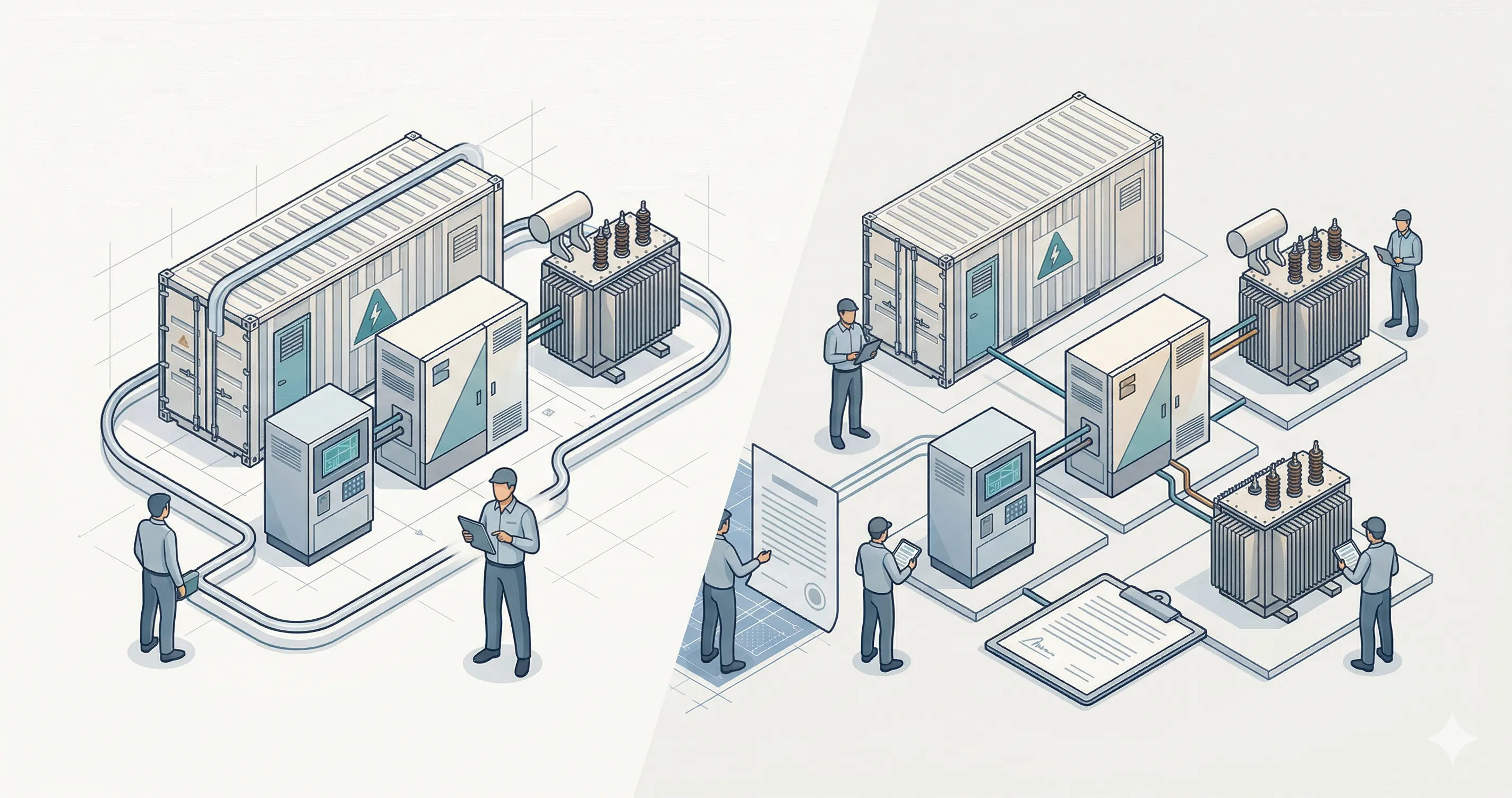
Ask five people on a utility-scale BESS project what “warranty” means, and you’ll get five different answers. The EPC contractor is thinking about their defects liability obligation. The equipment manufacturer is thinking about their limited product warranty. The asset owner assumes someone is responsible for fixing whatever goes wrong. The insurance provider is trying to figure out what falls outside their policy. The developer may mean something different again depending on which contract they’re looking at.
None of these people are wrong. They’re just talking about different contractual mechanisms — using the same word. And that misalignment stays unnoticed right up until the moment it matters most: when a defect appears, the plant is unavailable, and nobody agrees on who is responsible, who should pay to resolve, how fast it needs to happen, or which terms and conditions actually apply.
This article breaks down what “warranty” actually means on a utility-scale BESS project.
Warranty and Guarantee Are Not the Same Thing
Before getting into the warranty mechanisms, there’s a distinction that gets blurred constantly — sometimes even within the same contract document. Warranty and guarantee are not interchangeable terms in a BESS project, even though they’re routinely treated as if they are.
Warranty refers to an obligation — a set of terms and conditions governing how defects in hardware, software, or design will be handled after the equipment has been installed and is in operation. If a piece of equipment fails despite being used within the agreed operating conditions, that’s generally a warranty case. If that same equipment fails because it was operated outside the agreed conditions — wrong ambient temperature range, exceeded cycle count, improper maintenance — it’s usually not.
Performance guarantees are a separate category entirely. On a utility-scale BESS project, the most common performance guarantees are:
- Energy capacity guarantee
- Round-trip efficiency (RTE) guarantee
- Availability guarantee
These are contractual performance commitments. They come with their own terms and conditions, their own test procedures, and their own liquidated damages if the thresholds aren’t met. They are not warranty. They don’t follow warranty logic. Mixing the two up during contract negotiations creates problems that surface months or years later.
It’s common to see EPC contracts and developer requirements where “warranty” and “guarantee” are used interchangeably throughout the document — or where everything is called a “guarantee,” even when it’s clearly a warranty topic. This leads to friction during contract negotiations that end up taking longer and producing weaker outcomes than they need to.
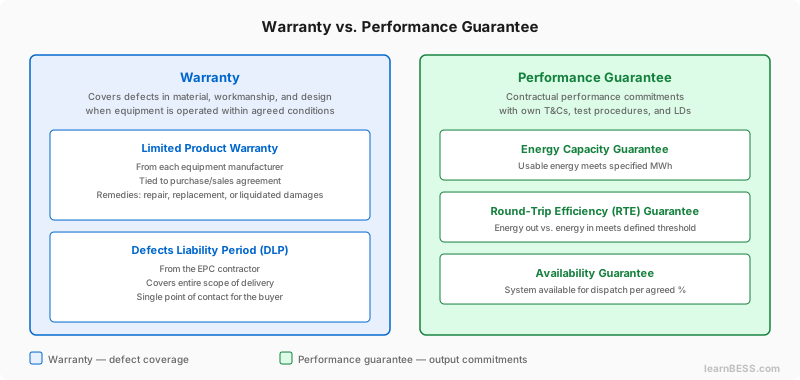 Warranty covers defects in equipment and workmanship. Performance guarantees are separate contractual commitments with their own test procedures and liquidated damages.
The Two Warranty Mechanisms
This is where most stakeholders get confused, and where clarity matters most. On a utility-scale BESS project, there are generally two distinct warranty mechanisms in play. They look similar from a distance, but they are fundamentally different in scope, ownership, and how they work in practice.
1. Limited Product Warranty
The Limited Product Warranty is provided by an equipment manufacturer for their specific product, based on their own terms and conditions. It’s a legal instrument tied to the purchase or sales agreement for that equipment.
On a utility-scale BESS project, there isn’t one Limited Product Warranty — there are several. Each major piece of equipment comes with its own:
- The DC block has its own Limited Product Warranty from the DC block equipment manufacturer
- The power conversion system has its own from the PCS provider
- The transformer has its own
- The power plant controller may have its own
- Additional electrical infrastructure — switchgear, cabling systems, protection equipment — may each come with separate warranty terms
A Limited Product Warranty specifies what the equipment manufacturer warrants: that the equipment shall be free from defects in material, workmanship, and sometimes design, for a defined period of time, provided the equipment is operated according to specified conditions. If a defect falls within the warranty scope, the document should set out the remedies — usually repair or replacement of the defective component. In some cases, where repair or replacement isn’t practical, the warranty may include liquidated damages provisions as an alternative remedy.
The critical point: whoever holds the sales contract or purchase agreement for that equipment owns the right to those warranty terms and conditions. This becomes very important depending on how the project is structured — more on that below.
2. Defects Liability Period (DLP)
The Defects Liability Period is a contractual obligation embedded in an EPC contract, between the EPC contractor and the buyer — usually the developer or asset owner/investor. It is not a Limited Product Warranty. It is a contract clause that makes the EPC contractor responsible for rectifying any defects in their works during a defined period after handover.
The terminology for this varies by region and contract form. You may see it called the defects notification period, or in some languages and jurisdictions, a guarantee period or other regional equivalent. The phrase varies, but the core concept is the same.
What the DLP covers is fundamentally broader than any single Limited Product Warranty. It applies to the EPC contractor’s entire scope of delivery:
- Workmanship and design
- Equipment (DC block, PCS, medium voltage, power plant controls, etc.)
- Technical coordination across equipment interfaces
- Balance of plant (civil works, electrical infrastructure, installation)
If something is defective during the DLP — regardless of whether the root cause is the EPC contractor’s own work, a subcontractor’s work, or a piece of equipment procured by the EPC contractor from an equipment manufacturer — the EPC contractor is the responsible party. The duration is usually one to two years from handover, sometimes up to five, depending on what has been negotiated.
Why This Distinction Matters
The practical impact of the DLP depends on the delivery model.
In an EPC-delivered project, the asset owner or buyer claims against the EPC contractor during the DLP. The EPC contractor is responsible for investigating, managing, and rectifying defects across the full scope of works — regardless of whether the root cause is a wiring issue from the EPC contractor’s own installation team, a malfunctioning battery module from the DC block equipment manufacturer, a software bug in the BMS, or a failed PCBA in the power conversion system. The EPC contractor then resolves equipment-level issues with the relevant manufacturers under their own purchase agreements.
Under a split-contract model, there is no single DLP covering the full plant. Instead, the buyer manages defect claims under each individual contract — one with the DC block manufacturer, one with the PCS supplier, one with the BoP contractor, and so on. This gives the buyer more direct relationships with each supplier, but requires active coordination across multiple parties when issues arise.
Both structures have trade-offs. The EPC model consolidates defect management into one contractual relationship. The split-contract model distributes it across several, giving the buyer more direct control but requiring stronger in-house project management capability.
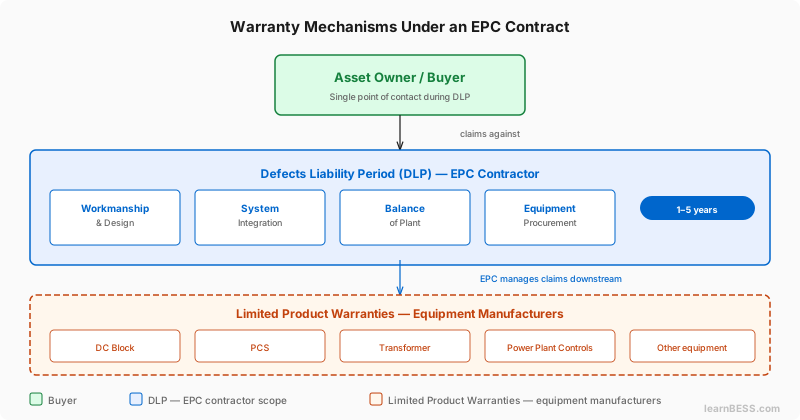 Under an EPC contract, the buyer claims against the EPC contractor during the DLP. The EPC contractor manages equipment manufacturer warranties downstream.
What Changes Under a Split-Contract Model
Not every BESS project uses an EPC contract. Under a split-contract approach — sometimes called multi-contract or direct procurement — the buyer contracts directly with equipment manufacturers and bears responsibility for technical coordination across equipment interfaces, either through an in-house engineering team or a specialist contractor.
In this structure, the buyer holds multiple purchase agreements directly with equipment manufacturers, each with their own Limited Product Warranty and specific terms and conditions. Defect management sits with each individual contract rather than being consolidated under a single DLP.
The buyer manages warranty claims directly with each equipment manufacturer — coordinating between multiple parties, each with their own response times, remedy procedures, and exclusions. Buyers with strong in-house technical teams often prefer this model because it gives them direct access to each manufacturer and removes the EPC contractor as an intermediary. The trade-off is that coordination across multiple contracts requires more active management.
What Happens When the DLP Expires
When the Defects Liability Period ends, the EPC contractor’s obligations under the DLP expire. The asset owner is now fully responsible for the BESS plant.
In practice, this transition is rarely as abrupt as it sounds. Most asset owners will have an operations and maintenance arrangement in place — either performing service themselves or engaging a service provider, which in many cases is the EPC contractor itself. These long-term service agreements often include terms that go beyond what the DLP covered in terms of responsiveness: faster response times, local storage of spare parts, remote monitoring and access for preventive and predictive maintenance. The service provider may also take on the coordination of any remaining equipment manufacturer warranty claims that are still active after the DLP has ended, since the Limited Product Warranties from equipment manufacturers often run longer than the DLP itself.
The key thing to understand is that the DLP expiring doesn’t mean all warranty coverage disappears. The Limited Product Warranties from each equipment manufacturer continue according to their own terms and durations. What disappears is the EPC contractor as the single point of contact and the party obligated to rectify defects across the full scope of works.
Get the Terminology Right
Aligning on the terminology from the beginning — during contract drafting, procurement, negotiations, and project management from execution to operations and maintenance — is the best way to avoid misunderstanding and friction between stakeholders. Two warranty mechanisms, properly defined and separated from performance guarantees, with informed stakeholders, is something all parties will benefit from.