What Is Balance of Plant (BoP) in BESS?
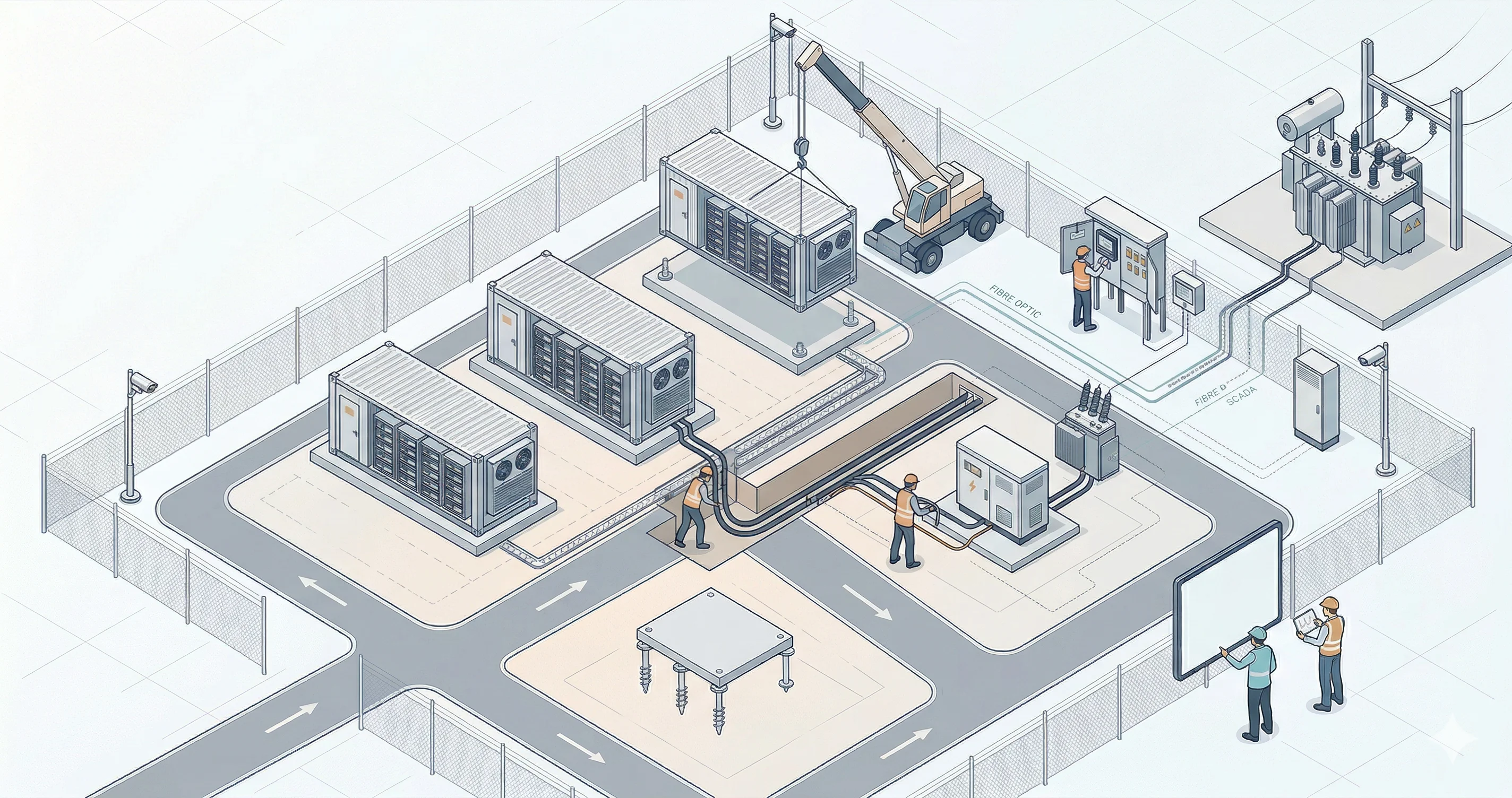
Balance of Plant (BoP) is a term that originates from power engineering, where it refers to everything that is not the main generating unit — the supporting infrastructure required to make a power plant operational.
In BESS, the main equipment is the DC block, the power conversion system (PCS), the medium-voltage transformer and RMU, the high-voltage substation, and the power plant controller/SCADA. Additional items required to design, build, and ensure the complete BESS plant is operational are generally categorized as Balance of Plant.
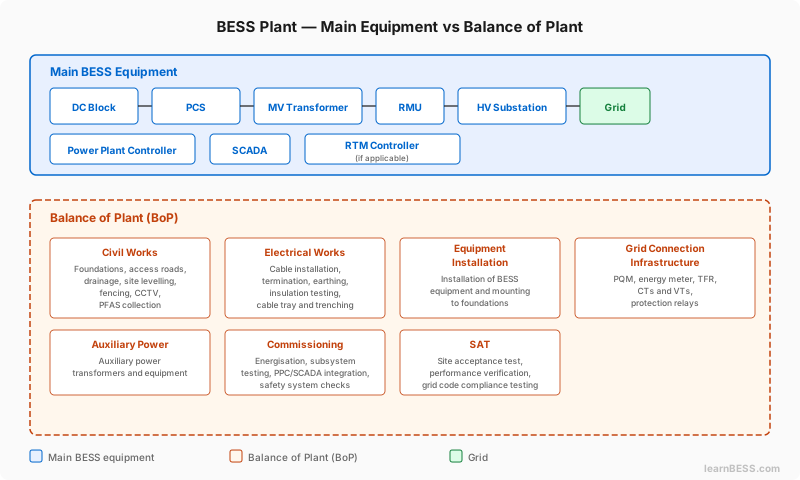 Main BESS equipment vs Balance of Plant scope categories.
Why BoP Is Difficult to Define
The general definition of BoP may be simple, but the difficulty starts when you try to define who is responsible for what. The line between designing and executing BoP work is not always clear, and the split between engineering and execution can sit with different parties depending on the project.
BoP is a scope of work. It describes the different categories of work that every BESS project needs to have executed. Which party performs each category, and whether they are responsible for the design, the execution, or both, can vary significantly depending on the overall contractual terms for the project.
This is why if you ask three different stakeholders in the industry, you may receive three different descriptions of what BoP means. Not because they are wrong, but because they are describing BoP from their experience — a scope of work that was defined and divided in a particular way on their projects. The categories that make up BoP may be consistent, but how they are contracted and executed can differ from project to project.
The Scope
Civil Works (CBoP)
Site preparation and leveling. Access roads. Drainage. Foundations — concrete pads or screw-pile installations depending on the site. Cable trenching. Fencing and perimeter security. CCTV.
Electrical Works (EBoP)
Cable installation, pulling, routing, termination, glanding, and labeling. Cable tray and trenching. Earthing and lightning protection. Protection and communication systems — relay installation, fiber optic and communication cabling.
Equipment Installation
Physically installing the main equipment on site — lifting DC blocks onto foundations, positioning PCS units, mounting auxiliary equipment and communication cabinets. Equipment manufacturers usually provide supervision and oversight while the BoP workforce does the hands-on work.
Auxiliary Power
Auxiliary power transformers and equipment — the electrical supply needed to support the plant and the workforce during construction and operation.
Grid Connection Infrastructure
The physical infrastructure connecting the plant to the grid — installation of energy meters, CTs and VTs, protection relays, and associated cabling between the plant and the point of connection.
Commissioning
Equipment and plant-level commissioning activities — energization, subsystem testing, PPC/SCADA integration, safety system checks and safety system verification.
Site Acceptance Tests (SAT)
Grid code compliance testing, frequency regulation pre-qualification, and overall plant performance verification.
How BoP Gets Contracted
The scope categories of Balance of Plant exist on every BESS project. However, how they get assigned and executed depends on who is leading the project and what contract structure is in place.
EPC
Under an EPC contract, the EPC contractor is responsible for the complete BESS plant delivery — engineering, procurement, construction, and technical coordination across all equipment.
In practice, the EPC contractor may subcontract most of the BoP execution work while performing the engineering work in-house. A local civil works company is often subcontracted for site clearance, groundworks, and foundations. An electrical contractor is appointed to handle cabling, termination, and other installation work. The split between in-house and subcontracted scope varies depending on the EPC contractor’s capabilities. The EPC contractor manages engineering, project management, and subcontractor coordination across the interfacing work. The subcontractors report to the EPC contractor, not to the buyer.
Split-contract (multi-contract)
The buyer procures the main BESS equipment directly from the manufacturers and splits the overall execution of the project between different independent contractors. The buyer might appoint a single BoP contractor to manage all scope categories, or split the scope across multiple contracts: one for civil works, one for electrical works, a grid compliance consultant, and so on.
Under this model, technical coordination across equipment suppliers sits with the buyer — either through an in-house engineering team or through a specialist contractor. The buyer manages the interfaces between equipment from different manufacturers and ensures the plant meets its intended performance requirements. The balance between in-house and outsourced capability varies by organization.
Why Defining BoP Matters
Clearly defining BoP — what is included, who is responsible for each category, and how interfaces between scopes are managed — is essential for every stakeholder involved in a BESS project. When scope boundaries are clear, contractors know what they are responsible for and interfaces are managed. When they are not, the gaps become the source of disputes, delays, and cost overruns.