What Is a Site Acceptance Test (SAT)? — BESS Guide
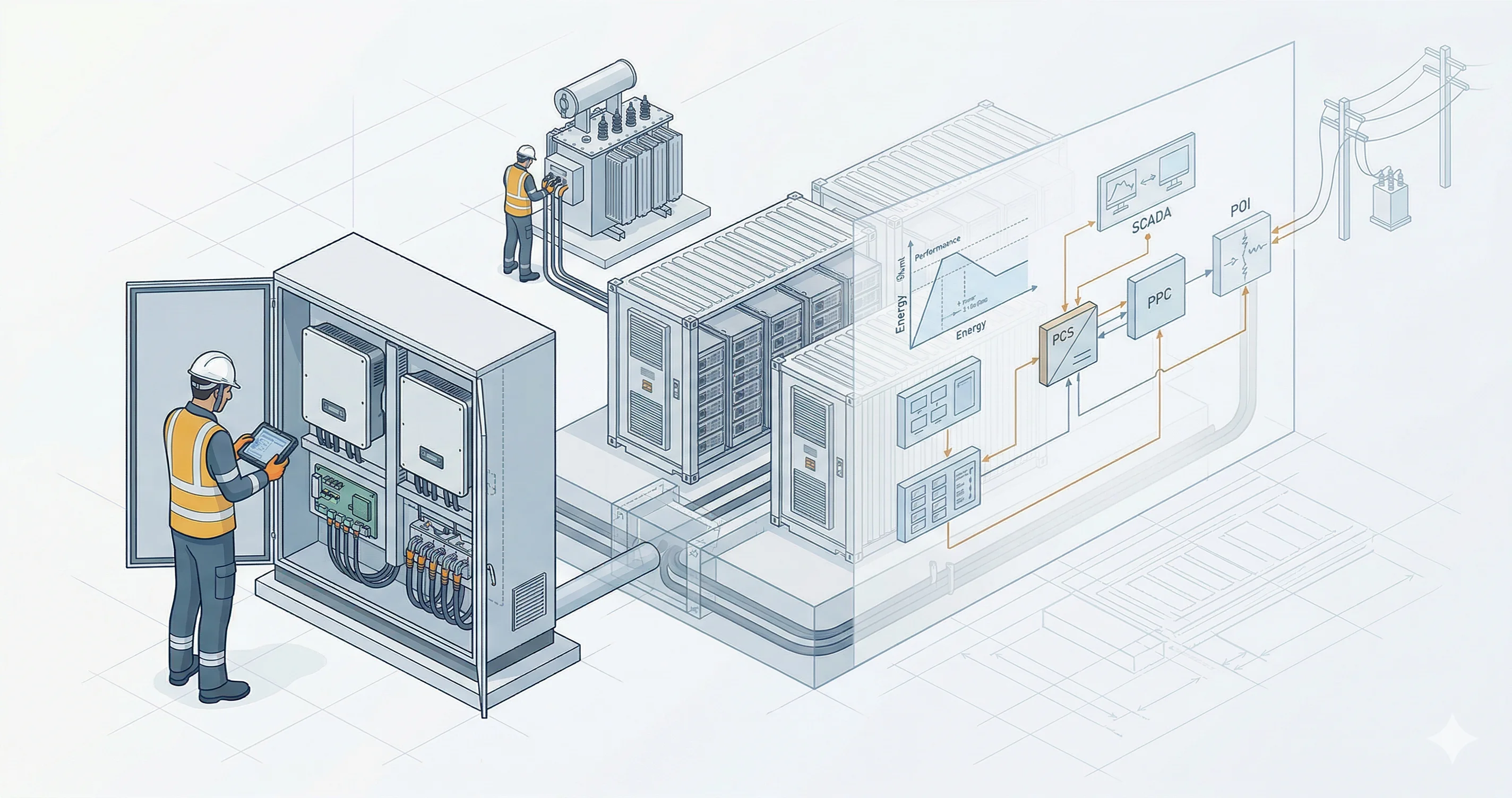
A Site Acceptance Test is a formal verification that equipment or a complete plant meets its contractual requirements after installation on site. The word “acceptance” is key — SAT is the point at which the buyer accepts what has been delivered. It marks a contractual handover.
On a utility-scale BESS project, this is where the confusion begins. Equipment manufacturers use “SAT” to describe the acceptance of their product — a DC block, a PCS, a power plant controller. An EPC contractor or developer uses “SAT” to describe the acceptance of the complete BESS plant. Both call it SAT. They are not talking about the same thing.
From Factory to Site
Testing on a BESS project follows a sequence. Each stage builds on the previous one, and each has a different purpose.
Factory Acceptance Testing (FAT) happens at the equipment manufacturer’s facility before equipment is shipped. It verifies that the product has been manufactured according to specification. The FAT is the first contractual acceptance point — the buyer confirms the equipment is ready for delivery.
Installation follows once the equipment arrives on site. DC blocks are mounted on foundations, PCS units are positioned, cabling is pulled and terminated. This is Balance of Plant execution.
Commissioning is the process of bringing the installed equipment to life — first without power (cold commissioning), then with power (hot commissioning). The purpose is to verify that the equipment is installed correctly, safe to operate, and performs as specified in its real operating environment.
Site Acceptance Testing is the formal acceptance that follows successful commissioning. It confirms that what has been delivered meets the buyer’s contractual requirements.
The confusion lies in that final step — because on a BESS project, there are two levels of acceptance, and they happen to share the same name.
Equipment-Level Acceptance
Each equipment manufacturer has their own commissioning and acceptance protocol. The naming varies — some call it cold commissioning and hot commissioning as separate stages, some combine them into a single protocol, some call their protocol “SAT,” others call it “site commissioning” or “acceptance testing.”
Regardless of the name, the scope is the same: the equipment manufacturer is testing their product on site and seeking acceptance from the buyer. Once accepted, the manufacturer completes the handover and invoices remaining payments.
Cold commissioning covers de-energized checks after installation:
- Visual inspection of installed equipment
- Cable connection verification and torque checks
- Insulation testing
- Communication testing between equipment and protection systems
- Fire protection and cooling system verification (DC blocks)
- Cabinet-by-cabinet inspection (PCS)
Hot commissioning covers energized functional testing:
- First energization
- Voltage verification and rack power-up
- Charge and discharge testing
- Ramp-up to full power
- Temperature monitoring under load
- Emergency stop verification
Successful completion of these tests means the equipment works to specification in its installed environment. The equipment manufacturer has delivered what they committed to. This is an acceptance between the equipment manufacturer and their buyer — usually an EPC contractor or a developer procuring directly.
Plant-Level Site Acceptance Testing
The plant-level SAT is a different acceptance. It verifies that the complete integrated BESS plant meets the customer’s contractual requirements, generally measured at the Point of Interconnection (POI) with the grid.
A BESS plant is not a single product. It is assembled from equipment supplied by multiple manufacturers — DC blocks, PCS units, MV transformers, HV substation equipment, power plant controllers, SCADA, monitoring and communication systems. Each piece may pass its own acceptance testing. That does not mean the plant works as a system.
Plant-level SAT commonly includes:
- Performance testing — rated discharge power, ramp rates, round-trip efficiency, energy capacity, response times
- Grid code compliance testing — frequency response, voltage regulation, reactive power capability, fault ride-through, power quality
- Balancing services pre-qualification — demonstrating the plant meets the technical requirements for grid service participation
- Safety system testing — plant-level safety functions, emergency shutdowns, and protection coordination across all equipment
This acceptance is between whoever delivered the complete plant — the EPC contractor or the developer’s delivery structure — and the buyer of the plant, usually the asset owner or investor. It is the point at which the plant is formally handed over.
Why the Two Get Confused
The naming overlap is the obvious problem. When an equipment manufacturer calls their commissioning protocol a “SAT,” it sounds like the plant-level site acceptance test. It is not. The equipment manufacturer is accepting their product. The plant-level SAT is accepting the complete system.
But there is a deeper practical issue. Some equipment performance requirements can only be tested at plant level. Energy capacity testing on a DC block requires charging and discharging through the PCS and across the grid connection. Discharge power at rated capacity involves the complete power path from battery to POI. Round-trip efficiency must account for losses across the full system.
This means equipment manufacturers are often involved in plant-level SAT for practical reasons — their performance specifications are verified during plant-level testing. It also makes more sense to perform energy capacity testing at plant level rather than repeating it on each individual piece of equipment, which would take significantly more time. The equipment-level acceptance and plant-level acceptance overlap in execution, even though they are separate contractual obligations.
This is where projects stall. If the contracts and test protocols do not clearly define which tests are equipment-level, which are plant-level, and which serve both, the acceptance process becomes a negotiation rather than a verification. Equipment manufacturers believe their obligation ends with their commissioning protocol. The party responsible for the plant expects the equipment to be ready for plant-level testing. The buyer expects a working plant. Nobody agrees on what has actually been tested, accepted, or remains outstanding.
Get the Distinction Right
Equipment-level acceptance confirms that a product works to specification. Plant-level SAT confirms that the complete BESS plant operates as an integrated system and meets the buyer’s contractual and grid compliance requirements. Same word — different scope, different responsibility, different contractual consequence.
Defining this distinction clearly in the contracts, in the test protocols, and across every stakeholder involved in the delivery is the best way to avoid disputes, delays, and unnecessary cost during handover.